Verizon prices Starlink's phone threat at $500 billion and 80,000 towers; FCC votes October 29
Verizon's chief put a half-trillion-dollar price and a years-long clock on Starlink matching his network. What moves money this month is the FCC's October 29 vote, plus the AI fiber demand the selloff ignored.
 Richard Tang · 3 min read

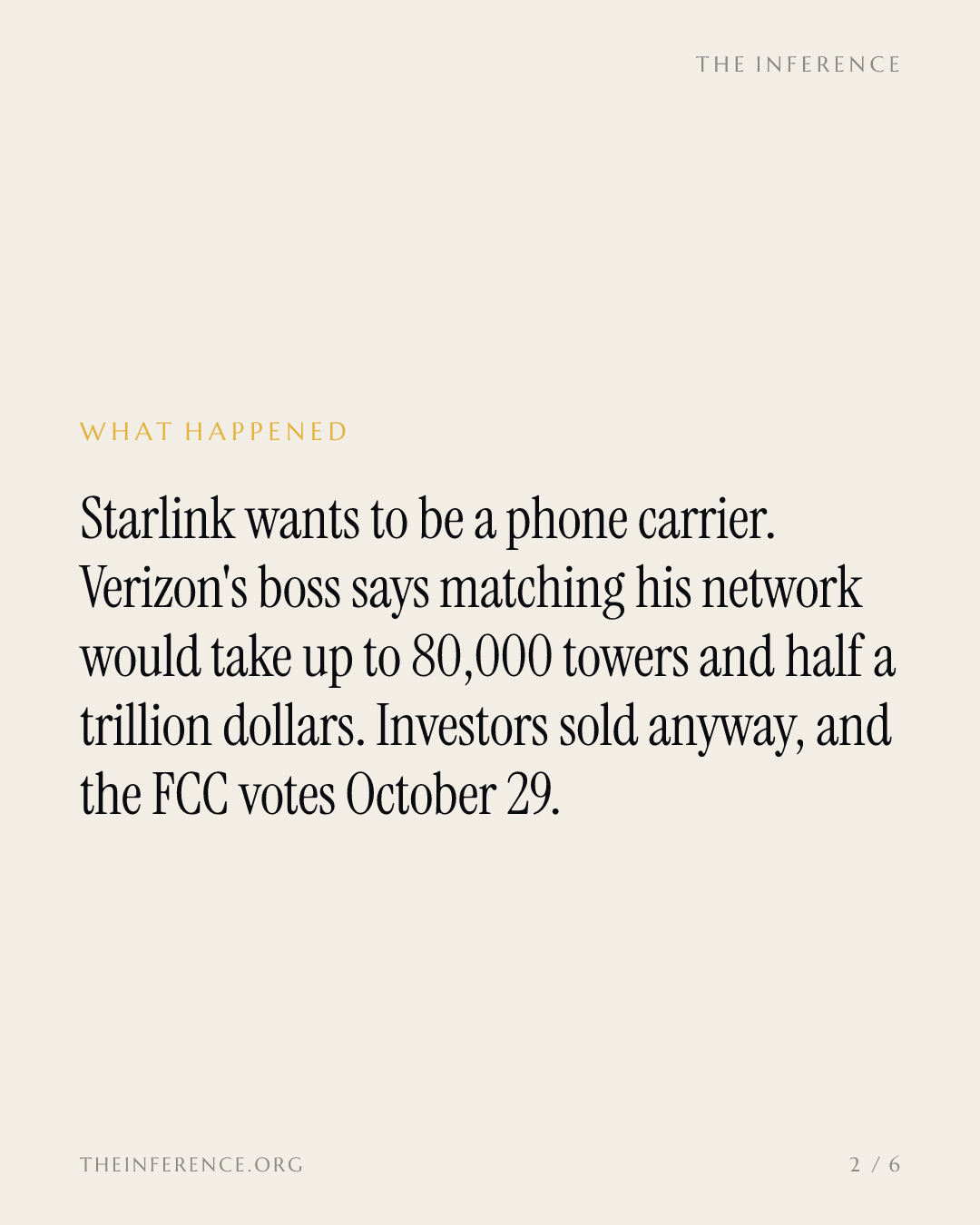
Dan Schulman, who used to run PayPal and now runs Verizon−3.49% — Verizon, down 3.49 percent today, spent Monday's earnings call pricing the rival that has knocked about a tenth off the three big US carriers this month 1. Matching his network, he said, takes as many as 80,000 large towers 1. That build runs to half a trillion dollars over six to eight years 1.
Verizon then beat estimates and raised its outlook, posting 406,000 postpaid phone additions, its best quarter in five years, and the stock still closed lower 2 6. The market has priced a network that does not exist.
What SpaceX bought is coverage, not capacity
The October 8 purchase is narrow: a nationwide block of low-band 800 MHz airwaves from the investment firm Grain Management, reported at about $8 billion 3. Low-band passes through walls, which makes it a coverage layer; capacity in dense markets still comes from radios on the ground, which is why SpaceX's−0.28% — SpaceX, down 0.28 percent today own regulatory filing describes antennas on towers and rooftops 3. Musk plans many small base stations attached to Starlink installations rather than classic towers, and calls the purchase the last piece of the spectrum puzzle 3 4.
The gap is years of towers, retail and billing
Schulman's math ends with Starlink owning "basically the same network and same cost structure" Verizon has today 1. SpaceX President Gwynne Shotwell targets service on Starlink's own airwaves in early 2028, a date that has already slipped once 5. Talks to lease tens of thousands of cell sites, reported by Bloomberg, knocked the carriers down again on October 23 5.
What reaches people first is coverage where towers never paid for themselves: T-Mobile's satellite texting already runs on Starlink 5. And where about 98% of Verizon's revenue sits, a satellite beam serves a vast footprint while a city network reuses its frequencies block by block; that physics, not the tower count, is the claim to hold both sides to 1.
This month's decision sits at the FCC
On October 29 the Federal Communications Commission votes on opening another 482 MHz of airwaves to satellite-to-phone service, and a yes would only open public comment 5. The Grain purchase still needs the agency's approval, while the carriers lobby to keep satellites off their 5G bands 5.
The incumbents split in public: AT&T's−0.38% — AT&T, down 0.38 percent today John Stankey will not "over-rotate" on "one carrier of low band spectrum," while Schulman assumes SpaceX does everything it says 1. The money in play reaches past the carriers to SpaceX shares and tower owners such as Crown Castle+1.74% — Crown Castle, up 1.74 percent today, reportedly in the site talks 5.
The selloff skipped the AI buyer
The same morning, Verizon signed more than $2 billion of fiber connectivity for Amazon Web Services+0.46% — Amazon Web Services, up 0.46 percent today data centers running AI workloads 6. A Google dark-fiber deal worth more than $1 billion came in July 6. AI compute needs fiber, and the carriers own it.
UBS analyst John Hodulik expects the spectrum purchase to clear, and still expects SpaceX to need years to scale, with limited near-term impact on the industry 4. The threat is real and it is late; the fiber revenue is early. This month, the decision lives at the FCC, not in the tape.
Get Applications by email, free
How AI is changing the software people and companies use. In our daily email, every weekday.