Kulicke and Soffa's revenue doubled on legacy wire bonding while the AI-named segment lost $12.6 million
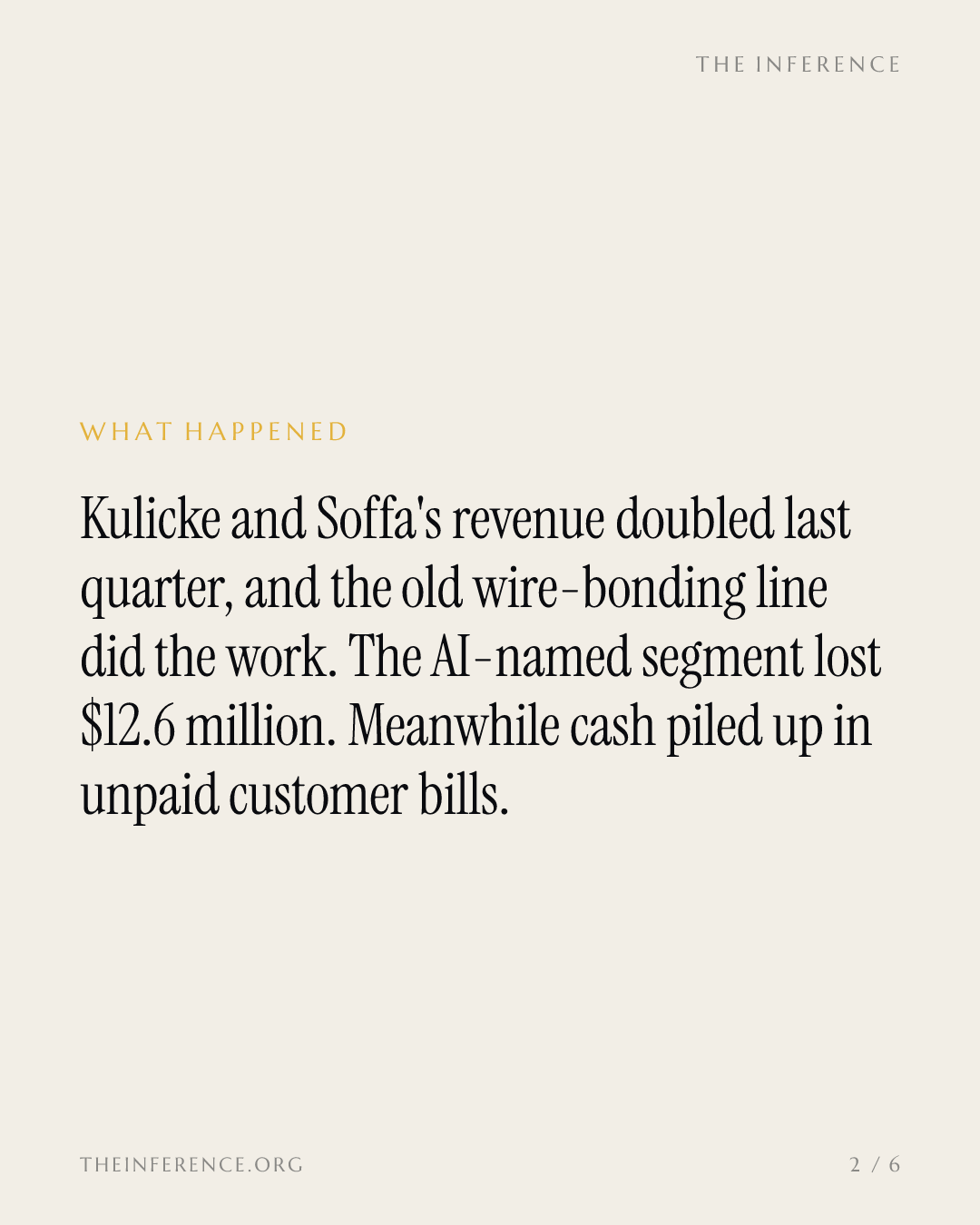
The August print showed revenue up 122.6%, but the filing shows the doubling came from the legacy ball bonder at 95% China utilization while the AI-named segment lost $12.6 million and cash piled up in receivables. The November report, where management promised fiscal 2027 detail, will say whether this is an AI ramp or a restocking cycle.
 Vincent Jiang · 3 min read
Kulicke and Soffa's+1.02% — Kulicke and Soffa, up 1.02 percent today fiscal third quarter looked like an AI company's dream: net revenue of $330.4 million, up 122.6% from $148.4 million a year earlier, net income of $57.4 million, $1.07 a diluted share against a $0.06 loss the year before 1. The wire services are still republishing that August print today. The filing underneath it tells a more ordinary story, and the report due this month, when management has promised its first detail on fiscal 2027, will decide which story investors actually own 12.
The doubling came from the old machine, not the AI one
The Form 10-Q splits the quarter: Ball Bonding Equipment, the mature wire-bonder line, took $226.1 million of the $330.4 million; Wedge Bonding $25.8 million; APS, the advanced-products and services line, $35.8 million 1. Advanced Solutions, the segment holding the fluxless thermocompression tools sold for HBM memory stacking, booked just $29.4 million 1.
The legacy ball bonder took $226 million of the $330 million quarter
Data
| Value | |
|---|---|
| Ball Bonding Equipment | $226.1M |
| Wedge Bonding Equipment | $25.8M |
| APS | $35.8M |
| Advanced Solutions | $29.4M |
That AI-named segment lost $12.6 million at the operating line and ran a 34.7% gross margin against 46.8% company-wide, which the filing attributes to product mix 1. The growth in the core line came at China utilization above 95%, with purchase orders extending into the second fiscal quarter of 2027, a pattern management itself called unusual for this business 2. The plain mechanism: customers were restocking wire-bonding capacity hard, and a restocking order book got priced as an AI story in a stock that had already run to $135.80 23.
The cash did not follow the revenue
Nine-month operating cash flow fell to $46.6 million from $105.0 million a year earlier, as receivables rose $146.0 million and inventories $75.9 million 1. A quarter of record paper profit, and the cash went into customers' unpaid bills. The company still holds $516.6 million in cash and short-term investments with capex guided at just $20 to 24 million 1.
The claim on the table is two to three times the trailing run rate
Management targets more than $100 million of Advanced Solutions revenue for fiscal 2026 and says fiscal-2027 thermocompression revenue should reach $150 to 200 million, against roughly $87 million trailing 125. Interim CEO Lester Wong, who ran the August call, declined any fuller fiscal-2027 outlook, pointing to the November report 2. He is no longer running it: Dr. Raj Talluri, formerly of Enovix and Micron−1.42% — Micron, down 1.42 percent today, became President and CEO on September 1, 2026, with Wong back as CFO 8.
The AI-named segment's targets run two to three times its trailing revenue
- Advanced Solutions revenue
- Estimate
Data
| Advanced Solutions revenue | |
|---|---|
| Trailing | $87M |
| FY2026 target (estimate) | $100M |
| FY2027 guidance low (estimate) | $150M |
| FY2027 guidance high (estimate) | $200M |
The Besi deal says the demand is real, the Hold rating says wait
The bull camp has a counterweight: Applied Materials+0.27% — Applied Materials, up 0.27 percent today just lifted its stake in rival packager BE Semiconductor to about 20%, betting hybrid bonding is the next AI chip enabler, so the demand behind Kulicke's claim is real 7. But institutions own 98.22% of KLIC and the street's consensus is Hold with an $85.33 target, against an opening price of $74.21 on November 2 3.
The fork is clean. If November's print shows Advanced Solutions turning profitable and receivables converting to cash, this is a $3.9 billion machine at 34 times earnings with net cash and a genuine AI ramp 13. If the segment stays small, loss-making and financed by its customers' credit, the doubling was an ordinary restocking cycle mispriced as AI demand. Watch receivables before revenue: that is where the money will show up first, or not at all.
Get Chips by email, free
How AI demand is reshaping chipmakers, memory and the fabs behind them. In our daily email, every weekday.