Microsoft's $41 billion capex quarter tops its $35.8 billion net income, and Maia is the bet
Microsoft's $41 billion quarterly capex bill now exceeds its quarterly net income, and most of it buys short-lived Nvidia chips. Maia, its own inference silicon arriving in 2027, is the bet to bend that cost curve before Wednesday's fiscal Q1 print.
 Richard Tang · 2 min read
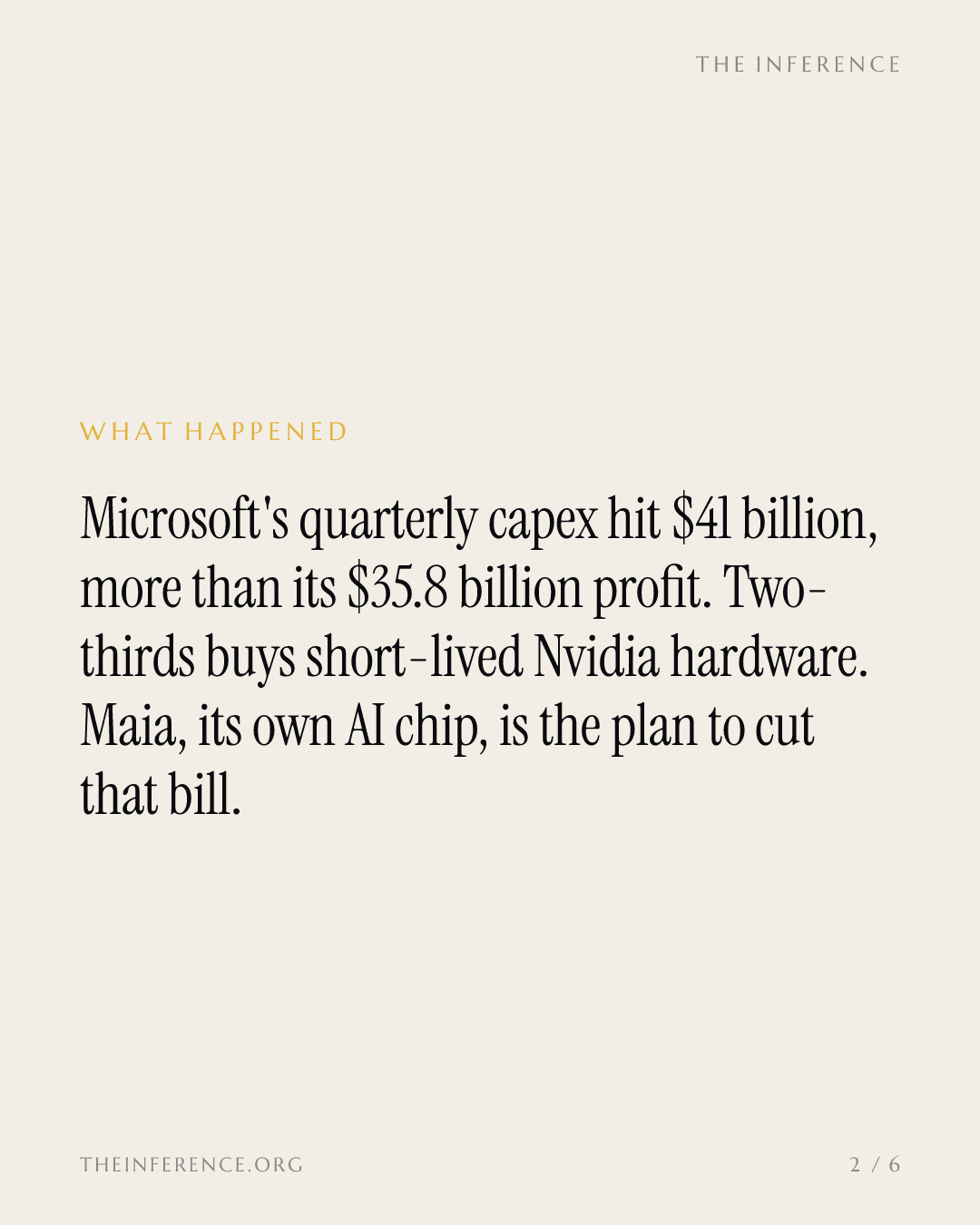
Microsoft+0.70% — Microsoft, up 0.70 percent today reports fiscal Q1 on Wednesday, and the number that will decide how the print is read is not revenue 1. It is capital spending, which hit $41 billion in the June quarter, more than the $35.8 billion Microsoft earned in net income that quarter 1. Two-thirds of that bill went to short-lived chips and servers, much of it Nvidia−0.26% — Nvidia, down 0.26 percent today silicon that wears out in a few years 1.
Microsoft is building its own Maia chips to take the highest-volume slice of that work, inference, in-house. Wednesday is when investors judge whether the spend is strategy or a hole.
Microsoft's capex has caught up with its quarterly net income
- Capex
- Net income
Data
| Capex | Net income | |
|---|---|---|
| Q3 '24 | 14.9 | 24.7 |
| Q4 '24 | 15.8 | 24.1 |
| Q1 '25 | 16.7 | 25.8 |
| Q2 '25 | 17.1 | 27.2 |
| Q3 '25 | 19.4 | 27.7 |
| Q4 '25 | 29.9 | 38.5 |
| Q1 '26 | 30.9 | 31.8 |
| Q2 '26 | 35.8 | 35.8 |
Inference is where Microsoft's bill compounds
Inference is the cheap-to-describe, expensive-to-run part of AI. Every Copilot answer, every GitHub coding suggestion, every dispatched agent is a billable query against a GPU. Microsoft runs those millions of times a day, so modest efficiency gains compound at scale 1. Maia 300, due in production deployments in 2027, is claimed at seven times Maia 200's rack output and 40% more AI per megawatt than top GPUs 1. If even the inference claims hold, Microsoft bends its own cost curve without waiting for Nvidia to cut prices.
It does not need to beat Nvidia everywhere
The honest counterweight: Bloomberg Intelligence's Mandeep Singh calls Microsoft's silicon "nowhere close" to Nvidia's or Google's 1. But Microsoft does not need to beat Nvidia everywhere. It needs Maia to handle the repetitive Copilot and agent workloads it pays for millions of times a day, while Nvidia keeps the frontier training business. Google's TPUs show this playbook works; Microsoft is years behind where Alphabet−0.59% — Alphabet, down 0.59 percent today is.
Cheaper serving decides who keeps the AI boom's margin
The chain from chip to your workday runs through who can afford to serve AI at scale. Cheaper inference means Copilot seats get priced for company-wide rollout, which is what enterprise buyers were finally doing last quarter, adding tens of thousands of seats at a time 3. The bottleneck has moved from model quality to serving cost. Whoever closes that link, Microsoft or Nvidia, keeps the AI boom's margin. Watch Wednesday's capex guidance for which one the market thinks it is.
What happens next
MSFTDoes capex keep outpacing net income, and does Maia shift the serving-cost story?
The case for
Maia 300's claimed 7x rack output and 40% better AI per megawatt would bend inference costs at Copilot scale
The case against
Capex above net income leaves earnings quality hostage to AI demand holding up
- Wed Oct 28, after market close ETMicrosoft reports fiscal Q1 results, with capex guidance in focus.
Get our follow-up when these land
Free. We'll email you when we publish on Microsoft, and send our free weekday newsletter. Unfollow in one click.