Western Digital bets on denser drives, not more factories, as Toshiba doubles output
On its October 22 call the company pointed its capital at recording heads and disk media rather than factories, and its CFO gave price growth three or four more quarters. The density bet is durable; the scarcity premium is on a timer Toshiba started.
 Richard Tang · 3 min read
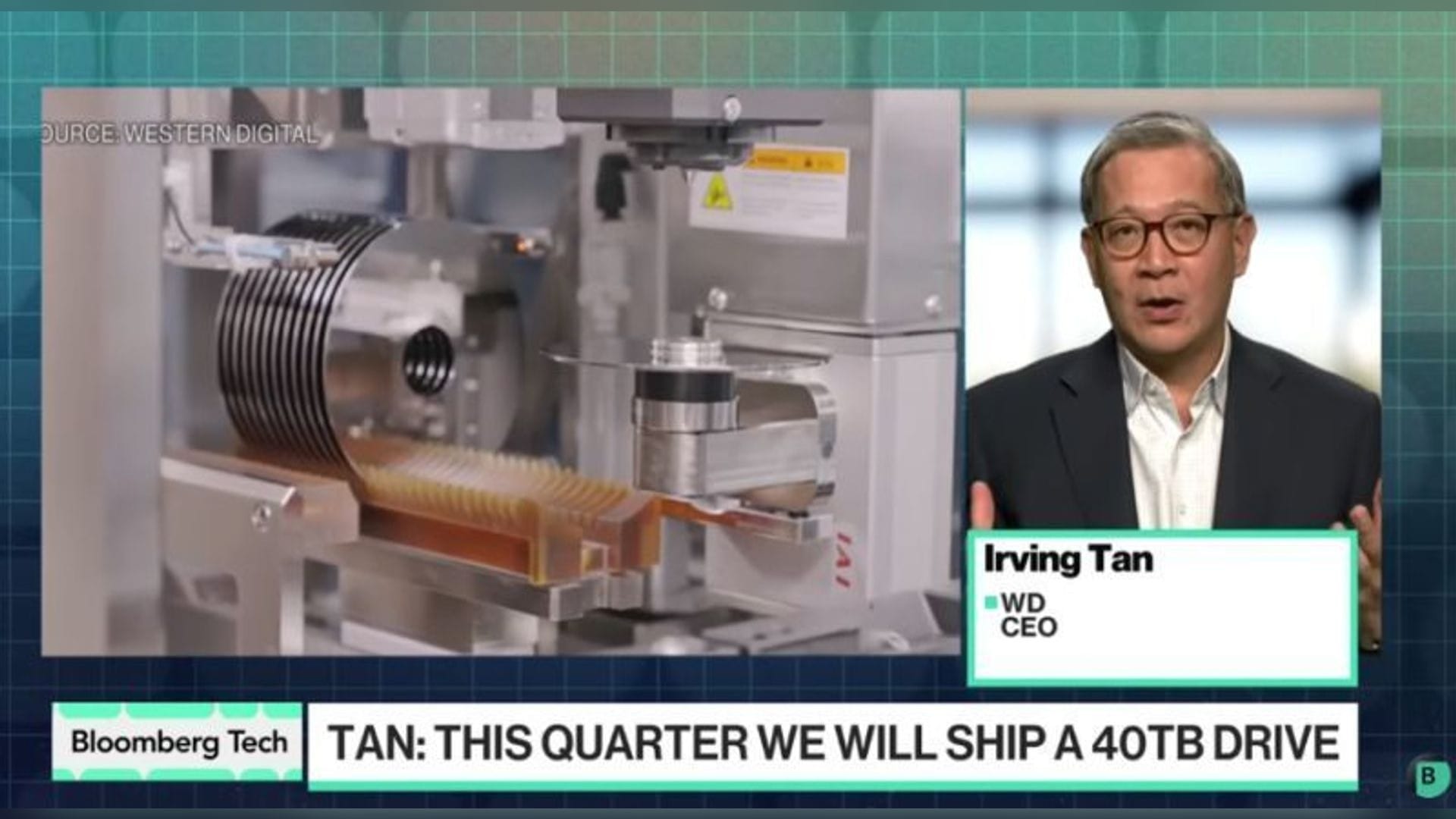
Western Digital−3.87% — Western Digital, down 3.87 percent today has answered Toshiba's plan to double hard-drive output, and the answer is no new factories. On its October 22 earnings call the company pointed its capital at recording heads, disk media and factory automation, "not to expanding our unit capacity" 1. The bet on density is the right one. It is also an admission that this year's profits are priced rather than built, and Western Digital's own finance chief just put a clock on that pricing.
The quarter was priced, not built
Revenue rose 55% from a year ago 3. The bytes shipped rose just 22% 3. The gap is price, and price per terabyte is what carried the quarter. Non-GAAP gross margin reached 58%, and management guided it higher for the December quarter 3. The stock still fell 6% on the day, because the buyside bar was already high after a month-long slide 14.
Price, not bytes, carried the quarter
Data
| Value | |
|---|---|
| Revenue | 55% |
| Price per terabyte | 28% |
| Exabytes shipped | 22% |
The premium is not new either. On the GAAP basis of its filings, Western Digital's gross margin has now risen for eight straight quarters as drives got scarce 5.
Gross margin has risen every quarter for two years
Data
| Gross margin (GAAP) | |
|---|---|
| Q3 '24 | 36.4% |
| Q4 '24 | 37.7% |
| Q1 '25 | 39.8% |
| Q2 '25 | 41% |
| Q3 '25 | 43.5% |
| Q4 '25 | 45.7% |
| Q1 '26 | 50.2% |
| Q2 '26 | 54.1% |
The money goes where bytes come from
A drive holds what its heads can write on its media: capacity per unit is areal density, and that is the layer the capital now funds 13. The 40-terabyte energy-assisted ePMR drives are ramping faster than any transition before them 3. Heat-assisted magnetic recording, which heats the platter to pack bits tighter, reaches first qualifications with hyperscale customers early in 2027 and volume shipments in the first half 3. Denser drives also cut a data center's power and rack cost per terabyte 3, so the bet pays the customer as well as the maker.
Toshiba set the expiry date
Toshiba, the smallest of the drive trio, is spending about $380 million at its Philippine plants 6. The goal is doubled output by fiscal 2027, and its ambition is 30% of shipped capacity 6. It holds just over a tenth today 6.
That breaks a stated discipline: Western Digital chief executive Irving Tan called tight supply "an opportunity for increased pricing leverage," and Seagate's−1.89% — Seagate, down 1.89 percent today Dave Mosley said "the total number of units is not really increasing" 7. Both incumbents are sold out for this year, and Seagate's own expansion is a tripling of head production rather than drive lines 8. Seagate already ships heat-assisted drives at 44 terabytes 9, a class Western Digital reaches only next year.
Meanwhile the DRAM and NAND inside every drive cost more, and near-term cost cuts per terabyte will miss the 10% annual goal 3. CFO Kris Sennesael gave the price boom "the next three, four quarters," and the further out, the less of it is under contract 1.
The roadmap outlives the premium
The AI demand underneath is real: Tan reads his seven biggest customers out to 2031, and Western Digital is sampling high-bandwidth drives for the key-value caches AI inference reads 1. The scarcity premium is income from a shortage Toshiba intends to end. The density roadmap is the asset, and it is the one the company is actually buying.
Get Data Center by email, free
Who is building AI's data centers, and who is paying for them. In our daily email, every weekday.