Monolithic Power Systems posts its first $1 billion quarter, raises its AI rack growth floor to 150%
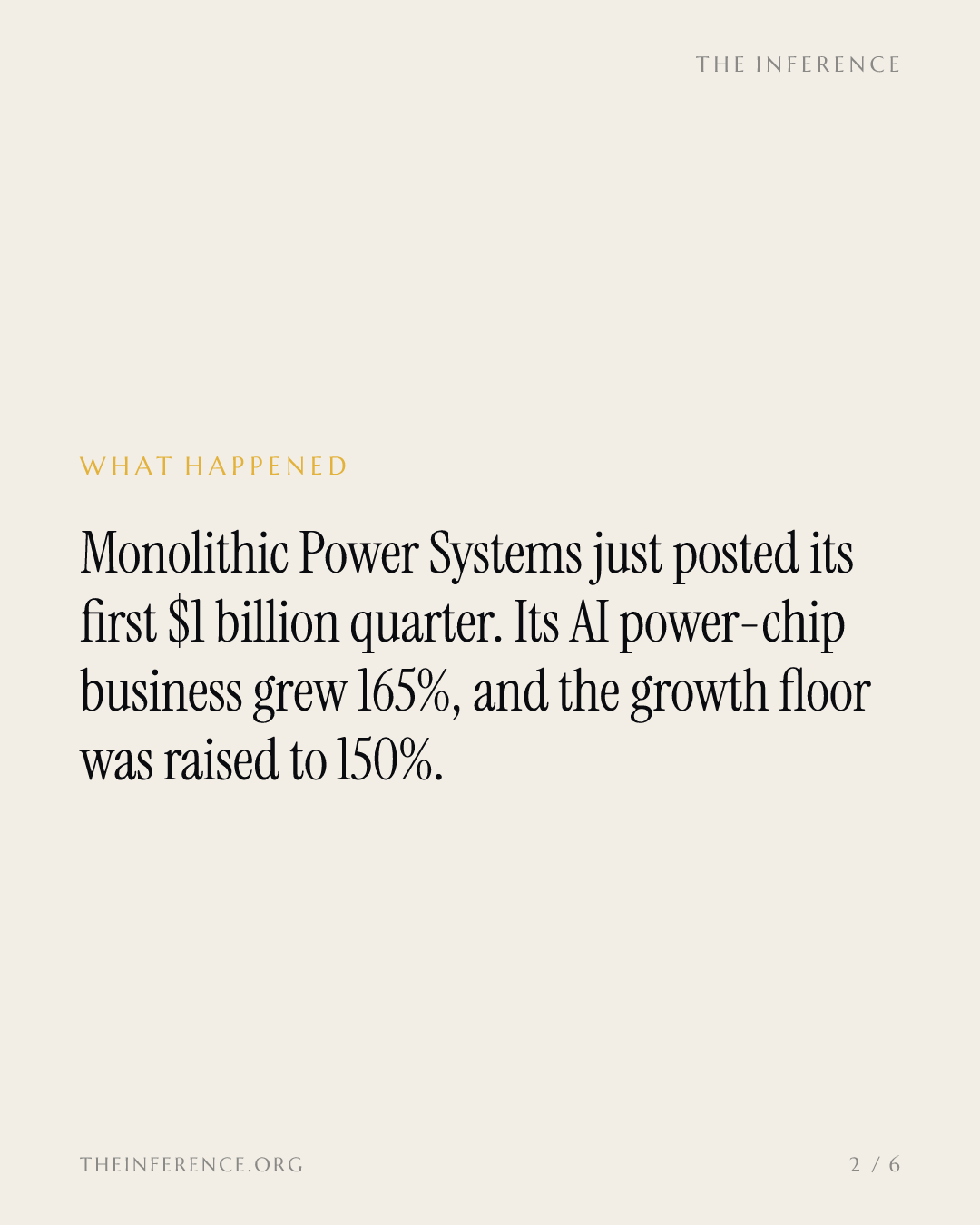
Monolithic Power Systems posted its first $1 billion quarter the night Intel's PC-led guide-down broke the AI trade, and raised the growth floor on its AI rack line to 150%. The order book says the buildout runs into 2027; the week's real question is who finances it.
 Richard Tang · 3 min read
Monolithic Power Systems+0.05% — Monolithic Power Systems, up 0.05 percent today (Nasdaq: MPWR) crossed $1 billion in quarterly revenue for the first time on the same night the AI trade cracked, with Intel's−28.36% — Intel, down 28.36 percent today weak December forecast dragging chip stocks down worldwide 12.
MPS designs the power-management chips that step data-center voltage down to what an AI server board can actually run on, and that business, enterprise data, grew 165% year over year to $506.7 million, now 42% of the company 1. It raised its floor for enterprise-data growth this year to 150% from 130%, and guided the December quarter above $1.3 billion 13.
The market spent that night repricing who pays for AI. The order book spent it saying the racks are still being built.
AI racks draw more power every generation, and MPS sells that conversion
Watts are the mechanism. Every GPU generation draws more power, and as the draw rises, the usable space around the processor runs out; founder and CEO Michael Hsing said that is what pushes customers toward vertical power delivery and power modules, both MPS products 3.
The step after that, 800-volt data-center architectures, begins ramping late in 2027 and turns meaningful in 2028, and MPS is already sampling gallium-nitride parts alongside its silicon-carbide designs 3. Capacity now supports $6 billion of annual revenue 1. Management expects $8 billion in place by late 2027, deliberately ahead of demand 13.
Quarterly revenue passed $1 billion for the first time in Q3 2026
Data
| Revenue | |
|---|---|
| Q4 '23 | $0.45B |
| Q1 '24 | $0.46B |
| Q2 '24 | $0.51B |
| Q3 '24 | $0.62B |
| Q4 '24 | $0.62B |
| Q1 '25 | $0.64B |
| Q2 '25 | $0.67B |
| Q3 '25 | $0.74B |
| Q4 '25 | $0.75B |
| Q1 '26 | $0.8B |
| Q2 '26 | $0.98B |
| Q3 '26 | $1.2B |
What cracked this week was the PC, not the rack
Intel's plunge came from the old machine: it guided December below expectations with PC units on track to fall about 12% this year 5. Its server segment grew nearly 80% year over year, and finance chief Dave Zinsner still called 2027 a growth year 5. The new risk is financing.
Nvidia−3.57% — Nvidia, down 3.57 percent today is in talks to guarantee credit for Nscale, a UK data-center operator whose West Virginia campus the AI lab Anthropic$350B — Anthropic, private, latest valuation $350B plans to use, Bloomberg reported 2. A GPU supplier underwriting its customer's borrowing marks the shift: the question is no longer whether the racks get built, but who carries the debt. MPWR slipped about 1% anyway, trading with its sector rather than its own numbers 1.
The AI-fed end markets more than doubled while consumer shrank
Data
| Value | |
|---|---|
| Enterprise Data | 164.6% |
| Communications | 134.7% |
| Industrial | 29% |
| Automotive | 19.2% |
| Storage & Computing | 3% |
| Consumer | -11.6% |
The fresh risk sits on MPS's own balance sheet
Shareholders carry the rest. MPS bought back $453 million of stock in the quarter, after $4 million the quarter before, and the board added $500 million of authorization 1. Cash and short-term investments fell to $1.1 billion 1. Inventory stands at 130 days, and stock compensation doubled from the prior quarter 1.
Revenue has doubled since 2023, free cash flow has not
- Revenue
- Free cash flow
Data
| Revenue | Free cash flow | |
|---|---|---|
| Q3 '23 | $0.48B | $0.15B |
| Q4 '23 | $0.45B | $0.14B |
| Q1 '24 | $0.46B | $0.23B |
| Q2 '24 | $0.51B | $0.11B |
| Q3 '24 | $0.62B | $0.2B |
| Q4 '24 | $0.62B | $0.1B |
| Q1 '25 | $0.64B | $0.22B |
| Q2 '25 | $0.67B | $0.19B |
| Q3 '25 | $0.74B | $0.2B |
| Q4 '25 | $0.75B | $0.06B |
| Q1 '26 | $0.8B | $0.19B |
| Q2 '26 | $0.98B | $0.14B |
Channel inventory sits at the lean end of its normal range, so the shipments read as demand rather than stuffing 3. And the CFO seat Robert Dean had held on an interim basis since February went permanently to Tony Balow, a 23-year Intel veteran, named in the same release as the record quarter 6.
The quarter is fact, the financing is the question
The orders are observed; 2027 is a forecast 7. Nothing in this print shows AI demand cracking: adjusted earnings of $8.19 a share beat the $7.80 expected 7. The racks keep going up. What this week actually put in question is who signs for them.
Get Chips by email, free
How AI demand is reshaping chipmakers, memory and the fabs behind them. In our daily email, every weekday.