Navitas says its 2030 market is over $8 billion; it guides just $13.5 million for the quarter
At its Navitas 2.0 call the power-chip maker tripled its identified 2030 market to more than $8 billion, while its quarterly revenue guidance sits at $13.5 million and its cash burn is covered by selling stock. November 3 picks the storyline.
 Vincent Jiang · 2 min read
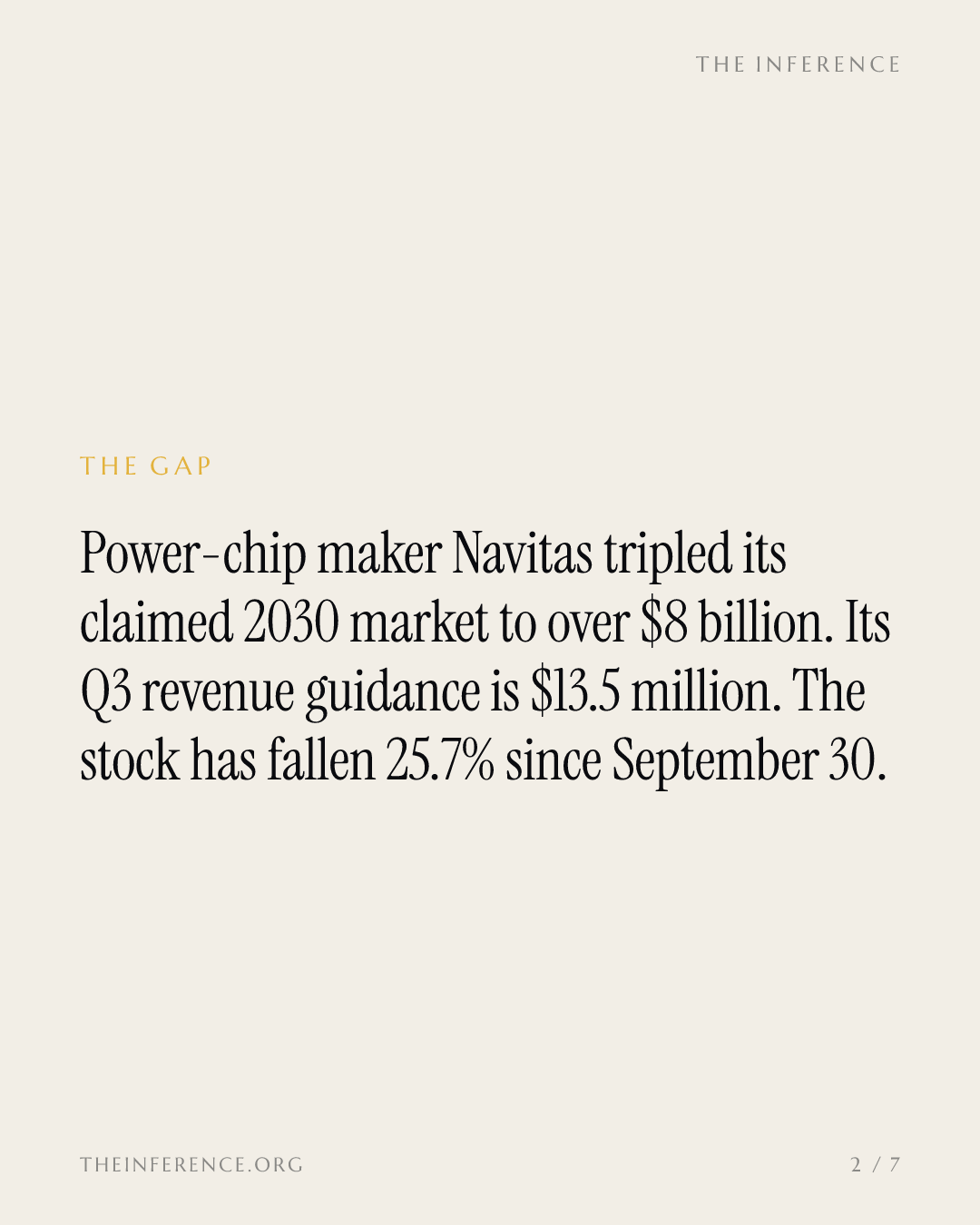
Navitas Semiconductor−6.46% — Navitas Semiconductor, down 6.46 percent today closed at $9.16 on October 21, down 25.7% from its September 30 close, and the market has stopped paying for the story 12. The stock's problem is not a lack of announcements. It is that every announcement dates its revenue forward: mobile gone by end-2026, AI sidecars in 2027, the Claros voltage regulators paying from 2028 12. Between now and then sits a $13.5 million quarter, guided for November 3 2.
The pivot, priced in one chart
At its October 20 "Navitas 2.0" call, CEO Chris Allexandre said mobile revenue will be insignificant by year-end and put the identified 2030 market at more than $8 billion, up from $3.5 billion, with AI infrastructure nearly 85% of it 1. The Claros acquisition, closed October 6, and a 24 kW, 800-volt board built with Nvidia−3.88% — Nvidia, down 3.88 percent today sit inside that number 345. So does a 2300-volt, 8 milliohm silicon carbide module put into sampling October 21, aimed at the solid-state transformers that would feed grid power straight to data center rails 345.
The $8 billion market against a $124 million 2028 revenue estimate
- Estimate
Data
| Value | |
|---|---|
| 2030 market (company-identified) (estimate) | $8,000M |
| 2026 consensus revenue | $47.7M |
| 2028 consensus revenue (estimate) | $123.9M |
The bar on the right is company-identified addressable market, not revenue; the company says so itself 1. The two small bars are what Wall Street models: $47.69 million of 2026 consensus revenue rising to $123.90 million in 2028, about 1.5% of the market being described 2. A company that wins its own market at half the street's rate would still be earning a rounding error of it eight quarters from now.
The bill for the bridge
The transition costs cash. Q2 brought a $228.2 million GAAP net loss, $203.1 million of it a non-cash earnout charge, and free cash flow of negative $32.21 million 2. Shares outstanding rose from 233.7 million on May 1 to 261.09 million by July 24 after roughly 17.4 million shares were sold at the market in May and June 2.
Analysts expect EBITDA losses of $9 million to $10 million a quarter through Q3 2027 2. Five of eight analysts rate the stock Hold, one rates it Sell, and litigation with Renesas−2.70% — Renesas, down 2.70 percent today and Wolfspeed−9.78% — Wolfspeed, down 9.78 percent today is unresolved 26.
The verdict arrives on schedule
Allexandre set his own test: two or three more quarters of double-digit growth and "this goes away" 2. Q3 revenue is guided to $13.5 million plus or minus $0.5 million, 28% above Q2, with a Q4 guide near $15.10 million expected 2. His own words frame the stakes: "Power has become a bottleneck for AI compute" 1. On November 3, the architecture stops being an argument and becomes a print 1.
Get Chips by email, free
How AI demand is reshaping chipmakers, memory and the fabs behind them. In our daily email, every weekday.