United Microelectronics CFO's stake fell 28.4% in September; insiders sold $526 million and bought nothing
The foundry's Form 6-K, filed October 23, 2026, shows chief financial officer Chitung Liu's stake fell 28.4% in September, inside a twelve-month stretch where insiders sold $526.4 million and bought nothing. On October 28 the market finds out whether the AI-power story can carry a multiple already 52% above its own five-year median.
 Vincent Jiang · 3 min read

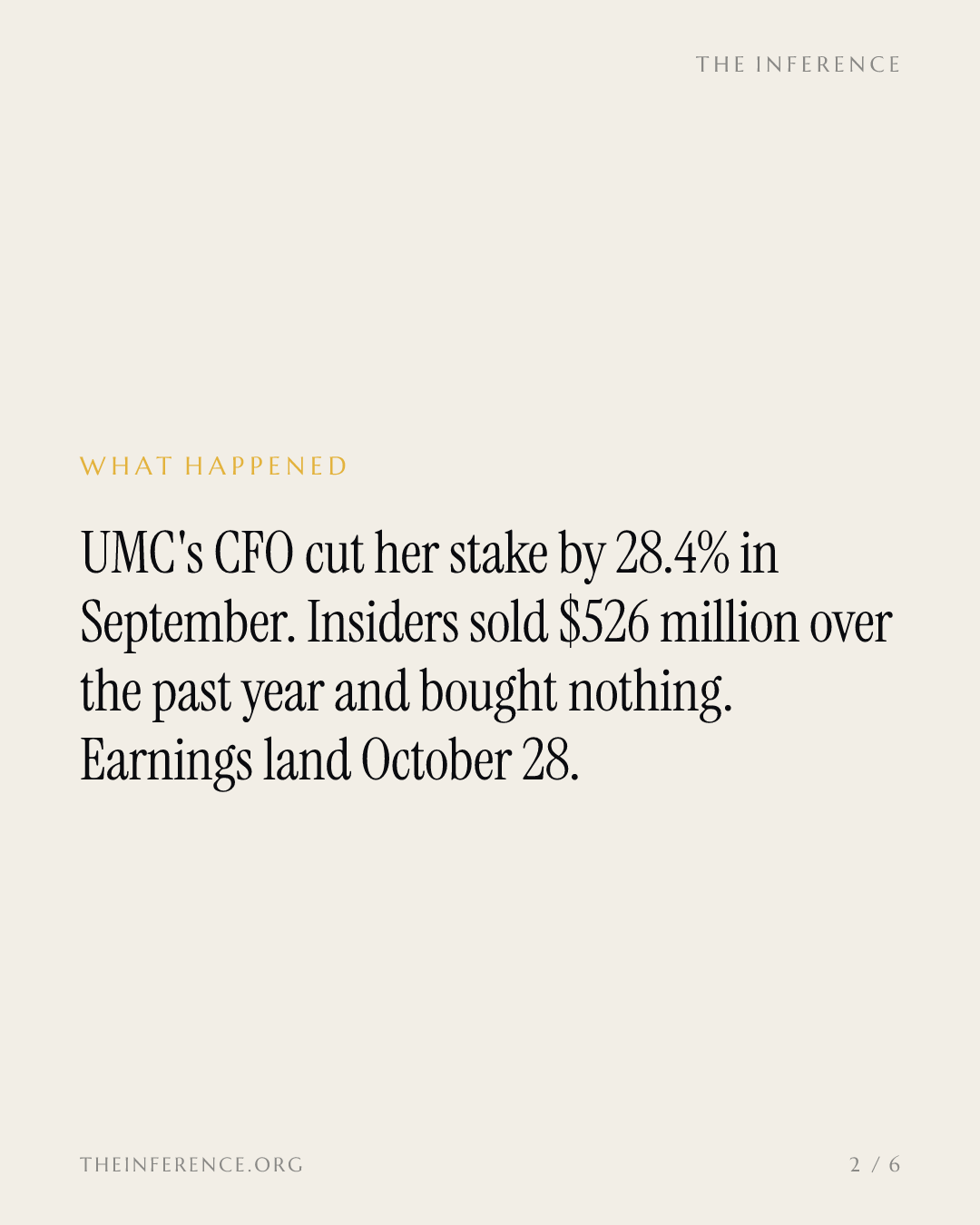
The filing landed this morning with almost no noise around it: a Form 6-K from United Microelectronics+1.13% — United Microelectronics, up 1.13 percent today, the Taiwanese chip foundry whose New York shares have more than doubled in a year 3. Inside it, in a monthly insider table, is the September book of the company's own finance chief. Chitung Liu, who signs the 6-K as CFO, held 2,112,917 UMC common shares on August 31 1. On September 30 the table shows 1,512,917 1. That is 600,000 shares gone in one month, 28.4% of the stake 1.
A vice president, JT Lin, trimmed 10,000 shares in the same window 1. The filing carries no prices and no proceeds, only the before-and-after counts 1.
The sale sits five days in front of the number that tests it
UMC reports third-quarter earnings on October 28, before the open 4. MarketBeat's consensus puts the print at $0.23 of earnings per share on $2.33 billion of revenue, against $0.53 and $2.16 billion last quarter 4. The headline drop looks like a collapse. It is mostly arithmetic: in the June quarter, CFO Liu told investors that investment and dividend income of roughly TWD 30 billion arrived as non-operating income, which is why net income hit TWD 42.26 billion, a 61.5% net margin on a business whose operating margin was 21.8% 9.
Strip that windfall and the consensus quarter is a normalization, not a verdict. What remains unexplained is everything else: why the stock still trades at $18.53, 100.5% above GuruFocus's $9.24 value estimate, with a trailing P/E of 17.7x against a five-year median of 11.7x 2.
UMC revenue climbed back to 2.16 billion dollars by mid-2026
Data
| Revenue ($B) | |
|---|---|
| Q1 '24 | 1.71B |
| Q2 '24 | 1.75B |
| Q3 '24 | 1.92B |
| Q4 '24 | 1.86B |
| Q1 '25 | 1.75B |
| Q2 '25 | 2.01B |
| Q3 '25 | 1.94B |
| Q4 '25 | 1.98B |
| Q1 '26 | 1.91B |
| Q2 '26 | 2.16B |
Q2 2026 net income spiked to 1.33 billion on investment gains, not wafers
Data
| Net income ($B) | |
|---|---|
| Q1 '24 | 0.33B |
| Q2 '24 | 0.42B |
| Q3 '24 | 0.46B |
| Q4 '24 | 0.31B |
| Q1 '25 | 0.24B |
| Q2 '25 | 0.31B |
| Q3 '25 | 0.49B |
| Q4 '25 | 0.28B |
| Q1 '26 | 0.51B |
| Q2 '26 | 1.33B |
The AI story is real, early, and already priced
The rally has a narrative. On October 22, UMC and AP Memory announced a partnership on deep-trench capacitor silicon, the components that carry stable voltage into AI chips inside the package rather than across the board; AP Memory's Gen2D designs taped out in the third quarter 5.
On the July earnings call, CEO Jason Wang put 2026 AI-related revenue near $300 million and said it would exceed $1 billion within three years 9. The company raised its 2026 capital budget to $2 billion from $1.5 billion, and financed the build with $1.8 billion of zero-coupon convertible bonds priced October 5, money investors effectively pay UMC to hold 89. The stock fell about 10% that day anyway 7.
What the insiders did while the story compounded
The ADR returned 136.88% over twelve months against 58.96% for Taiwan's benchmark, and closed October 22 at $18.53, down 6.51% on 17.6 million shares against a 12.3 million average 3.
Against that tape, GuruFocus counts $526.4 million of insider selling over the past year with no buying reported, and the September table adds the CFO's 28% reduction and an empty pledge ledger 12. Nothing here proves motive; the filing shows counts, not reasons 1. But positions speak louder than press releases, and the people closest to the wafers have been selling the rally, not joining it.
The bulls have their quarter, and their target
The counter-case deserves its due: third-quarter guidance called for shipments up high single digits, utilization above 90%, and gross margin in the mid-30s, the best operating setup in years 9. Wall Street's consensus target is $19.12, with a high of $33.76 3. If the AI power and silicon-photonics pipeline converts on schedule, today's premium looks like a down payment, not a mistake 59.
Watch Wednesday, then the October insider table
The October 28 print settles the first question: whether operations, not investment income, can carry a 17.7x multiple 49. The November 6-K settles the second: whether September's selling was a finish or a habit 1. Until both read out, the buyer of the AI-power story is the one holding shares the sellers would not.
What happens next
UMCCan operations, not investment income, carry a 17.7x multiple?
The case for
Q3 guidance is the best operating setup in years: shipments up high single digits, utilization above 90%, mid-30s gross margin.
The case against
Insiders sold $526.4 million over twelve months and bought nothing, and the CFO cut her stake 28.4% a month before the print.
- Wed Oct 28, before market openUMC reports third-quarter earnings before the open.
- November 2026The November Form 6-K discloses the October insider table. Was September's selling a finish or a habit?
Get our follow-up when these land
Free. We'll email you when we publish on United Microelectronics, and send our free weekday newsletter. Unfollow in one click.