PG&E's $5.1 billion wildfire cap: the bill must reach Newsom by November 15, ratepayers pay the rest
A PG&E presentation to state senators seeks a permanent shareholder liability cap of $1.5 billion to $5.1 billion regardless of negligence, against an estimated $14-18 billion Eaton fire cost. The bill must reach the governor by November 15, which makes the cap a dated catalyst for an equity trading at 9.8 times earnings.
 Vincent Jiang · 3 min read
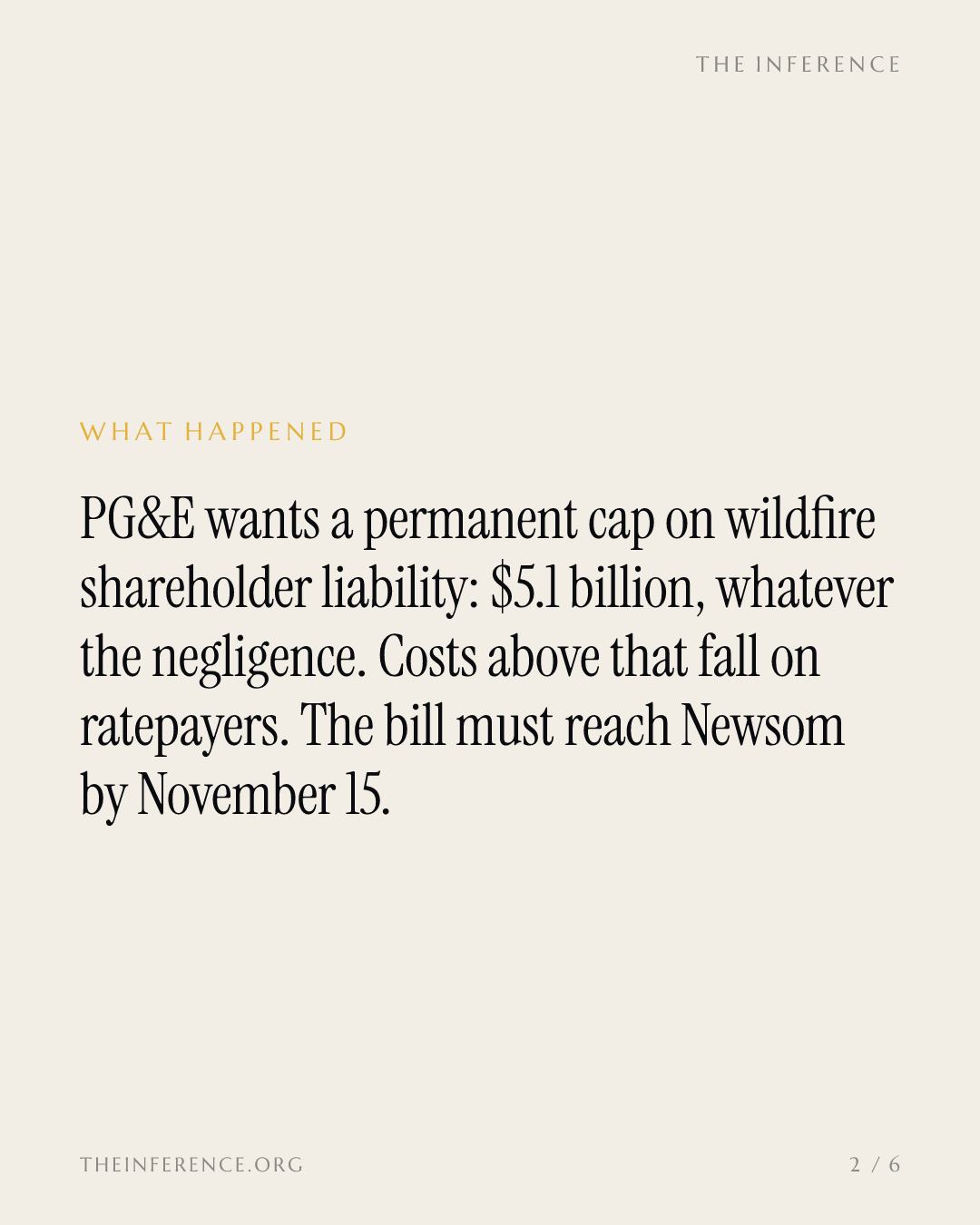
PG&E's presentation to California state senators asks for a permanent cap on shareholder wildfire liability of between $1.5 billion and $5.1 billion, whatever the degree of negligence, with the rest of a catastrophic fire's costs landing on ratepayers 1. Consumer Watchdog, the Santa Monica consumer group, contrasts that with an estimated $14 billion to $18 billion cost for the Eaton fire, which it attributes to Edison's negligence 1. A company that went bankrupt on one fire is asking Sacramento to make its worst case a known expense.
The clock matters as much as the ask. Edison chief executive Pedro Pizarro told investors a special-session bill must reach Governor Newsom by November 15, because this legislature is gone on November 30 5. Wall Street has priced the tail: PCG trades at about 9.8 times earnings against an industry average near 19, and the stock closed November 4 as the market's most actively traded name on $380 million of turnover 2. A legislated cap is the dated catalyst that could re-rate the equity; a failed bill leaves the unbounded tail.
The cap covers a third of one fire
The numbers sharpen the point. Under 2019's Assembly Bill 1054, Edison's shareholders already owe no more than $4.3 billion for the Eaton+4.27% — Eaton, up 4.27 percent as of its last quote fire if regulators find it imprudent, and the proposed cap equals 20 percent of each utility's transmission and distribution equity rate base: $5.1 billion for PG&E−0.23% — PG&E, down 0.23 percent as of its last quote, $4.3 billion for Edison, $1.5 billion for San Diego Gas & Electric 4.
So the proposal mainly makes permanent a ceiling that current law lets lapse once the state's wildfire fund runs out, while shifting everything above it to monthly bills 4. PG&E argues the cap would restore investment-grade credit ratings and lower borrowing costs for customers 4.
The cap is a third of what one fire costs
The proposed caps cover a fraction of the Eaton fire's estimated $14-18 billion cost
Data
| Value | |
|---|---|
| SDG&E cap | 1.5 |
| Edison cap | 4.3 |
| PG&E cap | 5.1 |
| Eaton fire cost (low est.) | 14 |
| Eaton fire cost (high est.) | 18 |
The opposition, and the leverage
Consumer Watchdog's Jamie Court calls the cap moral hazard, a predictable price on negligence that weakens the incentive to prevent fires 1. Utilities Reform Network's Mark Toney says the cap belongs on ratepayers, not shareholders 4. Rank-and-file lawmakers are reportedly cool to a special session, with Assembly committee chair Cottie Petrie Norris the main ally 5.
Senator Sasha Renée Pérez notes both companies still pay dividends while threatening to defer $2 billion of 2027 spending, a threat our November 3 reporting showed their own CEO's letter undercut: PG&E connects customers in 118 days against a 182-day target, and the cut leaves an $11.4 billion capital plan intact 3. Ignitions are down 74 percent since 2017, which is the utilities' best argument that the risk has already been tamed 2.
November 15 decides which tail holds
Watch November 15 15. If the bill reaches the governor, the wildfire tail closes and the 9.8 times earnings multiple gets tested 15. If rank-and-file opposition holds, the tail stays open and ratepayers keep the leverage 15.
Get Power by email, free
How AI's hunger for electricity moves utilities, power plants and the grid. In our daily email, every weekday.