Shopify grew merchant lending 71% while cutting its loan-loss provision 34%, and margins lean on it
Shopify's filing shows merchant-lending originations up 71% year over year while the loss provision fell 34%, and the fourth-quarter margin guide leans on that holding. The miss coverage skipped the line that now decides the cash flow story.
 Richard Tang · 3 min read

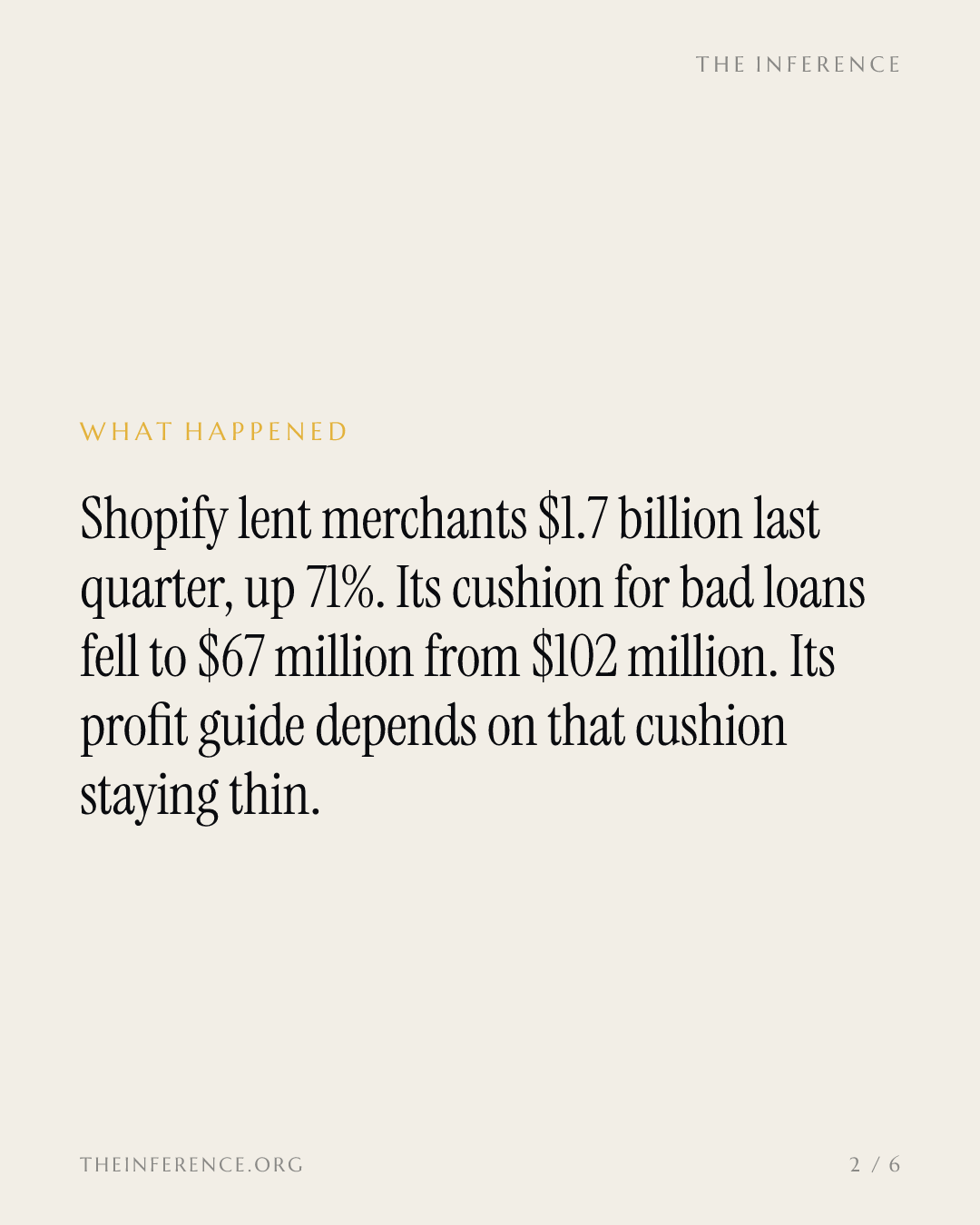
Shopify's−6.06% — Shopify, down 6.06 percent today quarter was reported as a miss, its first since 2022, and the stock fell hard on November 3 4. The filing underneath holds the number that should decide the next move: the company put $1.7 billion of its own money into loans and merchant cash advances for its merchants in the quarter, up 71% from a year earlier, while cutting the provision it sets aside for those loans going bad to $67 million from $102 million 1.
A lending book growing that fast while its loss cushion shrinks is the shape credit investors watch before losses arrive. We have covered Shopify's agent-and-checkout buildout here before; what is new since is this filing's lending line, which nobody wrote up 1.
The book is now big enough to move the margin
Shopify Capital, the loans and merchant cash advances sitting on Shopify's own balance sheet, reached $2.35 billion net at the end of September, up about a third since December 1. The company even moved merchant cash advances into its investing cash flows in April 2026, presenting them the way a lender presents loans 1. Originations have climbed every quarter this year, and in the same quarter Shopify bought back $562 million of its own stock 1.
Originations climbed each quarter while the loss provision fell
Originations have climbed every quarter while the provision fell 34% in Q3
- Loan and cash advance originations
- Provision for transaction and loan losses
Data
| Loan and cash advance originations | Provision for transaction and loan losses | |
|---|---|---|
| Q1 2025 | 805 | 43 |
| Q2 2025 | 944 | 44 |
| Q3 2025 | 996 | 102 |
| Q4 2025 | — | — |
| Q1 2026 | 1,349 | 48 |
| Q2 2026 | 1,584 | 94 |
| Q3 2026 | 1,700 | 67 |
The margin guide leans on provisioning staying light
Shopify guides the fourth-quarter free cash flow margin "consistent with" the fourth quarter of 2025, on low-thirties revenue growth 1. Lending is a cash business until losses hit: originations consume cash today, and each extra dollar set aside for expected loan losses comes straight out of operating cash. This quarter's margin beat rested on provisioning that fell from Q2's $94 million to $67 million; if holiday-quarter losses push provisioning back toward that level or past it, the guided margin takes the hit before anything else does 12.
Peers are already flagging the risk: Upstart cut its full-year outlook blaming consumer credit and rates, and Block's transaction and loan losses grew three times as fast as its gross profit 5. Affirm−15.15% — Affirm, down 15.15 percent today reports the consumer side of the same bet tonight 5.
The split, and what to watch
If merchant losses follow the consumer-credit signals peers are reporting, the free cash flow margin breaks first, because provisioning would have to rise from here. If provisioning stays light, this is a cheap growth engine: merchants borrowing Shopify's money for inventory into a soft holiday season, with Shopify's checkout data deciding who gets it.
Merchants get the working capital today; Shopify's shareholders carry the credit risk later, in the same cash flow the margin guide depends on. The February report's provision line, not the revenue print, is the number that settles it.
Get Applications by email, free
How AI is changing the software people and companies use. In our daily email, every weekday.