Shopify puts Shop Pay inside rival AI agents on Visa and Mastercard rails, and keeps the fraud liability
Shopify's Fall '26 Edition put Shop Pay inside rival AI agents, including for stores it does not power, on Mastercard, Visa and Discover tokens. The transaction fee now has two uncosted bills attached: agent fraud and Sidekick's compute, and the November 3 print shows which lands first.
 Richard Tangthree-minute read

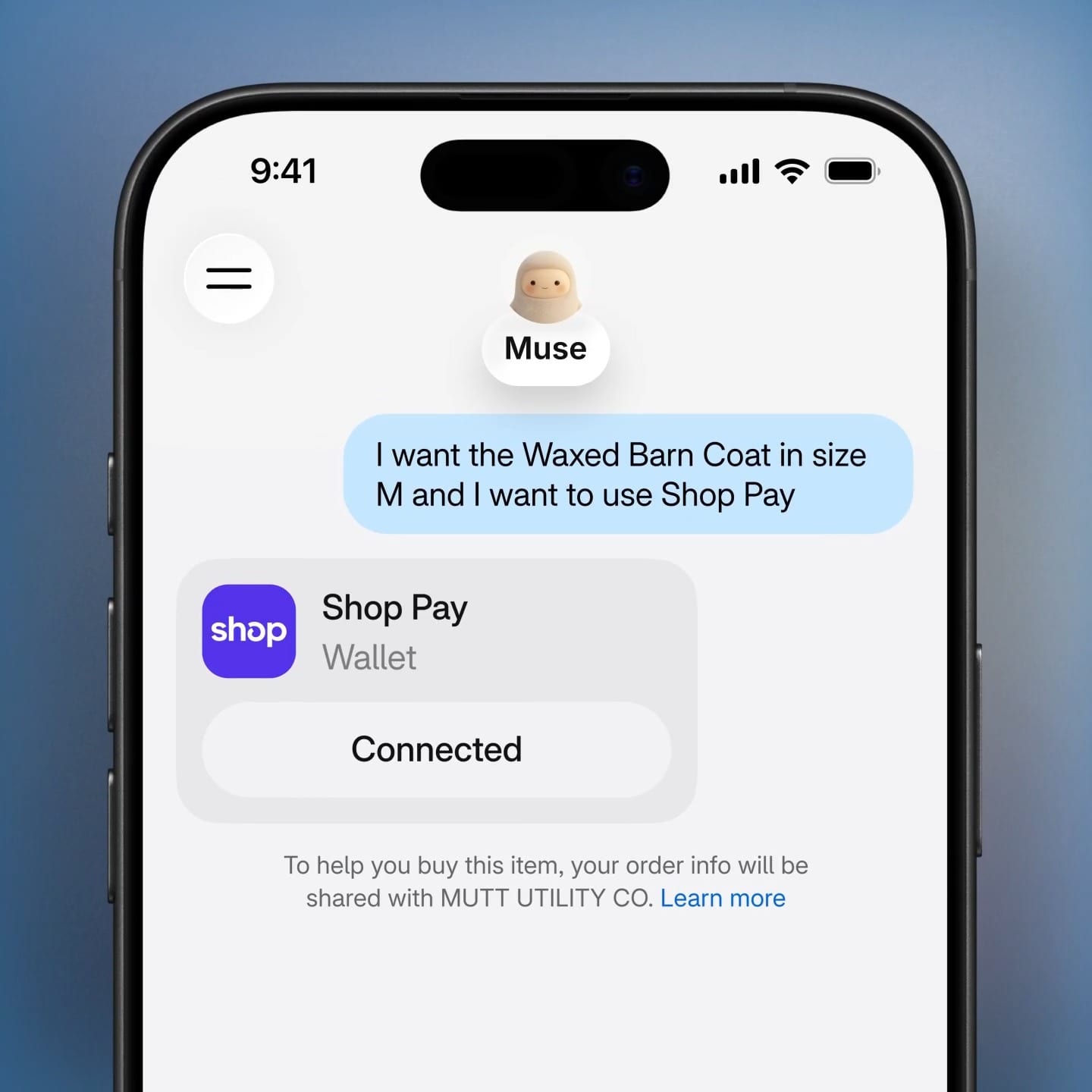
On October 28 Shopify+3.48% — Shopify, up 3.48 percent today handed its buy button to other companies' AI agents, and for the first time to stores Shopify does not power 12. Claude Duet, Grok Bot and Instinct can now check out with Shop Pay at brands that have never signed a Shopify contract, using single-use card credentials on Mastercard−0.70% — Mastercard, down 0.70 percent today, Visa and Discover rails, with American Express−1.10% — American Express, down 1.10 percent today coming 12.
The transaction fee now carries two uncosted bills, agent fraud and Sidekick's compute, and the November 3 print 7 shows whether this lands as a new take rate or a margin bleed.
The mechanism is the credential. A shopper's card never reaches the agent; Shopify tokenises it, so the agent spends within rules instead of holding the number 1. That puts Shopify's risk engine behind an agent's misbehaviour: Shopify Payments already blocks more than 12,000 high-risk payments every minute, and off-platform Shop Pay extends that shield to purchases Shopify's storefront never saw 1. Shopify is trading ownership of the storefront for ownership of the transaction, and quietly keeping the liability.
Growth accelerated to 34% while operating margin held in double digits
- Revenue growth, year over year (%)
- Operating margin (%)
Data
| Revenue growth, year over year (%) | Operating margin (%) | |
|---|---|---|
| Q3 '24 | 26.1 | 13.1 |
| Q4 '24 | 31.2 | 16.5 |
| Q1 '25 | 26.8 | 8.6 |
| Q2 '25 | 31.1 | 10.9 |
| Q3 '25 | 31.5 | 12.1 |
| Q4 '25 | 30.6 | 17.2 |
| Q1 '26 | 34.3 | 12.1 |
| Q2 '26 | 33.7 | 13.6 |
The payment layer is what is new since our last look
Our October 2 piece, "Shopify hands AI agents the buy button and merchants the bill," covered Shopify opening its storefronts to shopping agents while Amazon−0.12% — Amazon, down 0.12 percent today blocked them 12. What is new since is the payment layer: Shop Pay inside personal agents for non-Shopify brands on network tokens, plus shop.md, a skill that lets any agent search more than a billion Shopify products and check out with Shop Pay, and connectors that plug Shopify into nine agents, from ChatGPT and Meta's+1.11% — Meta, up 1.11 percent today Muse to Grok and Perplexity$30.00B — Perplexity, private, latest valuation $30.00B 12.
Control of the facts, and who joins the protocol
The second move is control of the facts. Shopify's new knowledge base means agents only learn what a merchant has published: return windows, shipping, gift services, and nothing drafted reaches an agent without merchant sign-off 1.
Shopify is also co-writing the Personal Agent Protocol with Meta, Sierra, Stripe and Walmart−1.81% — Walmart, down 1.81 percent today, and banks including Bank of America−0.48% — Bank of America, down 0.48 percent today and Wells Fargo−0.73% — Wells Fargo, down 0.73 percent today are exploring a framework built on it, while JPMorganChase and Amazon still block agents outright 345. Shopify is betting openness wins the shopper, and Visa's chief executive, who cited his company's agentic work with Shopify, warns the era is still nascent until disputes, rules and security are settled 6.
The bill is compute, and November 3 is the test
Sidekick, Shopify's merchant AI assistant, adds inference costs that weigh on subscription margins. Morgan Stanley−0.82% — Morgan Stanley, down 0.82 percent today, the bank behind the most-watched Shopify preview, expects payments, not a separate AI fee, to fund them; payments penetration reached 68% last quarter 7.
Sixty times free cash flow leaves no cushion
That is the test for November 3 7. The stock trades near 60 times 2027 free cash flow, against roughly 36 for large software peers, so growth and margins must do the work: Morgan Stanley wants about 33% volume growth against the Street's 30%, and weights the holiday guide most, with its early Black Friday math near 27% 7.
Watch where agent traffic lands first. If it shows up in payments penetration and gross profit, the toll booth earns. If fraud losses and Sidekick's bill land first, Shopify has taken the transaction fee on off-platform sales while absorbing the fraud losses on them. The evidence so far points to the rail being real; whether it is profitable is exactly what nobody has costed.
Get Applications by email, free
How AI is changing the software people and companies use. In our daily email, every weekday.