Teradyne's AI revenue grew 70% but it has $2.25 billion of purchase commitments and a flat Q4 guide
Teradyne's Q3 revenue rose 70% on AI test demand, but the 10-Q filed on October 30 shows $539.7 million of supplier prepayments and $2.25 billion of purchase commitments against a Q4 guide that is flat sequentially. The next signal is collections, not the headline.
 Richard Tang · 2 min read
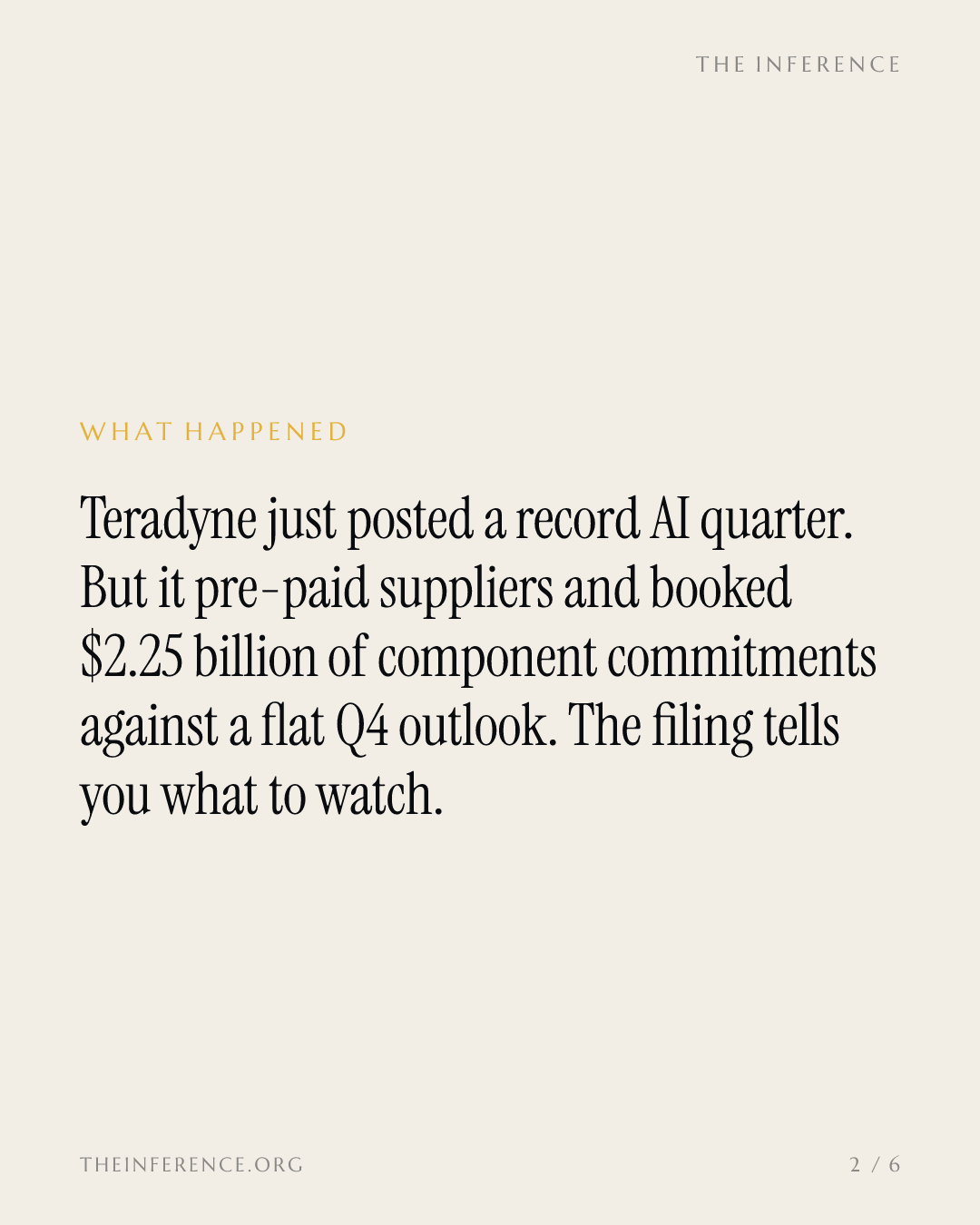
Teradyne's+3.82% — Teradyne, up 3.82 percent today record AI test quarter looks self-funding until you read the balance sheet it filed on October 30 1. Revenue of $1.31 billion, up 70% year over year, was financed from inside the working-capital line: the company has $539.7 million of manufacturer and supplier prepayments on the books and $2.25 billion of component purchase commitments, $1.9 billion of it due within a year, against a fourth-quarter forecast whose midpoint is flat with the third quarter 1. Teradyne has pre-paid for a demand ramp its own guidance does not yet confirm.
The headline is genuinely strong. Semiconductor Test brought in $1.07 billion, memory-test revenue hit $300.8 million, more than doubling on AI-related demand, and the GAAP operating margin expanded to 30.8% from 18.9% a year ago even while engineering spending rose to $163.1 million 12.
AI test demand, not a single chip type, is carrying the business: the buildout touches computing, memory, storage and the connections between them, and Teradyne's acquisitions, including the MultiLane stake for high-speed interconnect test and the pending $300 million FormFactor+4.47% — FormFactor, up 4.47 percent as of its last quote investment, are aimed at exactly those links 1. The demand thesis is real.
The 10-Q shows the bill for the thesis
Over nine months, receivables absorbed $302.7 million of cash, inventory $178.8 million, and prepayments and other assets $224.9 million, roughly $706 million tied up before acquisitions 1. Prepaying suppliers locks in components for the AI tester cycle, which is smart when orders keep coming and expensive when they slow.
Nine months of AI demand tied up about $706 million before acquisitions
Data
| Value | |
|---|---|
| Receivables | $302.7M |
| Prepayments and other assets | $224.9M |
| Inventory | $178.8M |
Meanwhile sequential growth has already flattened: the third quarter came in below the second quarter's $1.329 billion, and the fourth-quarter midpoint of $1.30 billion does not clear it either 12.
Sequential growth has flattened: Q3 came in below Q2 and the Q4 guide does not clear it
- Revenue
- Estimate
Data
| Revenue | |
|---|---|
| Q2 '24 | $0.73B |
| Q3 '24 | $0.74B |
| Q4 '24 | $0.75B |
| Q1 '25 | $0.69B |
| Q2 '25 | $0.65B |
| Q3 '25 | $0.77B |
| Q4 '25 | $1.08B |
| Q1 '26 | $1.28B |
| Q2 '26 | $1.33B |
| Q3 '26 | $1.31B |
| Q4 '26 (estimate) | $1.3B |
Watch collections, not the 70% headline
The 70% headline is a rearview number; the December quarter's collections and how fast those $1.9 billion of commitments run off are the live signal 1.
Breadth is concentration in disguise: a small number of large customers drive most test-equipment purchases, so Teradyne's working capital is now levered to the same few AI capex cycles as everyone else's 1. This is not a reason to doubt AI test demand, which is observable, but the stock's next test is arithmetic, not narrative: watch the December report for receivables turning into cash and commitments turning into shipped testers.
If both happen, the prepayments were cheap optionality. If shipments stall, Teradyne will have converted cash into inventory and supplier guarantees at the first sign of a plateau, and the flexibility it banked this year shrinks. The filing, not the call, told you which to watch.
Get Chips by email, free
How AI demand is reshaping chipmakers, memory and the fabs behind them. In our daily email, every weekday.