Kioxia broke the flash-price story, and Silicon Motion's own inventory is now the risk
Kioxia's below-estimate guidance broke the shortage assumption behind Silicon Motion's record quarter and its 40% growth promise. The part of Silicon Motion that buys flash and resells it at six-month prices is now the risk, not just the opportunity.
 Richard Tang · 2 min read
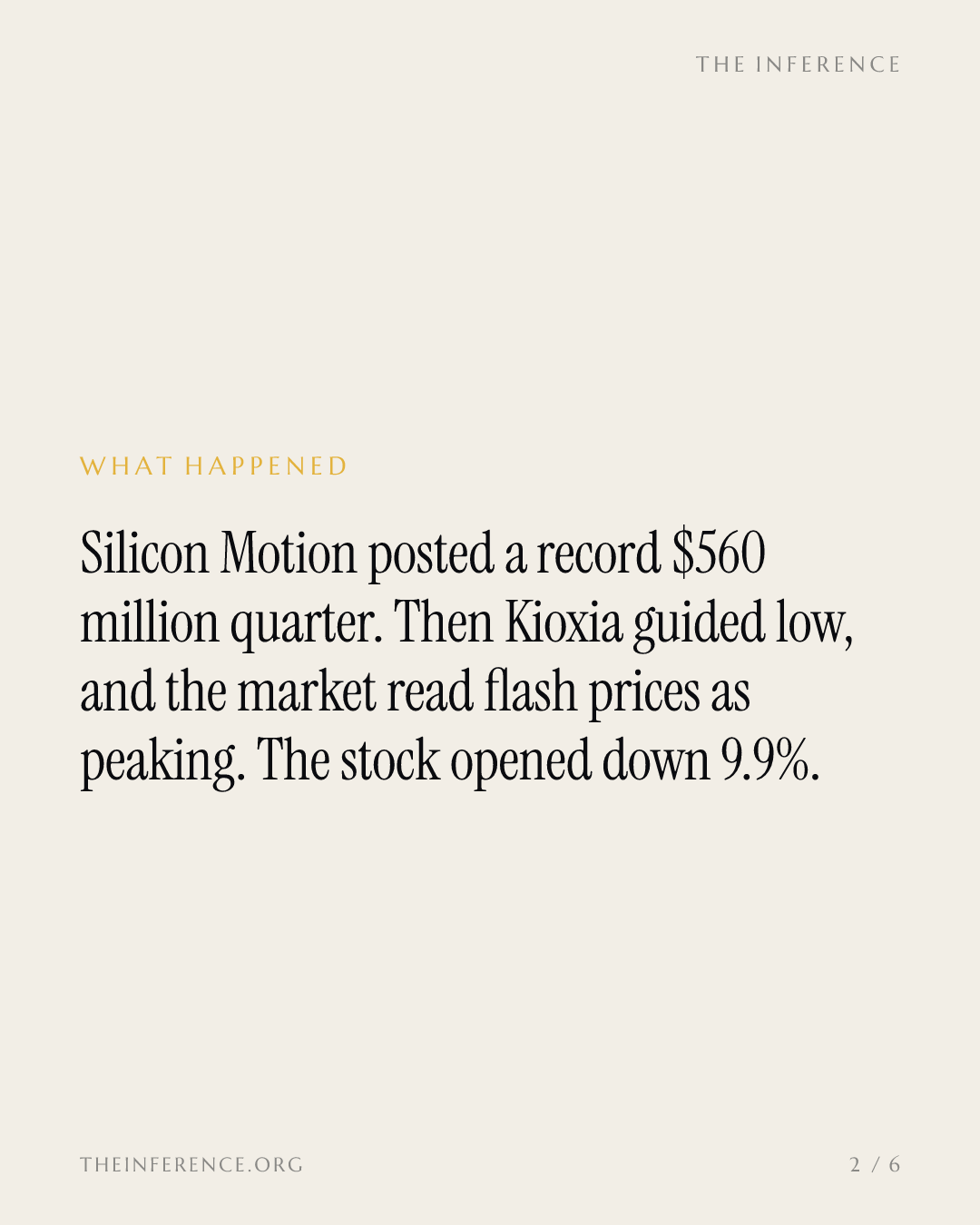
Silicon Motion's record quarter was priced on flash prices that keep rising, and Kioxia's below-estimate guidance on November 2 broke that assumption 4. The market read across the industry was that NAND price momentum is peaking, and Kioxia and peer SanDisk sold off on it 4. Silicon Motion+5.20% — Silicon Motion, up 5.20 percent today itself opened Tuesday at $187.90, down 9.9%, below its 200-day average 3. The dividend raised last month goes ex on November 5, so holders are deciding now 3. The question is not whether the controller business is good. It is who carries the flash.
The record quarter is real: revenue of $560 million, up 131% year over year, non-GAAP gross margin of 53.7%, and $4.35 per ADS 1.
Silicon Motion guided Q4 up 5 to 10% from a record Q3, with SSD controllers flat to lower
- Revenue ($M)
- Estimate
Data
| Revenue ($M) | |
|---|---|
| Q3 actual | $560M |
| Q4 guidance low (estimate) | $588M |
| Q4 guidance high (estimate) | $616M |
But the fastest growth came from the storage-solutions business, Ferri automotive drives and enterprise boot drives, now more than 40% of revenue 12. That business is different from selling controllers: Silicon Motion buys NAND flash itself, builds it into drives, and resells. Management runs it on six-month negotiated customer prices and turns purchased flash into cash over roughly two quarters 1. In a shortage, that machinery mints money: inventory bought cheap ships into rising prices, and cost increases pass straight through.
The same machinery works in reverse
If flash prices level off or fall, drives already built from expensive NAND must sell at the six-month-old price, and inventory cannot be repriced. Management's own guide shows where the strain sits: Q4 SSD controller revenue flat to slightly lower on memory and storage conditions, even as total revenue grows 1. The 2027 promise of at least 40% growth assumed the shortage holds 1.
For readers: the controller share gains and the boot-drive opportunity are genuine, and long-term that is the company. But over the next two quarters, the profit and loss is a bet on flash direction. The cash pile of $953.6 million, built on $1.13 billion of zero-coupon converts, buys time, not protection 12.
One thing is not disclosed: how much of the solutions inventory now on the books was bought at peak NAND prices, and whether flash actually rolls over. Nobody outside the company knows. The bet is on direction, not on disclosed numbers. The two sessions before the November 5 ex-date 3 are for deciding which side of that bet you are on.
Get Chips by email, free
How AI demand is reshaping chipmakers, memory and the fabs behind them. In our daily email, every weekday.