UMC posts its best quarter in years, then approves $3.2 billion to chase AI work it does not have
Record shipments, 92% utilization and margins up 420 basis points, and the stock never recovered from the October bond pricing. Now the board has approved $3.2 billion more capex for AI-adjacent work worth about $300 million of revenue today.
 Vincent Jiang · 3 min read

The best quarter its mature-node business has had, and the market shrugged
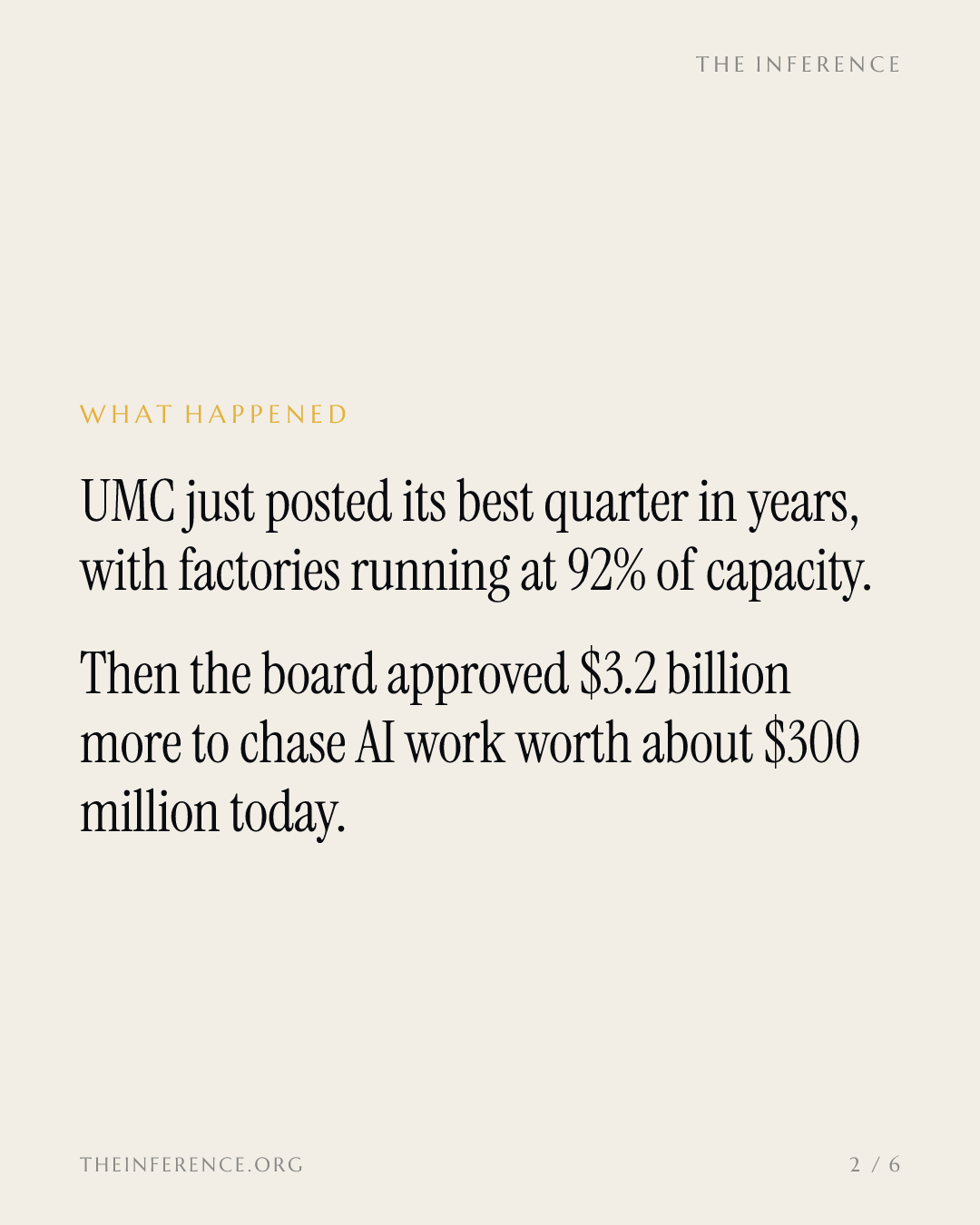
United Microelectronics+1.83% — United Microelectronics, up 1.83 percent today, Taiwan's third-largest chip foundry, just printed the best quarter in years for the mature-node corner of the fab world everyone wrote off. Q3 revenue rose 19.6% year over year to $2.32 billion, yet missed consensus by 1.3%, and earnings of 21 cents per ADS missed by 8.7% 1. Wafer shipments hit a record 1.212 million 12-inch-equivalent wafers, up 7.3% sequentially, with utilization at 92% against 78% a year earlier 1. Gross margin expanded 420 basis points to 34%, and operating margin expanded 630 basis points to 25.1% 1.
Revenue broke out in 2026, reaching $2.33 billion in Q3
Data
| Revenue ($B) | |
|---|---|
| Q1 '25 | 1.74B |
| Q2 '25 | 2.01B |
| Q3 '25 | 1.94B |
| Q4 '25 | 1.98B |
| Q1 '26 | 1.91B |
| Q2 '26 | 2.16B |
| Q3 '26 | 2.33B |
Cash followed the quarter: $4.48 billion on hand at September 30, debt-to-equity down to 44%, and free cash flow of NT$18.09 billion 1. Management guided fourth-quarter utilization to stay in the low-90% range and 2027 blended average selling prices up about 10% year over year, because capacity limits and higher costs are now the constraint on growth 12.
Gross margin recovered seven points to 34%
Data
| Gross margin (%) | |
|---|---|
| Q1 '25 | 26.7% |
| Q2 '25 | 28.7% |
| Q3 '25 | 29.8% |
| Q4 '25 | 30.7% |
| Q1 '26 | 29.2% |
| Q2 '26 | 32.5% |
| Q3 '26 | 34% |
The shares have gone the other way. They fell more than 11% on October 5 after UMC priced $1.8 billion of zero-coupon convertible bonds to fund equipment and plant expansion, and have not recovered since 4.
$3.2 billion more for a table UMC does not yet sit at
On October 27 the board approved roughly $3.2 billion of additional capex to accelerate expansion in Singapore and Tainan, aimed at silicon photonics and advanced packaging, the AI-adjacent work 13. That rides on top of a $2 billion 2026 budget it also maintained 1. July's approval of the Singapore P4 cleanroom and a new Tainan fab carried the same rationale, and CEO Jason Wang has said capacity must be prepared in advance to capture AI-driven opportunities 4.
Against that spending, AI-related revenue is expected near $300 million in 2026, roughly a tenth of one quarter's revenue, and management projects AI could exceed a quarter of total revenue within three years 1. That projection is management's own, not a reported number, and no source yet shows silicon-photonics or advanced-packaging revenue as a reported line item.
Two camps, and an uncomfortable footnote
The harvest camp points to the cash machine: record shipments, pricing power into 2027, free cash flow, deleveraging 4. The builder camp notes the board keeps funding expansion and that the converts, priced at 17.5% and 32.5% premiums, signal management sees the shares as expensive currency 4. Prior reporting this month cut against the builders: insiders sold $526 million in September and bought nothing 6. Selling does not prove doubt about the plan, but it does not endorse it either.
The decision rule
The spending question resolves on one observable: silicon-photonics and advanced-packaging revenue appearing in reported quarterly figures, not in guidance slides. Until a signed-customer line item shows up, the $3.2 billion is capital committed ahead of contracts, priced by a market that has already voted with an 11% one-day decline. Watch the next two prints for whether the ~10% ASP guidance holds and whether AI revenue clears the $300 million mark.
Get Chips by email, free
How AI demand is reshaping chipmakers, memory and the fabs behind them. In our daily email, every weekday.