Mobileye bets robotaxis won't need lidar, but Israeli grants fund $51 million of its $89 million profit
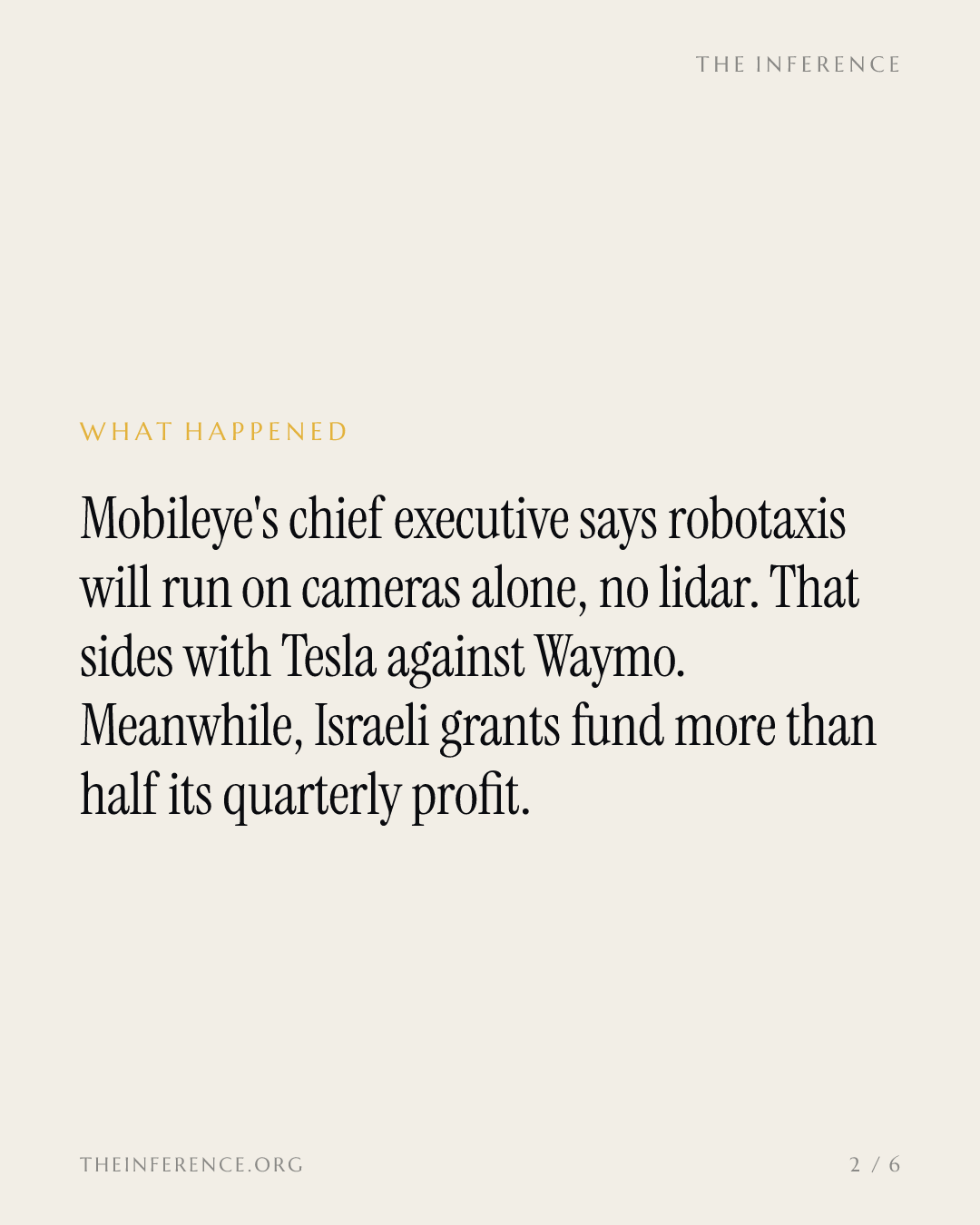
Mobileye's chief executive told investors robotaxis will eventually run without lidar, siding with Tesla against Alphabet's Waymo. The bill falls on a chip business whose quarterly adjusted profit leaned on $51 million of Israeli research incentives.
 Vincent Jiang · 3 min read
The call that picked a side
Mobileye+0.88% — Mobileye, up 0.88 percent today, the Jerusalem driver-assistance chipmaker in which Intel+2.70% — Intel, up 2.70 percent today still holds majority ownership 1, picked a side on its October 29 earnings call: "Our bet is on cameras and imaging radar. We believe that, in the long run, LiDAR will not be necessary," chief executive Amnon Shashua said 2. No date came with the bet; the imaging-radar program is seven years old 2.
The destination is Elon Musk's camp: he has called lidar, the laser-ranging sensor carried by most robotaxis, "a crutch" 3. Waymo, Alphabet's+0.45% — Alphabet, up 0.45 percent today robotaxi operator, holds the other side, arguing in August from more than 200 million driverless miles that "cameras are incredible, but they aren't enough" 3. If the bet pays, the robotaxi bill of materials shifts toward camera and imaging-radar suppliers and away from lidar makers, and it would be set by a company whose EyeQ chips have shipped in more than 230 million vehicles 1.
More than half the profit is a grant
The chip business paying for the bet is losing price. Third-quarter revenue fell 2 percent to $492 million 4, and revenue per system dropped 5 percent as Chinese automakers bought lower-software kits, a mix that alone cut average selling price by about $1 25. Adjusted operating profit rose 20 percent to $89 million, but $51 million of it was research credits under Israel's new R&D incentive law 25. Customers funded less than half the quarter's profit; the state of Israel funded the rest.
The full-year adjusted target of about $400 million embeds roughly $190 million of such credits, a grant share The Inference flagged on October 31, when a beat-and-raise still bought a 52-week low 5.
Two years without growth: Q3 2026 revenue sits below Q3 2025
- Quarterly revenue
- Estimate
Data
| Quarterly revenue | |
|---|---|
| Q4 '23 | $637M |
| Q1 '24 | $239M |
| Q2 '24 | $439M |
| Q3 '24 | $486M |
| Q4 '24 | $490M |
| Q1 '25 | $438M |
| Q2 '25 | $506M |
| Q3 '25 | $504M |
| Q4 '25 (estimate) | $446M |
| Q1 '26 | $558M |
| Q2 '26 | $508M |
| Q3 '26 | $492M |
Nine lidars a car, for now
The declared future argues with the present. Every Mobileye Drive robotaxi carries nine InnovizTwo lidars from Innoviz−0.26% — Innoviz, down 0.26 percent today, the platform's lidar supplier, and Innoviz sizes that ramp at more than 150,000 units, a pipeline the declaration puts on the wrong side of Mobileye's own bet 6. Orlando is slated for roughly 100 vehicles with no safety drivers in 2027, toward about 17,000 over five years, with Miami to follow 27. Hamburg's public rides still carry safety drivers, and Norway has approved deployment 4.
Volume keeps rising beneath the bet: nine-month EyeQ shipments grew 11 percent while global vehicle production slipped about 1 percent 24, and the Road Experience Management (REM) crowdsourced map database behind the strategy draws on about eight million cars 2.
A record low against a raised floor
Investors treated the raised revenue floor, $1.995 billion against a prior $1.97 billion 24, as detail. The shares fell 9 percent to a record low of $6.37 on report day 8, the slide the October 31 report caught, and kept falling: the delayed quote on the company's investor page read $5.65 on November 3 1. That is within 65 cents of RBC's pre-report $5 target and far under the $9.36 average Mobileye paid in its April-launched buyback 5.
Two dates now decide the bet: driverless Orlando rides through 2027, and 2028, when Surround ADAS at roughly twice base pricing and Chauffeur at about $2,500 a vehicle are scheduled to lift content per car 5. Until one arrives, more than half of Mobileye's adjusted profit comes from Israel's incentive law, not from any carmaker.
Get Chips by email, free
How AI demand is reshaping chipmakers, memory and the fabs behind them. In our daily email, every weekday.