The Claude Fee Turns AI Inside Salesforce Into a Line Item Customers Can Cap
The Information reports Salesforce will charge separately for Anthropic's Claude inside its apps, with no rate card published. The visible model price is the first crack in the bundled AI invoice, just as the seat it replaces is shrinking.
 Richard Tang · 2 min read

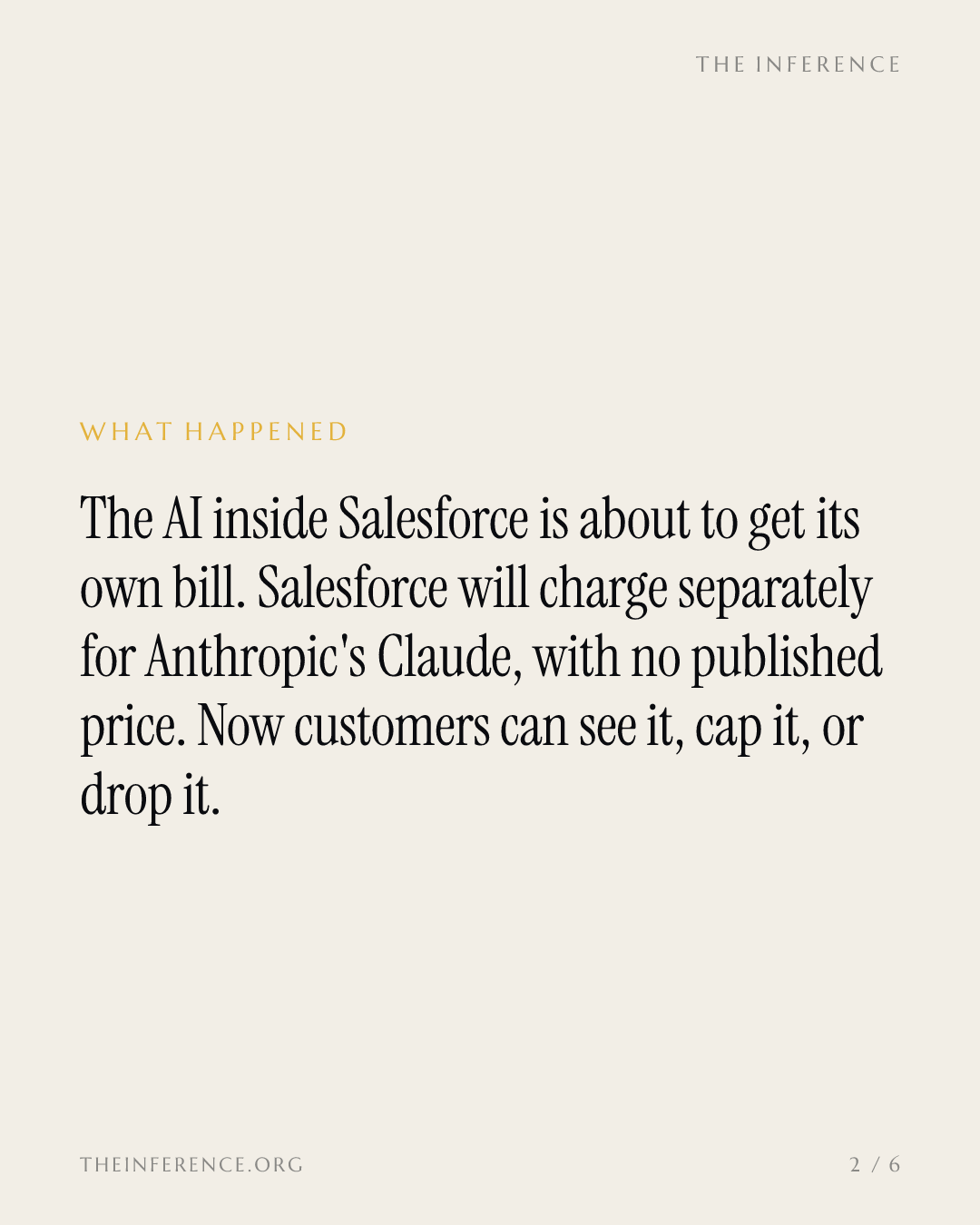
Salesforce−1.39% — Salesforce, down 1.39 percent today will charge customers a separate fee to run Anthropic's$350B — Anthropic, private, latest valuation $350B Claude inside its apps, The Information reported on October 22, and no rate card exists yet 1. That makes the AI inside a CRM a visible line item for the first time, at a price nobody has published. Salesforce rose 3.5% on the day while the Nasdaq fell on AI financing worries, so the market read it as pricing power 2.
Three prices for one worker
Until now a customer bought a seat and the AI rode inside it. Now one knowledge worker carries three prices: the seat, the premium AI edition, and the model's meter. Only 5% of the sales and service users on Salesforce's products have paid up for those editions, which sell at a 60 to 80% premium, even as Agentforce's annual recurring revenue reached $1.5 billion 2.
Three camps, three invoices
Each camp wants a different invoice. Salesforce needs the AI price visible because Claude is a cost inside its margin, and a pass-through turns that cost into revenue. Anthropic wants its name on the customer's invoice rather than wholesale inside Salesforce, so the model's value is priced on its own terms. The customer wants one invoice, and once the agent becomes a metered utility, it can cap usage or drop the meter entirely.
This is the pricing choice our October 21 piece said the argument turned on; it has now partly been made, on Anthropic's side of the ledger 3.
The seat the fee replaces is shrinking
A Bank of America−0.66% — Bank of America, down 0.66 percent today note dated October 20 cut CRM market growth from 14% to 11% once agents displace seats, and put about $116 billion of spending moving into agent applications by 2030, with annual erosion reaching $79 billion in 2030 4.
Bank of America projects annual erosion from agent applications reaching $79 billion by 2030
- Annual spending shifted to agent applications
- Estimate
Data
| Annual spending shifted to agent applications | |
|---|---|
| 2026 (estimate) | $0.4B |
| 2027 (estimate) | $2B |
| 2028 (estimate) | $11B |
| 2029 (estimate) | $25B |
| 2030 (estimate) | $79B |
SAP−0.77% — SAP, down 0.77 percent today answered the same customer anxiety differently. Its CFO told Reuters that clients now ask where the AI in their software was built, and SAP embeds more than 70 models from different providers, so customers can pick or swap models on sovereignty grounds 5. Salesforce has tied its AI revenue to one named model whose price it passes through; SAP stays agnostic and sells the choice.
December decides which line the fee lands on
The fee itself is still unknown: no size, no terms, no word on who absorbs it. That makes December's fiscal Q3 report the test 2. If Claude-in-Salesforce shows up as revenue, the visible price works; if it shows up as churn, the customer's cap on the meter becomes Salesforce's problem. Watch which line it lands on.
What happens next
CRMDoes Claude-in-Salesforce show up as revenue, or as churn from customers capping the meter?
The case for
A pass-through turns Claude from a cost inside Salesforce's margin into recognized revenue
The case against
Only 5% of sales and service users have paid up for the premium AI editions that carry the agent
- December 2026Salesforce fiscal Q3 earnings report.
Get our follow-up when these land
Free. We'll email you when we publish on Salesforce, and send our free weekday newsletter. Unfollow in one click.