Tokyo sold SCREEN's second half before it ships
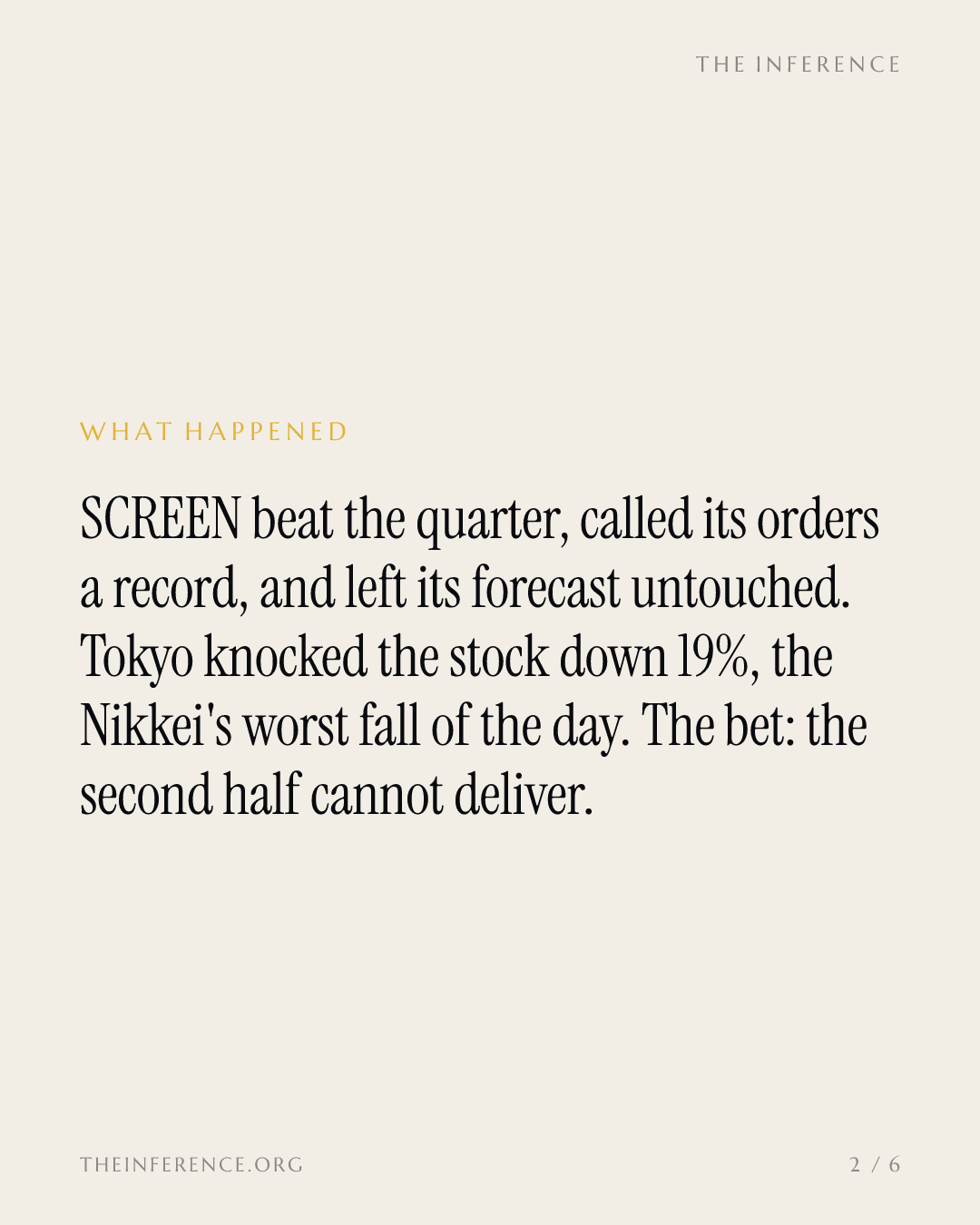
The wafer-cleaning toolmaker posted a 35% revenue quarter and record orders, then took the Nikkei 225's worst fall of the day. The gap between the demand it can see and the profit it has booked is the entire trade.
 Vincent Jiang · 3 min read
Tokyo's worst fall came off a record quarter
SCREEN Holdings−18.96% — SCREEN Holdings, down 18.96 percent today, the Kyoto company whose wafer-cleaning tools run inside chip plants worldwide, closed November 2 at ¥9,218, down 18.96%, the steepest decline of any Nikkei 225 component that session 12. The fall landed two trading days after the company reported September-quarter revenue of ¥186 billion, up 35% year on year, at a 22% operating margin, a 558-basis-point improvement 3, and after management called its order intake a record 4.
On October 30, when the Nikkei slid as much as 3% on worries over the sustainability of AI spending, Lasertec+8.01% — Lasertec, up 8.01 percent today was the named equipment loser, down 8.8%, and SCREEN was not among them 2. Two sessions later the positions reversed: Lasertec rose 8.01% and SCREEN took the index's worst fall 1. The market did not dispute the quarter just delivered. It repriced the six months still to be earned.
The forecast has not moved, and that is the problem
First-half results were strong: sales of ¥308.453 billion, up 12.5%, and operating profit of ¥54.523 billion, up 17.4% 5. Guidance stayed at ¥743 billion of sales and ¥156.5 billion of operating profit for the year ending March 2027 5.
The arithmetic that follows is the selloff's engine: the second half must earn ¥101.977 billion of operating profit, 1.87 times the first half, at a 23.47% margin against the 17.68% just booked 1. Meanwhile first-half operating cash flow ran negative as inventory and other working capital drained 6, and the company concedes installation timing pushed some revenue into later quarters 4.
Guidance asks for ¥102B of operating profit in the second half, 1.87 times the ¥54.5B just earned
- Operating profit
- Estimate
Data
| Operating profit | |
|---|---|
| H1 FY27 actual | ¥54.5 |
| H2 FY27 guided (estimate) | ¥102 |
| FY27 guided (estimate) | ¥156.5 |
The sellers' exhibits sit in the company's own filings
The bear case needs no speculation. Operating cash flow went backwards in the half while profit grew 6. The new capacity built for the demand boom, the ¥25 billion Nagaokakyo plant, starts producing wafer-cleaning equipment in January 2028 7, a fiscal year after the guidance now being priced. Foundry demand weakened even as DRAM strengthened, and sales mix shifted toward the United States and Korea and away from Taiwan 1. Every point of the required margin jump must come from tools already delivered but not yet accepted and invoiced.
The buyers' exhibits are contracts, not forecasts
SK hynix+3.15% — SK hynix, up 3.15 percent today, the Korean memory maker, said in late October that long-term agreements cover more than half of its 2027 and 2028 production capacity across 14 major customers, and it named SCREEN at its first Japan Partners Day among the suppliers invited to plan ahead with it 8.
SCREEN's own view of the wafer-fab-equipment market rose to $155 billion for 2026 and $200 billion for 2027 3. Its semiconductor production equipment segment grew on DRAM demand and post-sales service 5, and management says this year's capacity investment aims squarely at next fiscal year's demand 4.
A cheaper multiple is not automatically a bargain
At ¥9,218 the shares trade at 15.17 times company-guided earnings, against Lasertec's 40.59 times; both figures come from dividing the November 2 close by each company's own published per-share earnings forecast 1. The contrast sharpens the point: Lasertec's latest quarter showed operating profit down 41%, and its stock rose 8.01% the same day 1. A cheaper multiple is not automatically a bargain when the plan behind it asks for an 87% profit acceleration inside six months 1.
The next two quarterly reports settle this argument
The test is conversion, not demand. Watch the next two quarterly reports: if second-half recognized sales and margin climb toward the implied 23.47% 1, Monday's fall was a bet on timing; if orders keep landing without becoming revenue, or foundry stays weak, the ¥101.977 billion second-half target is exposed and the discount was earned 1.
The guided second half needs a margin 5.79 points above the one just reported
- Estimate
Data
| Value | |
|---|---|
| H1 FY27 actual | 17.68% |
| FY27 guided, calculated (estimate) | 21.07% |
| H2 FY27 implied (estimate) | 23.47% |
Get Chips by email, free
How AI demand is reshaping chipmakers, memory and the fabs behind them. In our daily email, every weekday.