Visa's $25 billion stablecoin run rate comes with no revenue figure, and renewals decide 2027
Visa's $25 billion stablecoin run rate carries no disclosed revenue, while the fiscal 2027 guide, client renewals and rising incentives set the real numbers. This week's pop priced the narrative, not the stablecoin business.
 Richard Tang · 3 min read
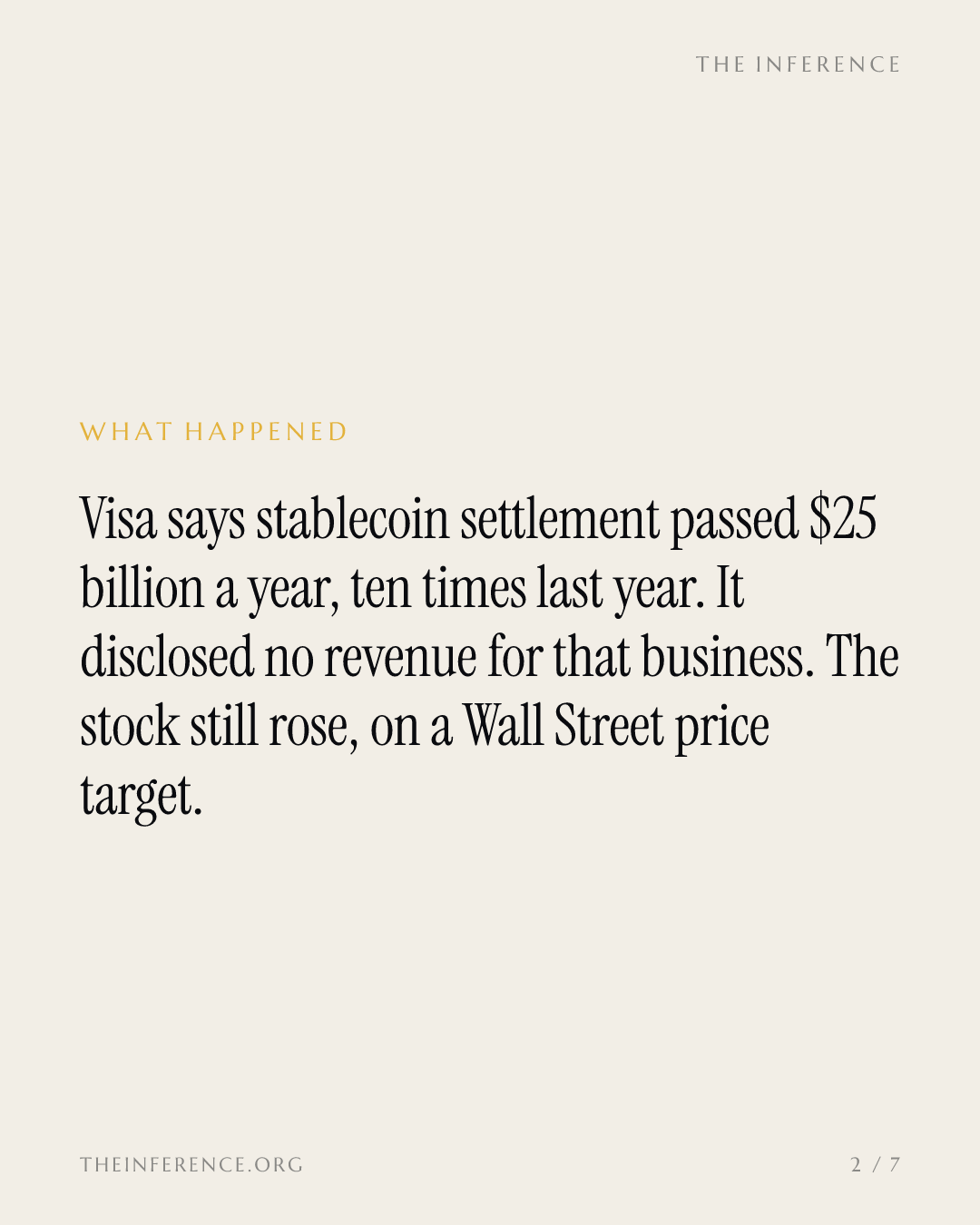
Visa−0.72% — Visa, down 0.72 percent today closed its fiscal year with record revenue of $46 billion, up 15%, then spent the following week repricing on businesses that carry no dollars yet 1. On October 27, CEO Ryan McInerney said stablecoin settlement passed a $25 billion annualized run rate, ten times a year earlier, with more than 225 stablecoin-linked card programs 1. Crypto press cheered the growth. Nobody asked what it earns.
Visa counts the hedge in partners, not dollars
That silence is the point. Visa counts this business in volumes, partners and blockchains: five stablecoins on ten chains, validator seats on the challenger chains Tempo and Canton, an invitation to Circle's Arc 1. No revenue figure was disclosed.
Value-added services, the line Visa does count in dollars, did $14 billion, up 30% 2. Against $46 billion of revenue, even healthy fees on $25 billion of settlement are rounding error today 2. The stablecoin build is positioning for a settlement standard that has not been decided, and Visa is buying its seat at the table early.
The counted line is $14 billion; the stablecoin bar is a run rate, not revenue
- Estimate
Data
| Value | |
|---|---|
| FY26 revenue | $46B |
| Value-added services | $14B |
| Stablecoin run rate (estimate) | $25B |
Why validating the rival rails is the right move
The hedge is rational. Regulators are pushing account-to-account and open-banking rails that bypass card interchange entirely, and Visa's own risk list names that disintermediation 3. By validating the chains that threaten it, Visa keeps a toll position whichever settlement standard wins. That is a network defending its chokepoint, and it is the right move.
The pop came from analysts, the guide says otherwise
The stock rose about 3% on November 2, and the move came from Wall Street, not stablecoin: Cantor Fitzgerald, the brokerage and research firm, raised its price target on Visa to $500 from $445 34. Meanwhile the fiscal 2027 guide steps down to low double-digit revenue growth, roughly a quarter of payments volume comes up for client renewal versus about a fifth last year, and incentives paid to bank partners grew 21% to $5.12 billion, faster than revenue 23. Renewals and incentives, not stablecoin volume, decide fiscal 2027 23.
Fiscal 2026 grew 15%, the fastest in years; the fiscal 2027 guide steps back to low double digits
- Revenue
- Estimate
Data
| Revenue | |
|---|---|
| FY2021 | $24.1B |
| FY2022 | $29.3B |
| FY2023 | $32.7B |
| FY2024 | $35.9B |
| FY2025 | $40B |
| FY2026 | $46B |
| FY2027 (estimate) | $51.3B ($50.6–52.0B) |
Agentic commerce is the same hedge in miniature
Agentic commerce is the same story. Only 23% of US consumers trust AI to pay on their behalf, but 61% trust Visa to secure such a payment 5.
Mastercard−1.19% — Mastercard, down 1.19 percent today is building the same position: a partnership with OpenAI around its Agent Pay product 6, and a memorandum of understanding with Tencent's TenPay Global to explore agentic payments through Agent Pay and Agent Connect 7. Whoever owns the agent, the networks want to be the trust layer it pays through. Watch the renewal cohort and the incentive line, and treat the 10x stablecoin number as positioning until it shows up in dollars 123.
Get Economy by email, free
How AI moves rates, banks, payments and the wider economy. In our daily email, every weekday.