Zebra Technologies beat and raised guidance, but a $145 million memory bill sent the stock down 9%
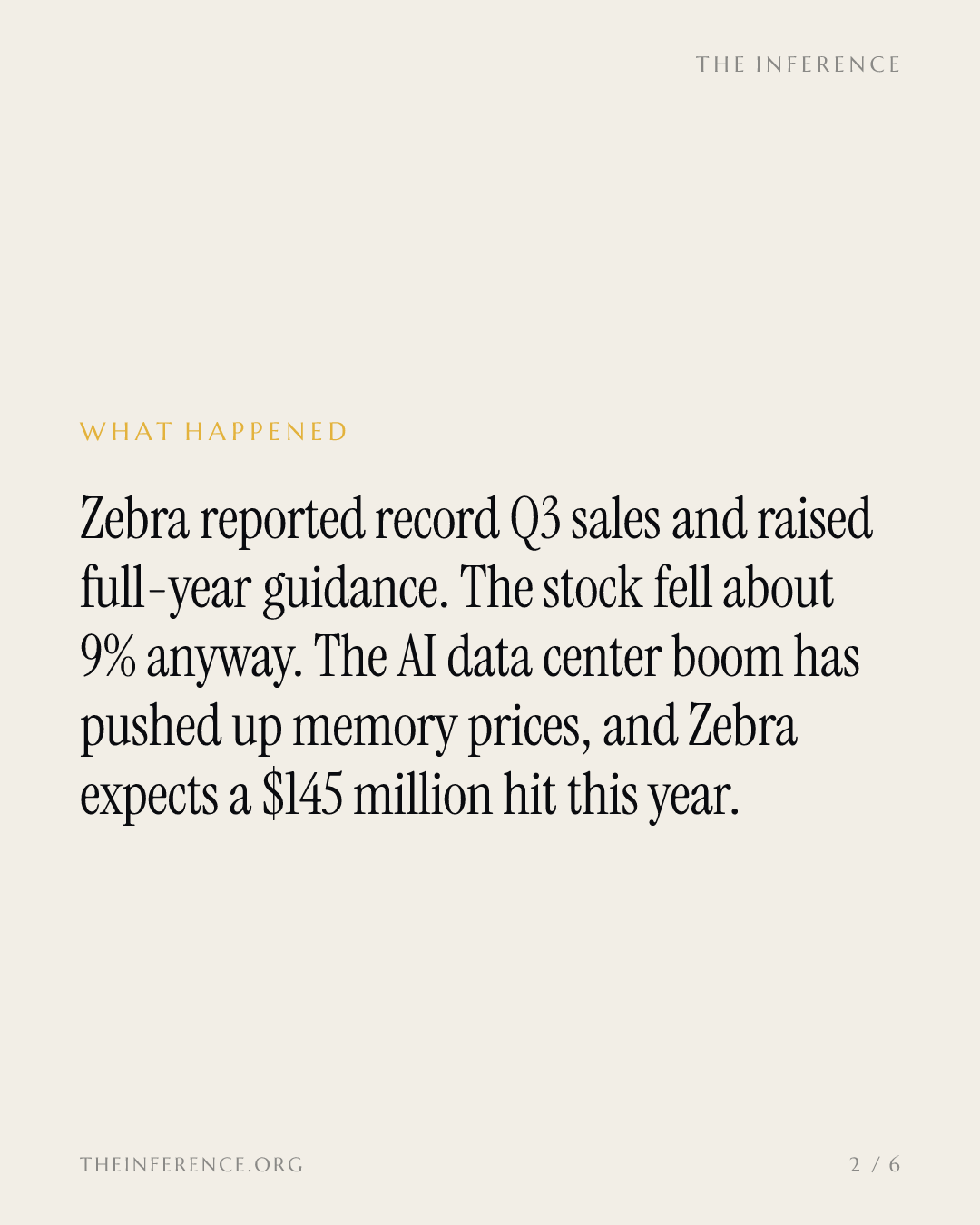
Zebra beat and raised on November 3, then the stock fell about 9% anyway: the market is not yet convinced the price increases Zebra is pushing to cover the $145 million memory bill will hold through 2027 renewal and refresh negotiations.
 Vincent Jiang · 3 min read
Zebra Technologies+0.89% — Zebra Technologies, up 0.89 percent today makes the barcode scanners, warehouse mobile computers and machine-vision gear that carry "physical AI" to the frontline, and on November 3 it reported a record third quarter: net sales of $1,614 million, up 22.3% year over year (11.3% organic), with non-GAAP diluted EPS of $4.95, up 27.6% 12. It raised full-year guidance to about 17% sales growth 12. The stock fell anyway, closing at $329.50, down 8.76%, after trading down as much as 12.69% 23.
Zebra's record Q3: sales up 22.3%, EPS up 27.6%
Data
| YoY growth | |
|---|---|
| Net sales | 22.3% |
| Organic sales | 11.3% |
| Non-GAAP EPS | 27.6% |
The reason is the memory bill. The AI data center buildout has pushed DRAM prices up the whole stack, and Zebra now expects a $145 million full-year memory cost headwind, raised $25 million from its prior estimate entirely because mobile computer volume ran hotter 23. In Q3 the company ate roughly $50 million of memory cost and recovered only about $25 million in price; adjusted gross margin fell 220 basis points to 46.0% 12.
CFO Nathan Winters' bridge has to hold
Winters says the bill is fully offset dollar for dollar, this year and next: about 1.5 points of pricing, led by a roughly 15% October increase on mobile computers, covers about $90 million; the other $55 million comes from restructuring savings, tariff relief and operating-expense productivity 2. Zebra is also hoarding ahead of the curve: inventory rose about $90 million in the quarter, entirely memory supply, and it has qualified five new memory suppliers with two more expected in 2027 23.
Pricing covers about $90M of Zebra's $145M memory bill
Pricing covers $90M of Zebra's $145M memory bill; $55M rides on one-off levers
Data
| Value | |
|---|---|
| FY memory bill | 145 |
| Pricing covers | 90 |
| Other levers | 55 |
The bull case: supply, not demand, was the cap
The bull case is management's own: prior guidance was capped by memory supply, not demand, and with supply secured, a multiyear transport-and-logistics refresh beginning in 2027 should push growth to the high end of Zebra's 5-7% long-term range 23.
The bear case: pricing only covers half the bill
The bear case is the market's: Q3 pricing recovered only half the cost, the rest came from one-off levers, and a 15% increase has to survive 2027 negotiations where Zebra must still win the largest logistics deals against vendors making the same price argument 2. CEO Bill Burns concedes customers "don't like the price increases," but says they have to invest 2.
The mechanics of the risk are simple: memory costs are expected to keep rising into the first half of 2027 23, so any customer who stalls a refresh or splits an order at the old price leaves Zebra eating the difference while rival device makers, facing the same memory bill, offer their own increases as cover.
Fifteen and a half times earnings pays for growth, not the pricing risk
What does the 9% drop actually assume 13? The arithmetic is on the page: $329.50 divided by the $21.20 full-year non-GAAP EPS guidance at the Q4 midpoint 13 equals about 15.5x forward earnings, a multiple that pays for the growth but little of the pricing risk.
The concrete test is 2027: whether the 15% increase survives the transport-and-logistics refresh negotiations and whether memory prices moderate in the back half of the year as Winters expects 23.
Get Robotics & Defense by email, free
Robots, self-driving vehicles, drones and AI in defense. In our daily email, every weekday.