Cerebras faces its November unlock down 72% with a $25.4 billion backlog resting mostly on OpenAI
Cerebras Systems (Nasdaq: CBRS) closed October 30 at $109.18, about 72% below its post-IPO high. The final lockup tranches open November 9 and 10 and earnings land November 12, over a $25.4 billion backlog that is mostly one OpenAI contract.
 Vincent Jiang · 3 min read

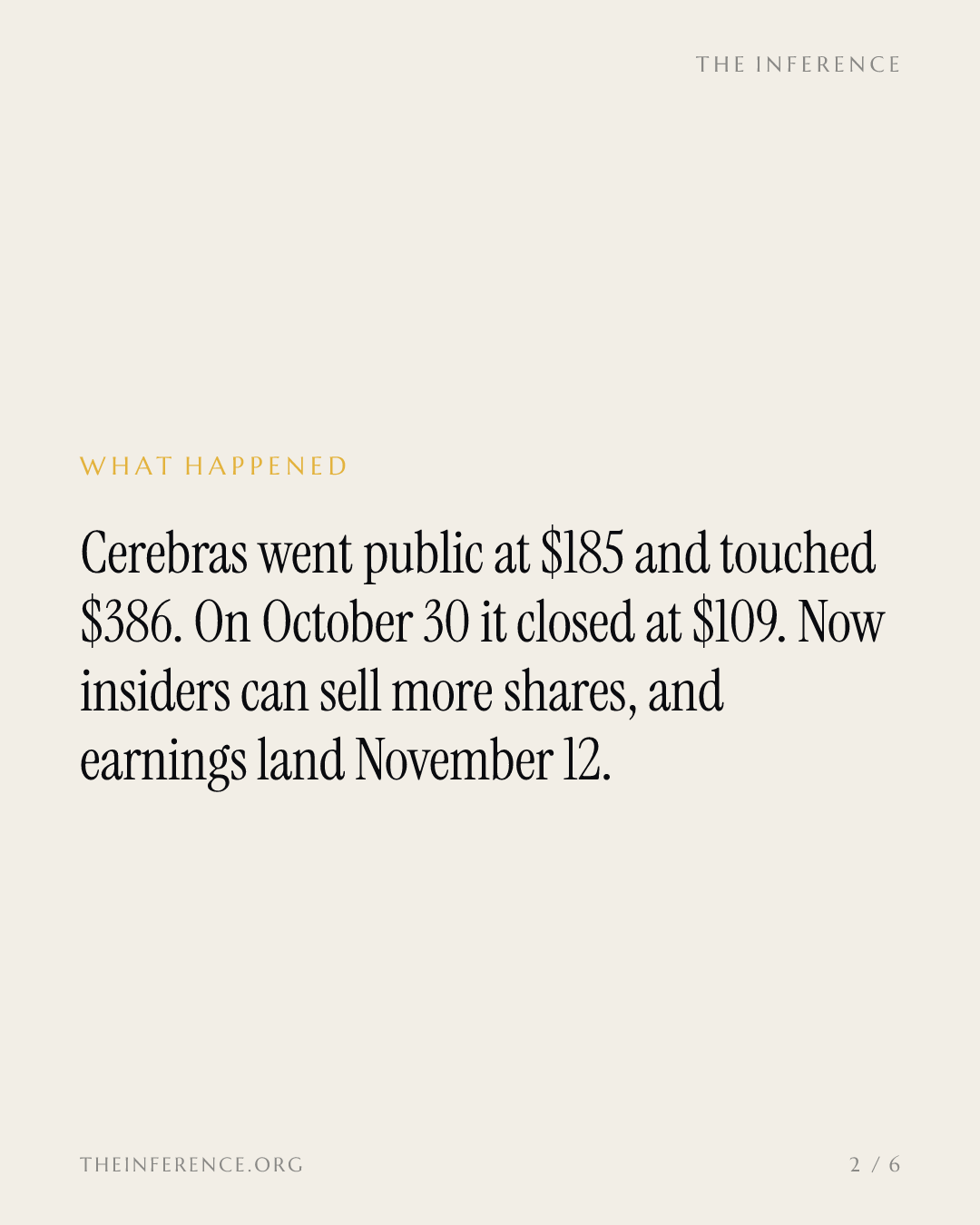
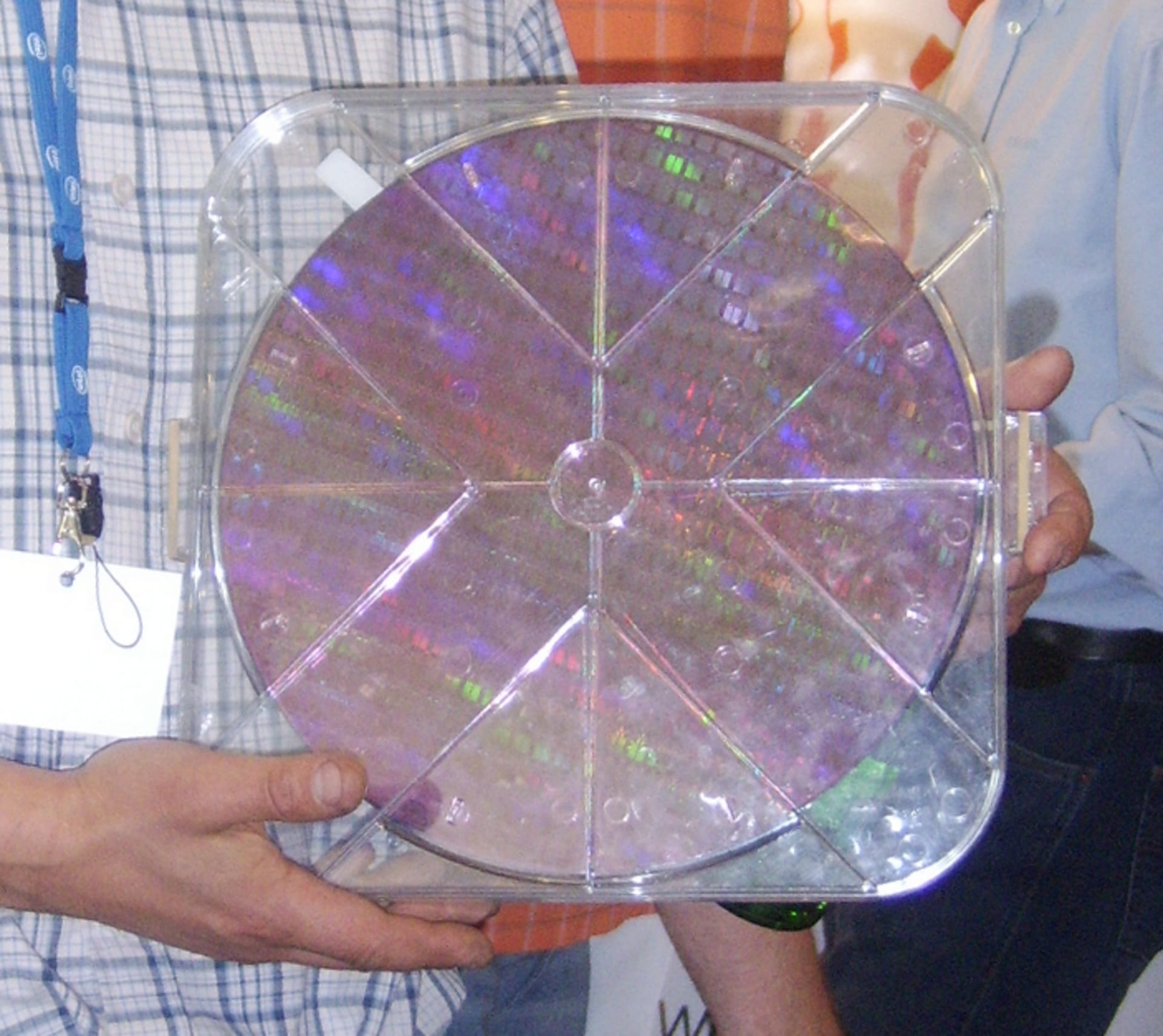
Cerebras Systems−9.34% — Cerebras Systems, down 9.34 percent today (Nasdaq: CBRS), which fuses compute and memory onto a single silicon wafer into one chip roughly 50 times the size of a GPU 3, priced the biggest AI IPO of the year at $185 a share on May 14, raised $5.55 billion and closed its first day at $311.07 1.
The stock later peaked at $386.34; on October 30 it closed at $109.18, roughly 72% below that high and back under its offer price 1. The next two events are already dated: the staggered 180-day lockup releases its final tranches around November 9 and 10, and third-quarter results land after the close on November 12 13.
Insiders sold before the door opened
Chief Technology Officer Sean Lie sold more than 710,000 shares for about $147.6 million on August 20 under a pre-set 10b5-1 trading plan, with further sales through October 1. When a lockup tranche expired on September 30, roughly 19.4 million shares became sellable and two officers filed notices covering $84.3 million of stock: Chief Operating Officer Dhiraj Mallick and finance chief Robert Komin Jr. 2
Another 19.4 million shares turned eligible the day the short seller struck 4. A Form 144 records an intent to sell; only a later Form 4 confirms an executed sale, and those filings will show what actually changed hands 2.
The quarter underneath the slide
Second-quarter revenue rose 74% to $180.1 million, but gross profit fell 20% to $25.6 million, stock compensation hit $377 million and the net loss reached $450.5 million 1. Capital spending ran to $416.9 million in the quarter and $548.9 million across the first half, mostly cloud systems 53. Gross margin, up from 11.7% in fiscal 2022 to 42.3% in fiscal 2024, slipped to 39.0% in fiscal 2025 6.
Capex now outruns revenue while gross profit collapses
- Revenue
- Gross profit
- Capex
Data
| Revenue | Gross profit | Capex | |
|---|---|---|---|
| Q1 '25 | $99.51M | $41.6M | $98.24M |
| Q2 '25 | $103.32M | $32.1M | $86.85M |
| Q4 '25 | — | — | — |
| Q1 '26 | $193.41M | $86.18M | $131.97M |
| Q2 '26 | $180.11M | $25.56M | $416.9M |
Two camps and no verdict
Culper Research, a short seller that disclosed its position on October 28, claims the wafer-scale processors fail after 18 to 30 months in service, run continuous dummy operations to keep from cooling, and use a connector material developed in the 1980s 47. Its sharpest point comes from Cerebras's own paperwork: draft IPO filings through December 2025 gave the systems useful lives of 1.5 to 3 years; four months later the range was 3 to 5 years, with no explanation 6. Longer lives mean lower depreciation and fatter margins 6.
Three law firms, Levi & Korsinsky, Bronstein Gewirtz & Grossman and Johnson Fistel, have announced securities investigations; none is a finding 7. Chief Executive Andrew Feldman's answer so far is millions of production hours, cited on August 12 7. The other side is buying.
ARK Invest, the fund group run by Cathie Wood, bought 45,729 shares after the report surfaced 8. Eleven analysts carry a consensus strong-buy rating with an average target near $283 1. An Oracle Cloud channel lifted the stock 10%; it goes live in 2027 with no disclosed contract value, on a shelf shared with Nvidia+1.44% — Nvidia, up 1.44 percent today, Google's TPU AI chips and SambaNova$11B — SambaNova, private, latest valuation $11B 9.
What settles it on November 12
The bull case is $25.4 billion of contracted but unrecognized revenue, and most of it is one contract: a December 2025 master agreement under which OpenAI committed to buy 750 megawatts of inference capacity, worth more than $20 billion 1. About 22% of the backlog is expected to be recognized in the first 24 months from June 30 1.
Whoever catches November's unlocked shares is underwriting that promise. The November 12 print tests it against guidance of $214 to $216 million in third-quarter core revenue 2, while the forecast of core gross margin above 60% for 2027 rests on the very depreciation assumption Culper attacked 7.
Get Chips by email, free
How AI demand is reshaping chipmakers, memory and the fabs behind them. In our daily email, every weekday.