China Resources Micro says AI servers hit the power wall before the GPU wall, Q3 results Oct. 30
CR Micro chairman He Xiaolong told a Shenzhen expo that power conversion, not compute chips, now caps how far AI servers can scale, and his company has a silicon-carbide part built for that exact job, sampling now. The first hard count of whether it pays lands with third-quarter results on October 30.
 Vincent Jiangthree-minute read

The chip that decides how many AI servers China can build this decade may not be a GPU. At the Bay Area Semiconductor expo in Shenzhen, held October 14 to 16, He Xiaolong, chairman of China Resources Microelectronics−3.84% — China Resources Microelectronics, down 3.84 percent today (CR Micro), the country's largest power-device maker 3, told the industry the binding constraint on AI servers is no longer the compute chip: power-conversion efficiency and supply-architecture upgrades are "the core key" to scaling the next generation of AI servers 12.
A traditional cloud rack drew about 12 kilowatts; current racks commonly run in the 100-kilowatt class, and AI racks burn past 130 13.
AI racks draw ten times the power of a traditional cloud rack
Data
| Rack power | |
|---|---|
| Traditional cloud rack | 12 kW |
| Current racks | 100 kW |
| AI racks | 130 kW |
Every fix runs through a power chip
He named four shifts: 800-volt high-voltage DC supply; commercial solid-state transformers, which convert 10-kilovolt medium-voltage AC straight to 800-volt DC at better than 98.5% efficiency; vertical power delivery mounted beneath the processor; and wide-bandgap materials such as silicon carbide (SiC) and gallium nitride (GaN) 1.
Market-research firm Yole, cited at the expo, sizes global power-semiconductor sales at $28.9 billion in 2025, rising to $43.3 billion by 2030 1. A Dadong Times think-tank forecast puts the solid-state-transformer niche at RMB 2.7 billion this year and RMB 91.5 billion in 2030, with AI datacenters in about a fifth of new installations by then 1.
The chip built for the job is still a sample
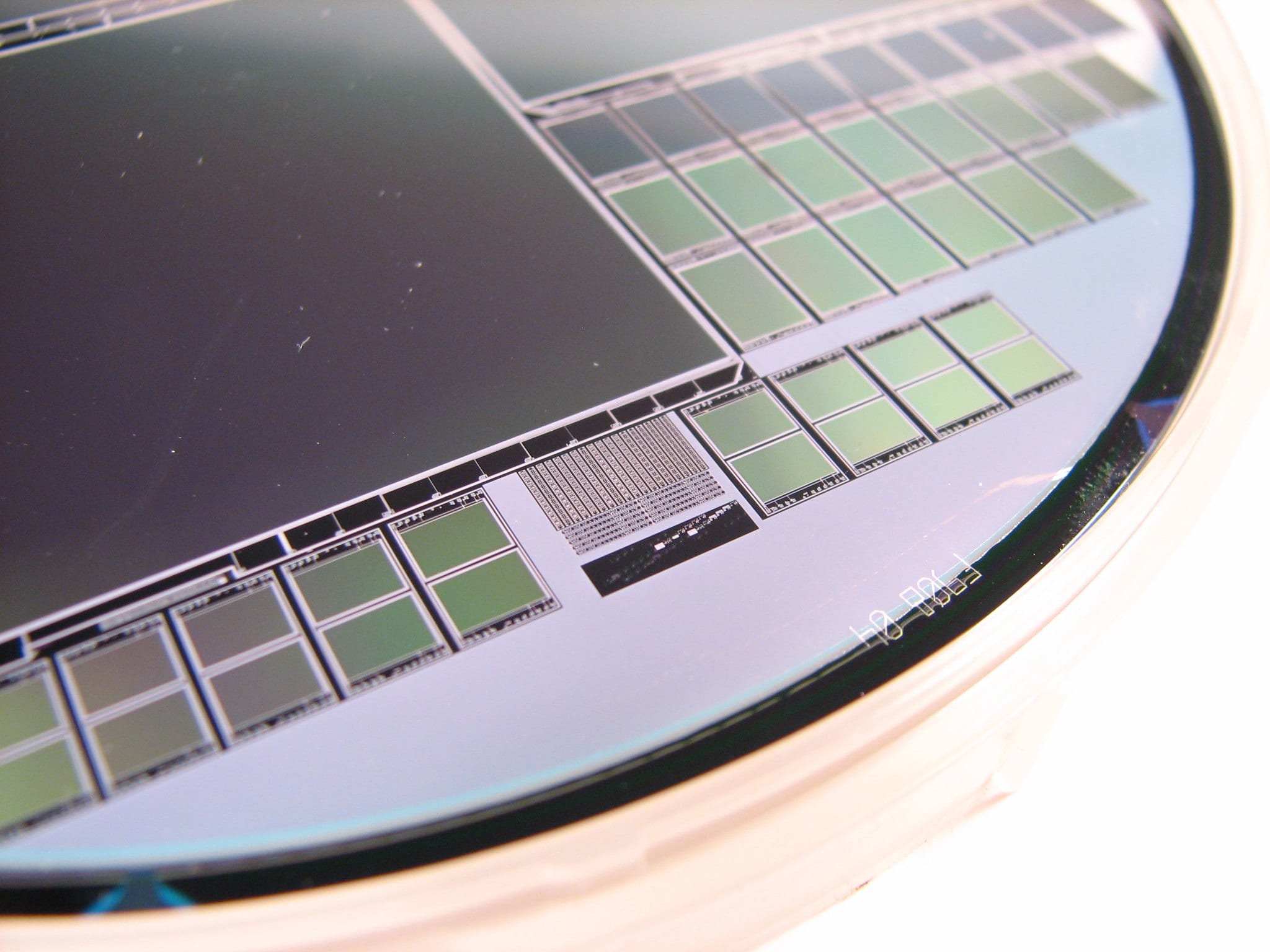
CR Micro, ninth among the world's power-device firms and first in China, is an integrated device manufacturer: it designs and makes its own chips on 6-, 8- and 12-inch lines 13. Its October 9 investor-relations record is the substance behind the speech 3.
First-half SiC device and module revenue more than doubled year on year, and an integrated SiC MOSFET, a power-switching transistor custom-built for AI compute power supplies, has passed evaluation and is sampling 3. The caveat sits in the same record: 85% of that SiC revenue came from cars and energy storage, not AI 3.
Its MOSFET, SiC and GaN parts already supply leading cloud providers, server makers and power-supply manufacturers, and its SiC ships in datacenter solid-state transformers today 3. The AI-server power board has been Western incumbents' ground: onsemi+0.78% — onsemi, up 0.78 percent today, Infineon and STMicroelectronics+4.53% — STMicroelectronics, up 4.53 percent today are the firms pushing through 2026's global power-chip price increases 4. If power delivery, not the GPU, caps the buildout, value shifts to whoever supplies that board; if not, the SiC push is a capital-hungry side bet on an auto-led cycle.
Full fabs, an undecided market
The first half delivered RMB 6.128 billion of revenue, up 17.44%, and net profit of RMB 722mn, up 113.23%, with lines full and nine months of order visibility 34. Broker China Post Securities upgraded the shares to Buy on October 9 4; they slid anyway. The stock closed at CNY 55.10 on September 30, when it traded at 69.75 times trailing earnings 5, and closed 3.01% lower at CNY 48.32 on October 14 6. By October 22 it had recovered to CNY 51.00 7, still half its 52-week high of CNY 101.99 5.
Revenue is climbing into the October 30 test
- Quarterly revenue
- Estimate
Data
| Quarterly revenue | |
|---|---|
| Q3 2025 | RMB 2.85B |
| Q2 2026 | RMB 3.27B |
| Q3 2026 est. (estimate) | RMB 3.47B |
The stock sits at half its 52-week high even with seven bullish analysts
Data
| Closing price | |
|---|---|
| Sep 30 | CNY 55.1 |
| Oct 14 | CNY 48.32 |
| Oct 22 | CNY 51 |
The bear case is already on the record
A year ago the third quarter's net profit fell 14.7% 7. Peer Guangzhou foundry CanSemi raised RMB 6.16 billion in an IPO toward a third 12-inch line while losing RMB 1.14 billion in the first half, capacity funded at the top of the price cycle 4. And no disclosure yet shows the AI part winning volume orders.
The October 30 report prices the power story
Third-quarter results are expected on October 30 8. Three analysts see earnings per share of CNY 0.284 against 0.140 a year earlier; two see revenue up 21.56% to RMB 3.47 billion 8. Seven rate the shares Outperform, average target CNY 64.06 7. CR Micro has raised prices twice this year and said on October 20 the increases cover its wafer foundry too 49. Read against doubled precious-metal input costs 4, the gross margin in that report prices the whole power story in one number.
Get Chips by email, free
How AI demand is reshaping chipmakers, memory and the fabs behind them. In our daily email, every weekday.