HSBC's Islamic fund can't sell its $38 million Palantir stake; the S&P sharia screen owns the sell button
HSBC promised a swift review of its Islamic fund's $38.3 million Palantir stake after pressure from Nest and the People's Pension. But a passive index tracker cannot sell on its own: the real decision sits with an S&P sharia screen and the standard-setter behind it, and that is the flow event PLTR holders should price into Monday's print.
 Richard Tang · 4 min read
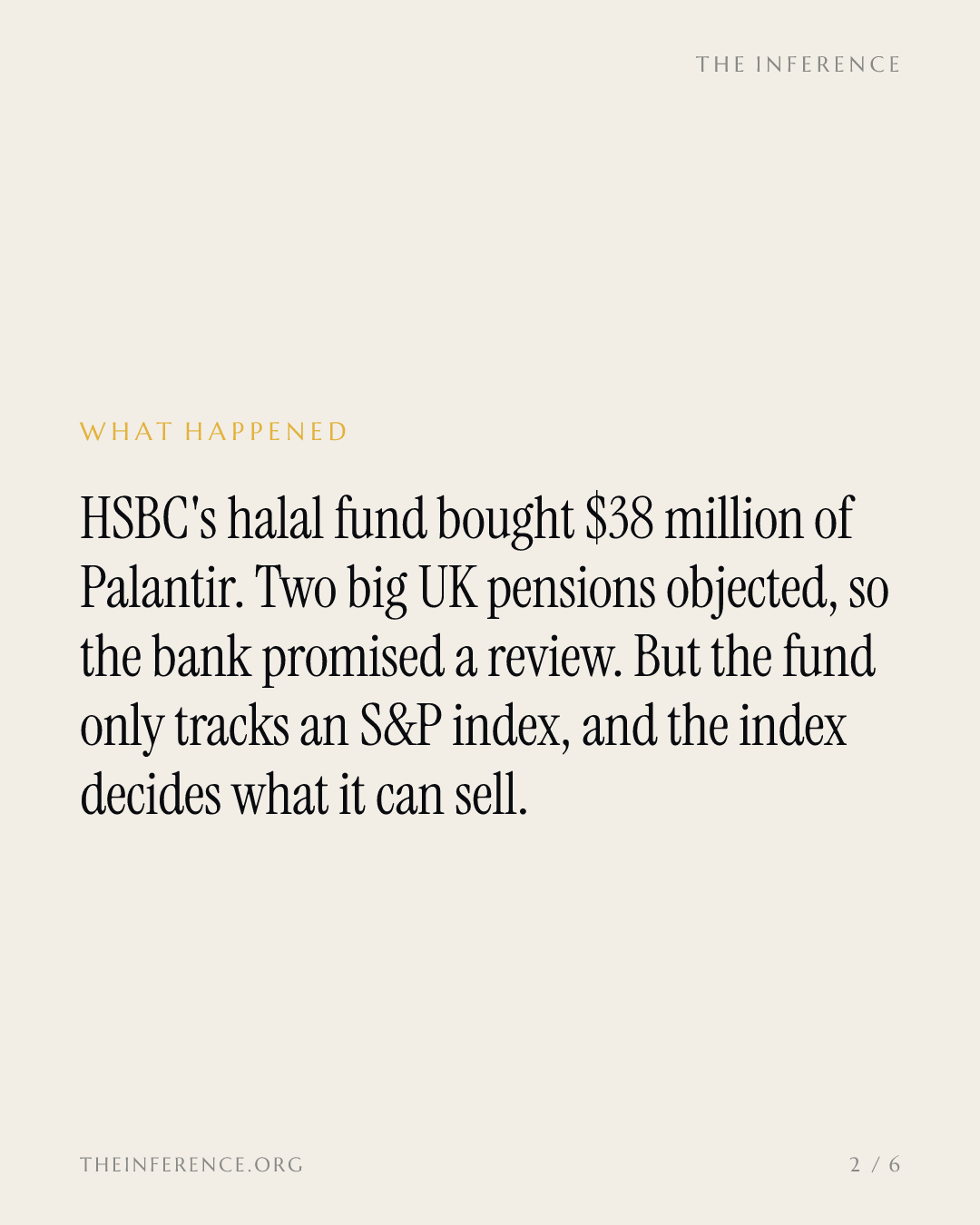
HSBC has promised a "swift" review of the Palantir shares held by its Islamic Global Equity Index Fund, the UK's largest halal fund, after two of Britain's biggest pension providers objected 1. The review sounds like HSBC holds the exit door. It does not.
The fund passively tracks the S&P Global+1.27% — S&P Global, up 1.27 percent today 1200 Shariah Select Index, a ready-made sharia screen it only adopted in March 1, so the bank can drop Palantir−5.94% — Palantir, down 5.94 percent today only by overriding the index or pressing S&P to change the screen 2. The real decision-maker is the methodology, and the fight over it has just moved into public.
The fund cannot sell what the index keeps
Hyphen revealed on October 13 that the fund bought $38,338,000 of Palantir shares in the first half of 2026 1. Nest, the UK's largest workplace pension provider, runs a sharia fund that had 33,139 savers as of July 2025 1. It put 70% of that money into HSBC's fund, and the People's Pension, with more than seven million members, also raised concerns 1. HSBC then said it would review the matter with independent expert advisers 3.
Sharia screening checks what a company sells, not what its customers do with it. A firm passes if little of its income comes from alcohol, gambling, weapons or interest, with tainted profits given to charity 1. Palantir fits that box as a technology company, even though it signed a strategic partnership with Israel's Ministry of Defense in January 2024 for "war-related missions" 1.
Two index houses, two answers on defense
The gap between providers is the point: S&P's standard sharia indices do not directly exclude defense companies, while Dow Jones Islamic Market indices do 4. A Durham University finance professor, Muhammed Ebrahim, told Al Jazeera the screens assess declared principal activities and do not trace a product's end use 4. In a passive fund, the screen is the portfolio manager.
The trigger sits with the standard-setter, not HSBC
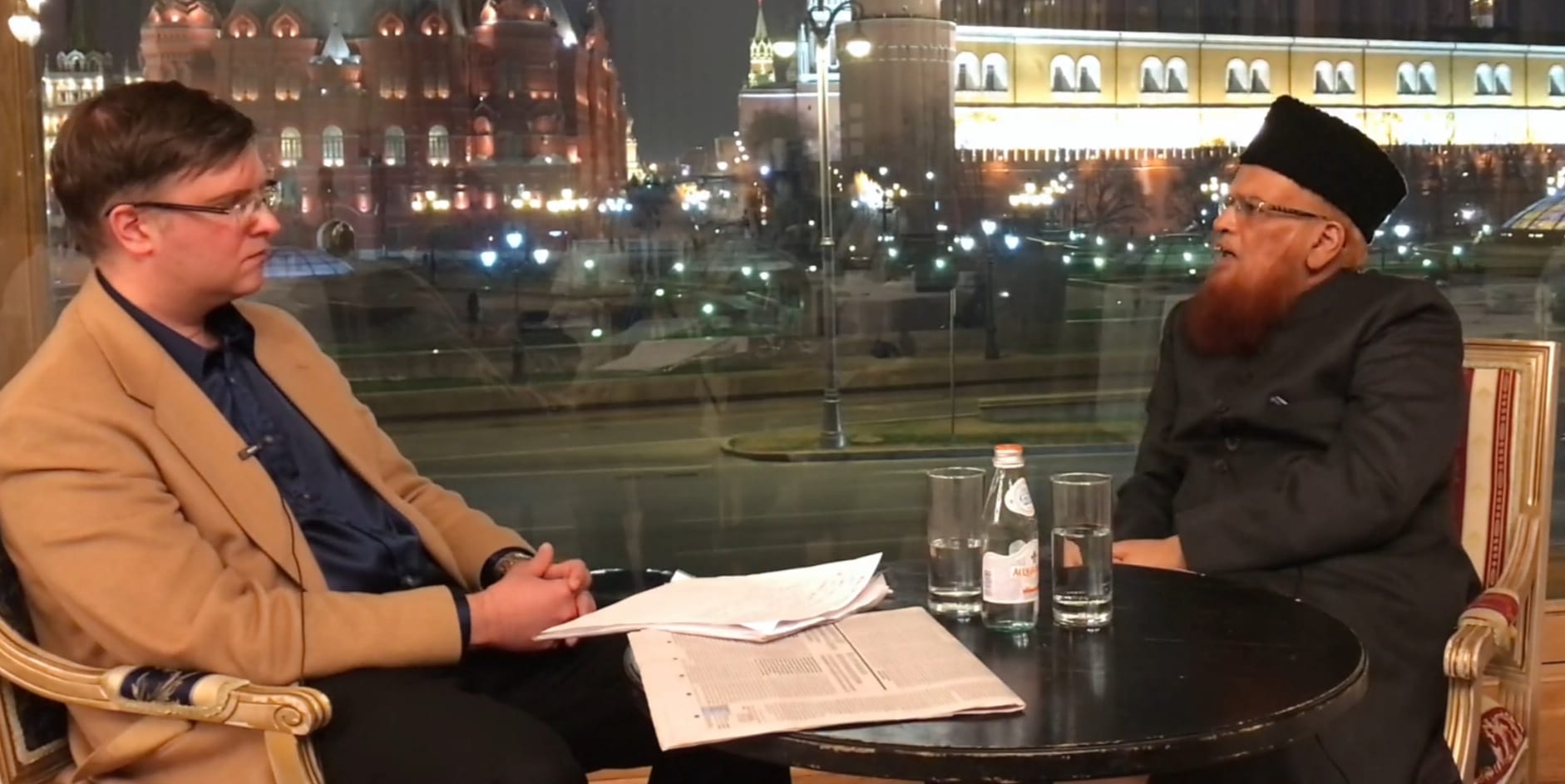
That is why the most consequential exchange of the past fortnight happened at a London Islamic finance summit, not at the bank. Dr Najib Al Aswad of the Islamic Finance Capacity and Advisory Bureau asked Mufti Taqi Usmani, chair of the sharia board of Aaoifi, the Bahrain-based body that sets Islamic finance standards globally, whether Muslims may hold a company supplying technology to an army "killing our brothers and sisters". Usmani answered that it depends, but when a buyer is certain the product will be used "in a haram way to harm others", holding it is haram 1.
The rule change is the sell order
If Aaoifi or S&P tightens the screen in response, every passive sharia product tracking their methodology becomes a forced, non-price-sensitive seller of Palantir at once. Exclusion from a major screened fund creates selling pressure regardless of how the underlying business performs 5. HSBC's own March switch to a new parent index shows these screens get changed and swapped 1, and Dow Jones's defense exclusion is an off-the-shelf exit 4.
The stake is noise; the precedent is not
The money itself is small: the Palantir stake sits inside a fund of roughly $9 billion against a market cap near half a trillion dollars 2.
Palantir is not even the halal fund's biggest Israel-linked buy
Data
| Value | |
|---|---|
| Palantir | $38.3m |
| RTX | $35.7m |
| Analog Devices | $20.3m |
| Honeywell | $18.9m |
| Rolls-Royce | $17.6m |
Al Jazeera counted more than $130 million of the fund's first-half purchases across five firms linked to Israel's military 4. The signal, not the size, is what PLTR holders should price. Palantir reports its third quarter on Monday November 2, guided to $2.16 billion of revenue 6. The stock closed last week at 98 times forward earnings 6, and options price a 13% move either way around the print 7. At that multiple, a register event matters more than it would for a company the market prices on cash.
Palantir's revenue has nearly tripled in two years; Monday's guide is $2.16 billion
- Revenue
- Estimate
Data
| Revenue | |
|---|---|
| Q1 '24 | $0.63B |
| Q2 '24 | $0.68B |
| Q3 '24 | $0.73B |
| Q4 '24 | $0.83B |
| Q1 '25 | $0.88B |
| Q2 '25 | $1B |
| Q3 '25 | $1.18B |
| Q4 '25 | $1.41B |
| Q1 '26 | $1.63B |
| Q2 '26 | $1.94B |
| Q3 '26e (estimate) | $2.16B |
Savers who wait for the screen change pay the price
The cost falls asymmetrically. A saver who switches funds now chooses freely. A saver who waits for Aaoifi or S&P to act exits at whatever price follows the forced selling, because passive money cannot front-run the rule change it waits for.
Watch two things: whether HSBC's review touches the index or only its own committee, and whether the standard-setter responds. The capability is not on trial here; the register is. And for as long as the screen holds, it is the screen, not HSBC's committee, that owns the sell button.
Get Economy by email, free
How AI moves rates, banks, payments and the wider economy. In our daily email, every weekday.