IBM's quantum chip beat a supercomputer on a benchmark, but IonQ rose 8.95% while IBM fell 1.73%
A third-party benchmark showed IBM's commercial quantum chip beating an exascale supercomputer, and its most advanced machine went live in Chicago, yet IBM fell 1.73% while narrative-led IonQ rose 8.95%. The market is pricing optimism, not the dated 2028 revenue line only IBM carries.
 Richard Tangthree-minute read
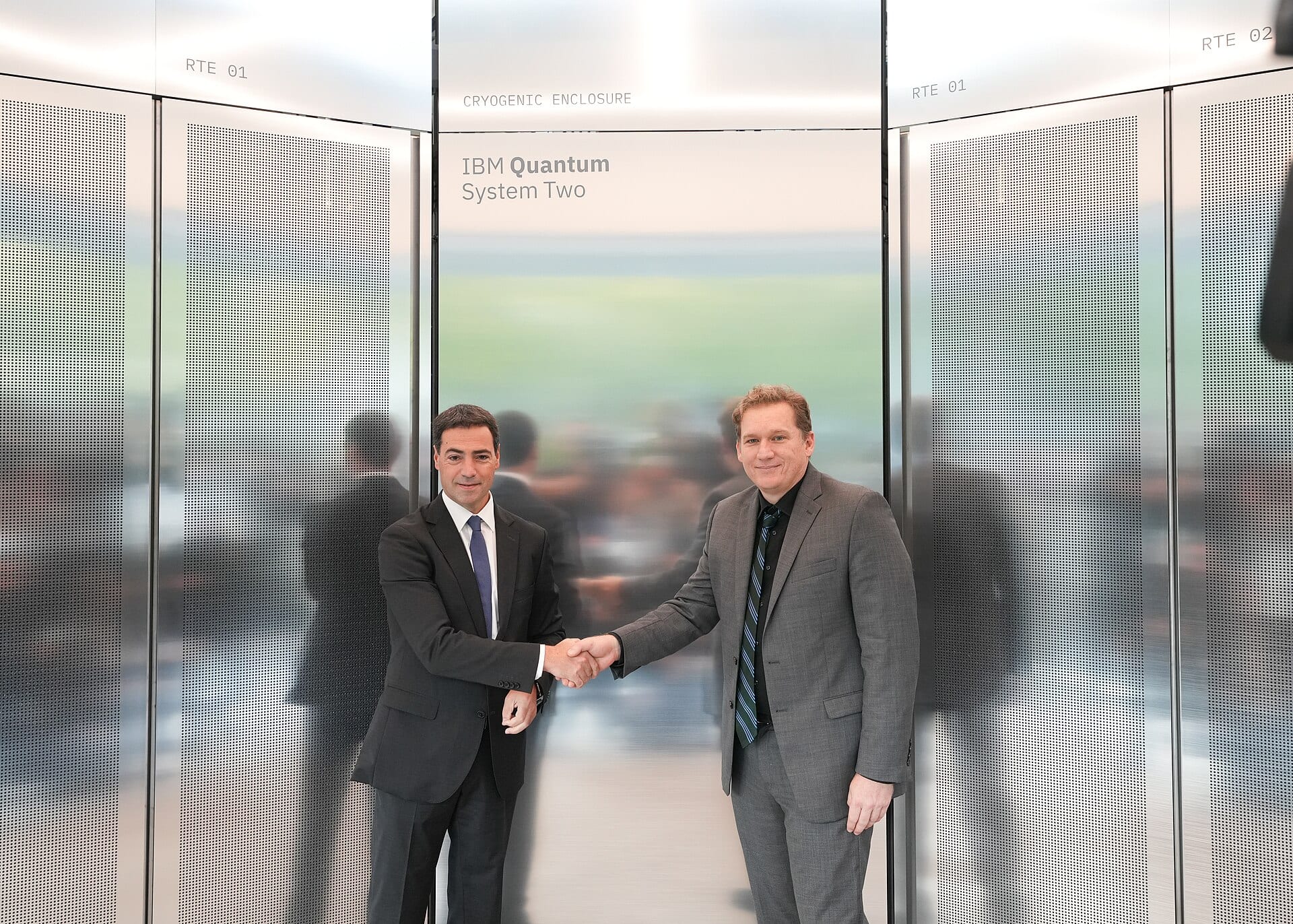
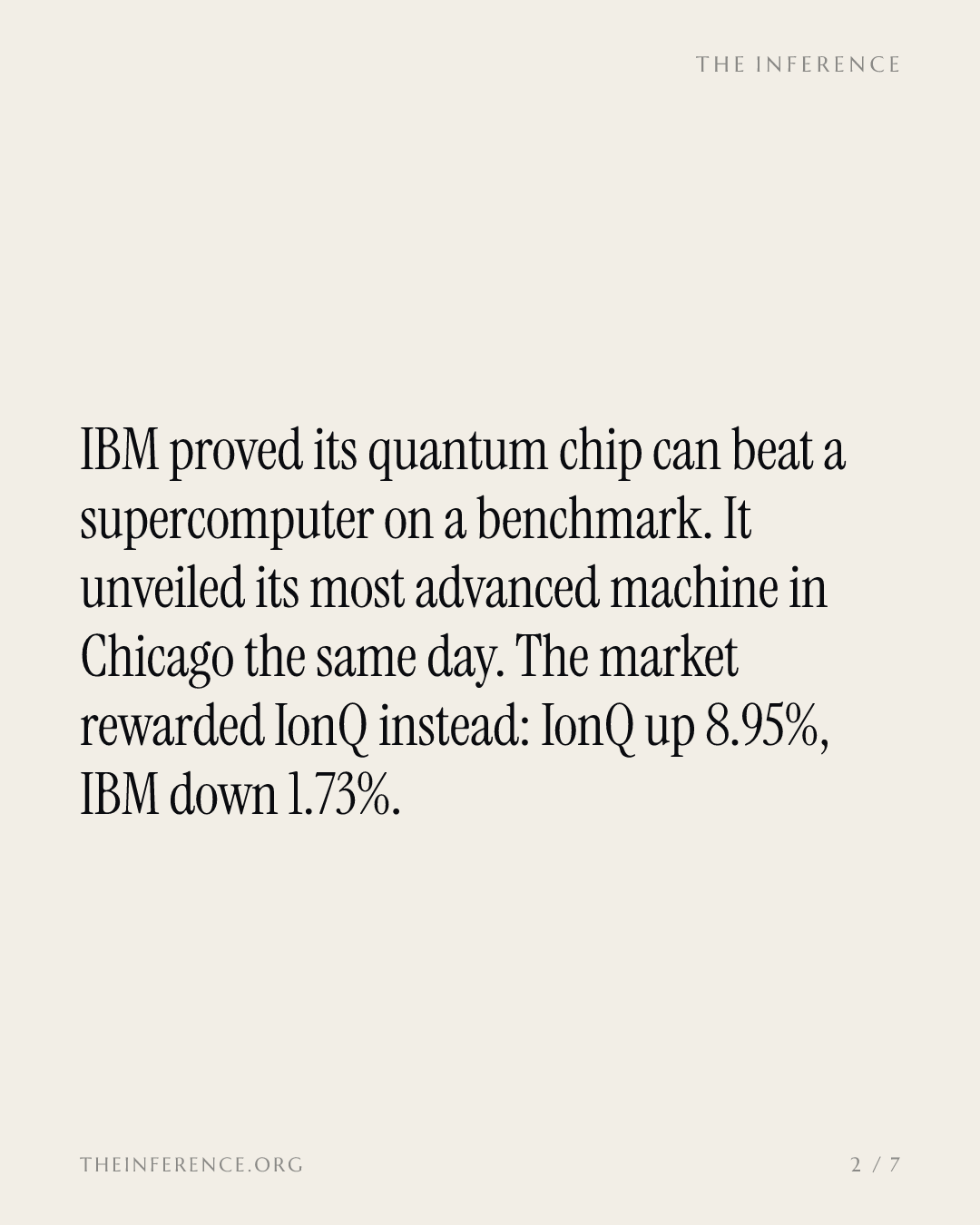
IBM−0.85% — IBM, down 0.85 percent today spent the past two weeks proving its quantum bet and the market marked it down for it. On November 6 the company switched on its most advanced quantum computer, an IBM Quantum System Two running the 120-qubit Nighthawk r2 chip, at the University of Chicago's Hyde Park Labs, the first IBM quantum system in Illinois and the anchor of the National Quantum Algorithm Center 3. That day, IonQ rose nearly 9% and IBM fell 1.73% 4.
The receipts behind the bet are real. On October 29, an independent team showed IBM's commercial hardware beating an Oak Ridge exascale supercomputer at a defined task 2. And on the Q3 call, CEO Arvind Krishna put a date on the money: quantum should start contributing to IBM revenue in 2028 or 2029, ahead of Starling, the fault-tolerant machine targeted for 2029 1.
The receipt came from outside IBM
Researchers from BlueQubit, with EPFL and the XPRIZE Foundation, ran random-circuit sampling on IBM's ibm_phoenix processor through the standard Qiskit cloud queues, with no special calibration; collecting the same million samples classically, they estimate, would take more than a century of Frontier time, while the quantum machine needed 19 seconds 27. The authors call it the first demonstration of quantum advantage on a processor most ordinary users can rent 7.
A benchmark is not yet a workload anyone buys
That matters because the benchmark ran on the same architecture, and through the same access path, that customers would use. Fidelity was verified by two independent estimators, one spanning depths from 4 to 40 cycles 7. The honest caveat is in the paper itself: the demonstrated task is a benchmark, not a service anyone buys, and better classical algorithms could shrink the 110-year margin, as happened to earlier claims on Google's Sycamore 27. What pays instead is the work the Chicago center exists to find, and the first candidates are named: Deloitte and AbbVie+0.96% — AbbVie, up 0.96 percent today are running quantum molecular simulation for drug discovery with IBM and Northwestern, while EPRI and the University of Illinois explore power-grid optimization 10.
Who actually got paid
IonQ's+21.79% — IonQ, up 21.79 percent today own quarter was strong: revenue of $173.8 million, up 336%, guidance raised to $505 million to $515 million 8. But most of the lift came from the newly consolidated SkyWater chip foundry, and the adjusted EBITDA loss widened to $133.6 million from $48.9 million a year ago 8. The MIT and Accenture−1.94% — Accenture, down 1.94 percent today Quantum Index, published the same week, still finds quantum computers below classical machines for all useful tasks today, even as funding nearly quadrupled to $10.9 billion in 2025 59.
IonQ's revenue jumped in the quarter it consolidated SkyWater
Data
| Revenue | |
|---|---|
| Q4 '23 | $6M |
| Q1 '24 | $8M |
| Q2 '24 | $11M |
| Q3 '24 | $12M |
| Q4 '24 | $12M |
| Q1 '25 | $8M |
| Q2 '25 | $21M |
| Q3 '25 | $40M |
| Q4 '25 | $62M |
| Q1 '26 | $65M |
| Q2 '26 | $80M |
| Q3 '26 | $173.8M |
The market paid the story, not the receipt
The pure play gained while IBM fell the day its best machine went live
Data
| Value | |
|---|---|
| IonQ | 8.95% |
| QNT | 6.65% |
| IBM | -1.73% |
Where the bottleneck sits
The link that moved is the first one: an outside receipt that IBM's roadmap hardware escapes classical reach on commercial terms. The link that now limits the outcome is the next one, turning a sampling benchmark into workloads a bank or a lab schedules weekly. IBM research director Jay Gambetta put it the same way at the unveiling: "the real value of quantum computing is actually when we start to discover algorithms and problems that will eventually matter for the industry" 11.
A dated revenue line versus a story with widening burn
Until then, the IBM holder owns the sector's only dated quantum revenue promise, 2028, attached to a software business that grew 8% to $7.8 billion last quarter 16, while the pure-play holder owns a narrative with widening cash burn behind it 8. What to watch: whether the named Grand Challenge workloads become paying contracts, and whether classical algorithms shrink the 110-year margin before the 2028 revenue line arrives 168.
Get Chips by email, free
How AI demand is reshaping chipmakers, memory and the fabs behind them. In our daily email, every weekday.