Micron's record $54 billion quarter meets a $1.3 trillion memory rout; nearly 35% of sales locked to 2030
Micron just locked in customers to 2030, promised a new HBM generation every year, and printed a record quarter, but the market has erased over a trillion dollars of memory value in October. The gap between those two facts is where the trade lives.
 Richard Tang · 3 min read

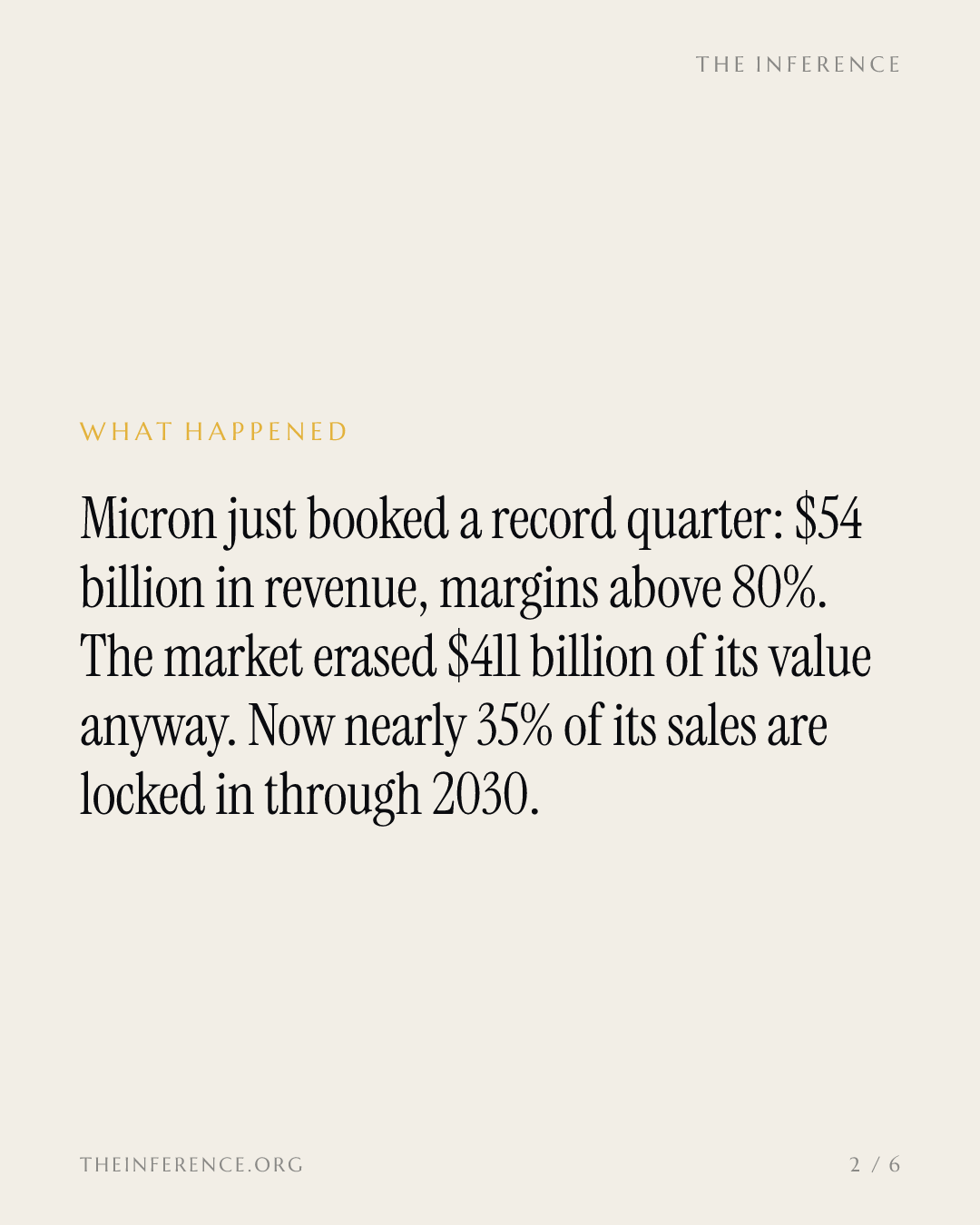
The memory business has rarely been healthier, and its stocks have rarely been punished harder. Micron+2.35% — Micron, up 2.35 percent today booked a record fiscal fourth quarter with $54 billion of revenue and an operating margin above 80%, then used a webinar on October 21 to promise a new HBM generation every year through 2030 51.
The market answered by erasing $1.3 trillion from memory and storage valuations from their 2026 records, $411 billion of it Micron's; 58 of 59 chip stocks in Yahoo Finance's basket fell in October 2. Both things are real. The question is which one the price is wrong about.
The record is a staircase, not a spike
Micron's revenue more than doubled in two quarters as AI memory demand compounded
Data
| Revenue | |
|---|---|
| Q4 '24 | 8.71B |
| Q1 '25 | 8.05B |
| Q2 '25 | 9.3B |
| Q3 '25 | 11.32B |
| Q4 '25 | 13.64B |
| Q1 '26 | 23.86B |
| Q2 '26 | 41.46B |
| Q3 '26 | 54.23B |
Micron's roadmap is an argument that AI demand changes what memory is, not just how much of it sells. Vertical HBM from 2028 targets about 2 TB/s of bandwidth under one picojoule per bit; GPU-accessible flash would let AI systems reach far larger data pools without paying HBM prices for all of it; DDR6 and LPDDR6 are designed for AI data centers first, with Meta−1.36% — Meta, down 1.36 percent today named as an LPDDR6 deployment partner 17.
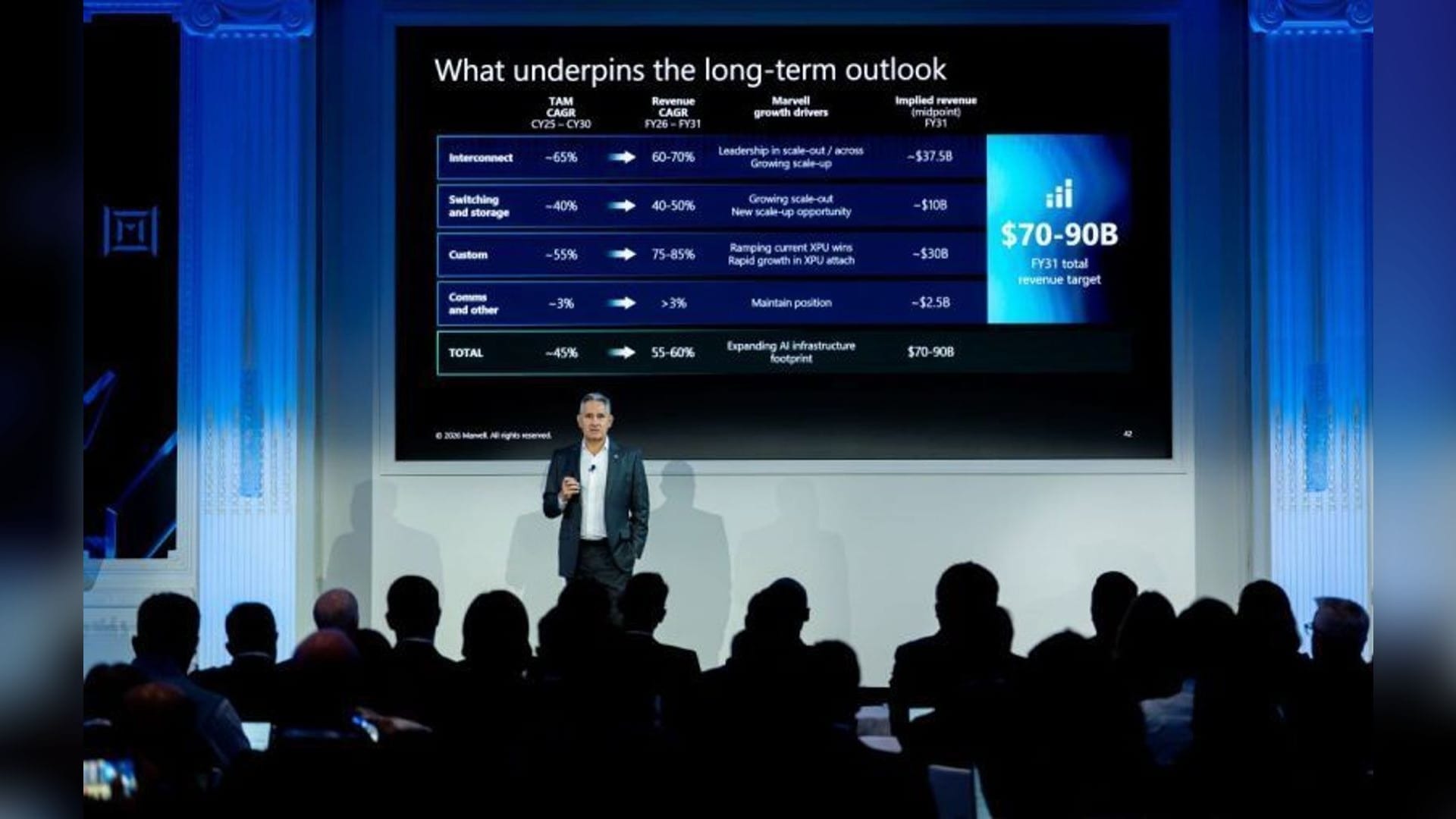
This is the link the usual reading skips: memory is moving from commodity component to engineered subsystem, and engineered subsystems get designed in early, through the strategic customer agreements Micron says now cover nearly 35% of sales through 2030 1.
Lock-in to 2030 against a cycle priced to end in 2027
Micron expects supply to stay tight through fiscal 2028 1; SK Hynix's+3.73% — SK Hynix, up 3.73 percent today own research makes the same point, noting its stock at 4.8 times forward earnings "prices a cycle that ends in 2027" against tightness Micron sees running a year longer 6. And on Friday SK Hynix shelved the Solidigm flash IPO that would have funded new US NAND capacity, removing, in LYNX Equity Strategies' words, "the overhang of new capacity addition to the global supply of NAND flash" 3.
What weighs against it: insiders. Micron executives made 261 open-market trades in six months, all sales, zero purchases, including roughly $182 million from CEO Sanjay Mehrotra 5. Sellers at record profits are not proof of a top; they are a cost of holding, priced in salary and options. The median analyst target sits at $1,500, with Cantor and Barclays−1.45% — Barclays, down 1.45 percent today at $2,000 5, against a stock the rout has hammered.
What this week's prints will settle
The next data arrives now: SK Hynix reports October 28 with a shareholder-return package as the named trigger 6, SanDisk follows Thursday, Micron prints in December. If HBM demand were actually rolling over, the first place it would show is those numbers, not the October tape. Investors should read them against the 2030 lock-in, not the rout 6.
The chain is clear: AI systems need more memory per compute dollar, memory makers convert that into record margins, and margins fund the roadmap. The missing link is the customer book. Nearly 35% locked is real demand; the rest is still the market's opinion of the AI buildout. Watch the December print for how much more of it converts.
Get Chips by email, free
How AI demand is reshaping chipmakers, memory and the fabs behind them. In our daily email, every weekday.