Tower Semiconductor: $290 million in prepaid 2027 orders after the optics rout; Q3 print November 2
AI-optical names sold off this week on financed-demand fear, but Tower's customers wired cash before delivery. The November 2 Q3 print is the first test of whether prepaid 2027 demand holds through the rout.
 Vincent Jiang · 3 min read
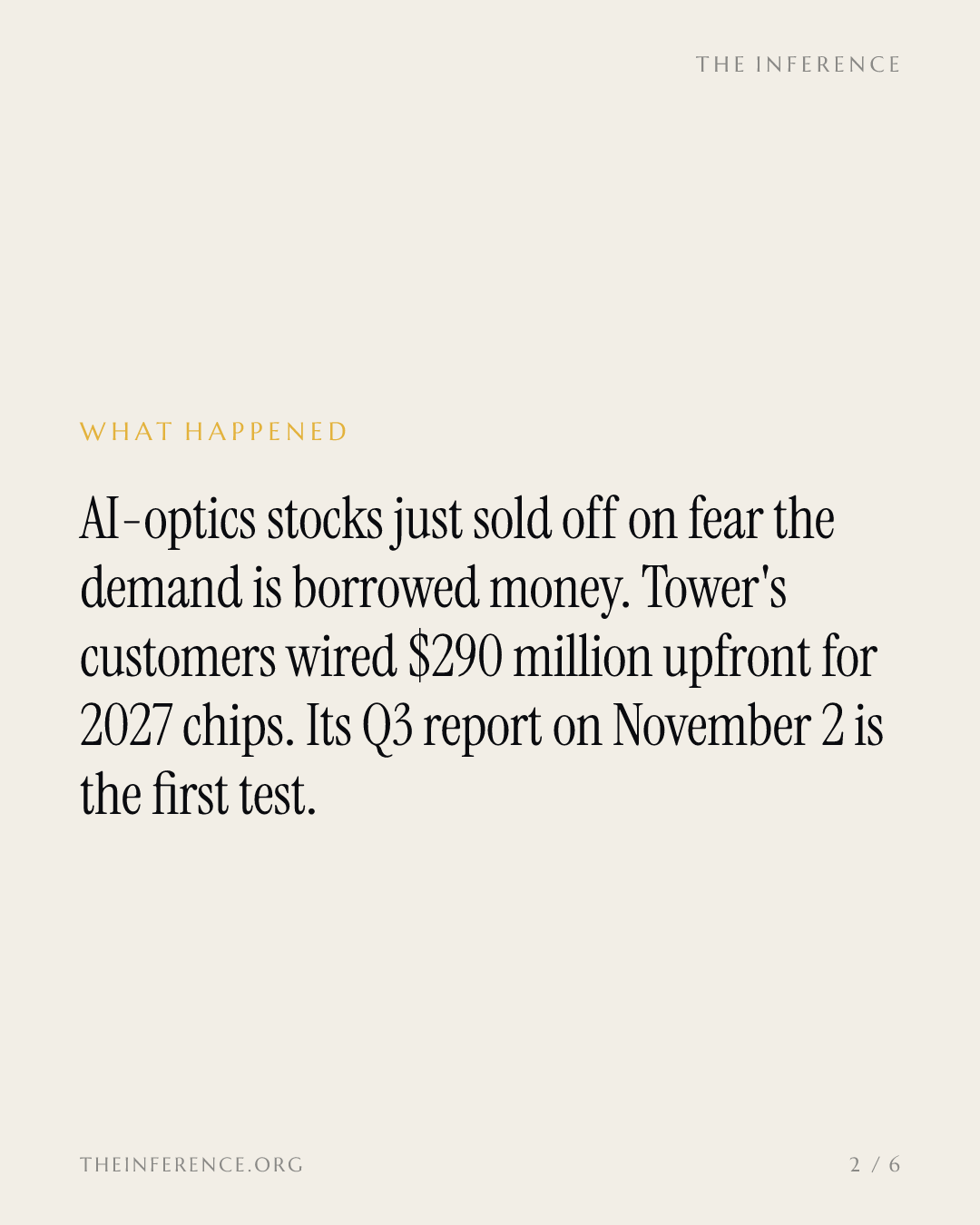
AI-optical stocks are being sold on fear that the demand behind them is financed rather than real. The rout began on October 12, when Broadcom−0.45% — Broadcom, down 0.45 percent today chief executive Hock Tan said access to capital could become a bigger constraint on AI expansion than chip shortages, and Intel's+1.13% — Intel, up 1.13 percent today chief executive pointed to rising borrowing costs 4. By October 22, Coherent had fallen 12% in a single session, Applied Optoelectronics 10% and Lumentum 9%, with the Roundhill photonics ETF down 10% against a 2% slide in the Nasdaq 100 5.
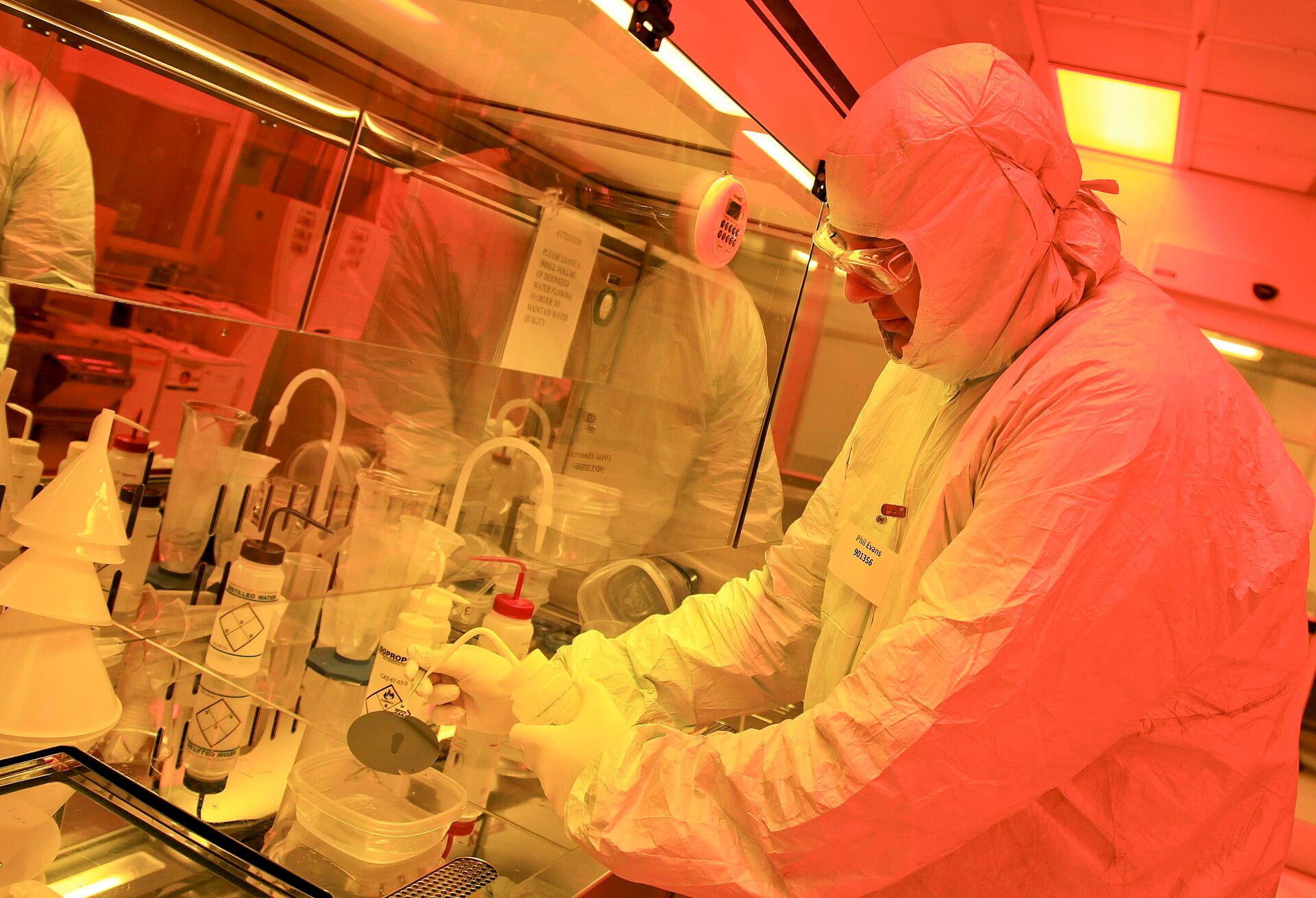
Tower Semiconductor−0.30% — Tower Semiconductor, down 0.30 percent today, the Israeli specialty foundry whose silicon-photonics wafers feed AI data-center optics, closed at $167.56 on October 24, a $20.28 billion market cap near the middle of its annual range 1.
Cash before a wafer ships
The receipts on Tower's side of the trade run against that fear. Contracts worth $1.3 billion for 2027 delivery, announced in May, came with roughly $290 million of customer prepayments: cash paid before a wafer ships 1. Barclays−1.45% — Barclays, down 1.45 percent today, which initiated the stock at Overweight with a $310 target on September 18, is effectively pricing the same prepayment structure Nvidia−0.54% — Nvidia, down 0.54 percent today now uses with its own Taiwanese suppliers, including a $1.1 billion capacity-reservation advance to chip tester King Yuan Electronics announced at GTC Berlin on October 21 26.
The foundry's own filings back the prepaid demand
Q2 2026 revenue reached $460 million, up 23.7% year over year, at a 30% gross margin with normalized EPS of $0.88, ahead of expectations 1. The acceleration is visible in the quarterly trail: revenue rose from $327 million in Q1 2024 to $460 million, and gross margin from 22.2% to 29.9%, with Q2 operating income up 126.5% year over year 3.
Tower's revenue and gross margin both inflected as photonics demand ramped
- Revenue ($M)
- Gross margin (%)
Data
| Revenue ($M) | Gross margin (%) | |
|---|---|---|
| Q1 '24 | 327.24 | 22.2 |
| Q2 '24 | 351.18 | 24.8 |
| Q3 '24 | 370.51 | 25.1 |
| Q4 '24 | 387.19 | 22.4 |
| Q1 '25 | 358.17 | 20.4 |
| Q2 '25 | 372.06 | 21.5 |
| Q3 '25 | 395.67 | 23.5 |
| Q4 '25 | 440.21 | 26.7 |
| Q1 '26 | 413.63 | 26.8 |
| Q2 '26 | 460.08 | 29.9 |
The price already assumes the growth
Trailing P/E sits at 58.59 against the S&P 500's 25.27, but the forward P/E is 23.91 versus an index average of 20.37, with EPS up 35.55% over the past year and projected annual revenue growth of 33.05% 2.
Prepaid orders must keep the lines full through 2028
Management targets $3.6 billion of revenue and $1.2 billion of net income by 2028, contingent on lifting gross margin to 45% and utilization to 85% 1.
Utilization is the share of a foundry's wafer lines that are actually running paid jobs; idle tools still cost money, so the 2028 math only works if prepaid 2027 volume keeps the lines full 67. That is the risk shareholders carry if a module-maker downturn breaks customers' ability to pay balances. Competition adds pressure: Nvidia and SPIL, the Taiwanese packaging house in the ASE Group+2.72% — ASE Group, up 2.72 percent today, plan a 15x optical-engine capacity expansion by mid-2027, and TSMC+1.25% — TSMC, up 1.25 percent today fabricates silicon photonics on its own COUPE platform 67.
Tower's Q3 report, due November 2, is the first print to test prepaid 2027 demand since the rout began. We flagged the stock's run on an undisclosed photonics shipment on October 11 and the Intel lawsuit over $450 million in walk-away costs on October 21 (/article/tower-semiconductor-is-up-99-97-this-year-on-an-ai-photonics-shipment-with-no-disclosed-volume; /article/tower-semiconductor-sued-intel-over-450-million-in-walk-away-costs-ahead-of-its-nov-2-print); what is new is the rout itself, and whether the prepayments hold through it.
Get Chips by email, free
How AI demand is reshaping chipmakers, memory and the fabs behind them. In our daily email, every weekday.