A fifth of Google's searches happen in ChatGPT, yet Search grew 12%: the leak is monetization, not traffic
ChatGPT already answers a fifth of Google's query volume, but the money is leaking inside Google's own results page, not to a rival. Nearly half of Alphabet's trailing profit is now paper gains, and at $280 the shares still need the bull case.
 Richard Tang · 9 min read
A fifth of Google's searches now happen in ChatGPT, and Search still grew 12%
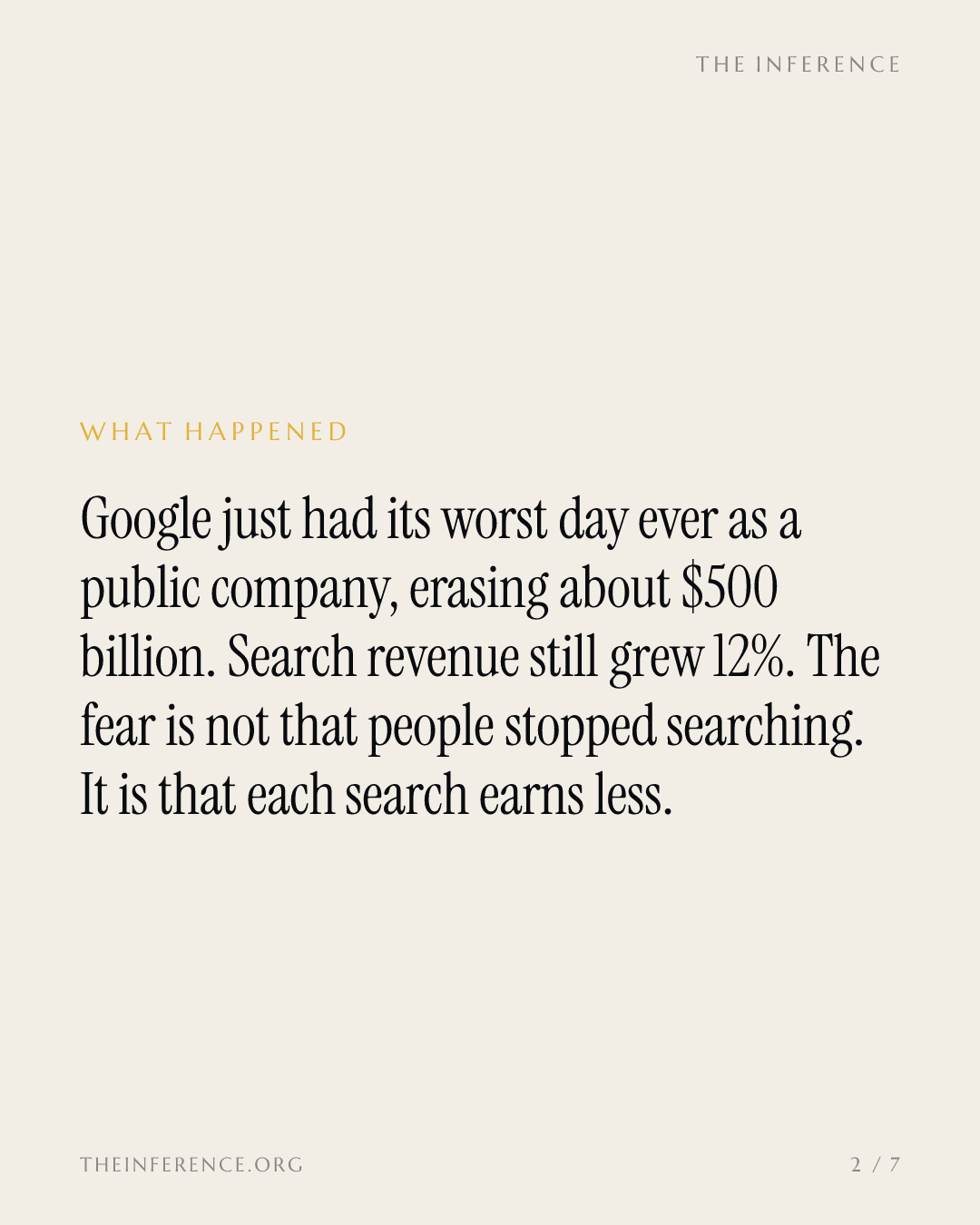
On October 28 Alphabet+4.16% — Alphabet, up 4.16 percent today reported revenue up 25% to $127.6 billion, Google Cloud up 103%, and its new model taking the top spot on an independent benchmark 1313. The next day the stock fell 12.6%, from $324.89 to $283.82, its worst day ever as a public company, erasing about $500 billion 1221. Followers are left holding a contradiction. The franchise everyone fears for, Search, grew 12% and now sits just under half of revenue, 49.7% of the third quarter, down from 56.6% in 2024 12.
The gap depends on what you count
The fear is that chat is eating search. Measured the usual way, by website visits, it barely shows: google.com drew about 87.5 billion visits in May against roughly 5.6 billion for chatgpt.com, a 15-to-1 gap 6, and ChatGPT drew 5.9 billion in September 7.
Measured the way OpenAI$1.18T — OpenAI, private, latest valuation $1.18T does, the gap is five to one. OpenAI's consumer chief Adam Fry said this month that ChatGPT receives about a fifth as many search-like queries as Google, counting every question that sends the bot to the web 5. Google has said it handles more than 5 trillion searches a year 5.
The gap is 69 to 1 on referrals and 5 to 1 on queries
Count queries, not visits: ChatGPT is a fifth of Google's search volume
Data
| Value | |
|---|---|
| Referral traffic to websites, Oct 2026 | 69× |
| Monthly site visits, May 2026 | 15× |
| Search-like queries, Nov 2026 | 5× |
Five cents a query is what the traffic war is fought over
Five trillion searches carrying $250.1 billion of trailing Search and other revenue works out to about five cents a query. That is my arithmetic from the filings, an approximation since the line also includes Gmail, Maps and Play 12. A fifth of the volume, at Google's rates, is worth about $50 billion a year. The scenario bears describe, losing a fifth of search traffic, already exists on paper.
Yet paid clicks rose 8% and the price per click rose 4%, and Sundar Pichai told analysts query growth is the fastest in five years 14. The traffic war is real, but it is not where the money is leaking.
Traffic is not the problem: clicks, price and Search revenue all rose
Paid clicks rose 8% and the price per click 4%, and Search revenue grew 12%
Data
| Year-on-year growth, Q3 2026 | |
|---|---|
| Paid clicks | 8% |
| Price per click | 4% |
| Search revenue | 12% |
The leak is inside Google's own results page
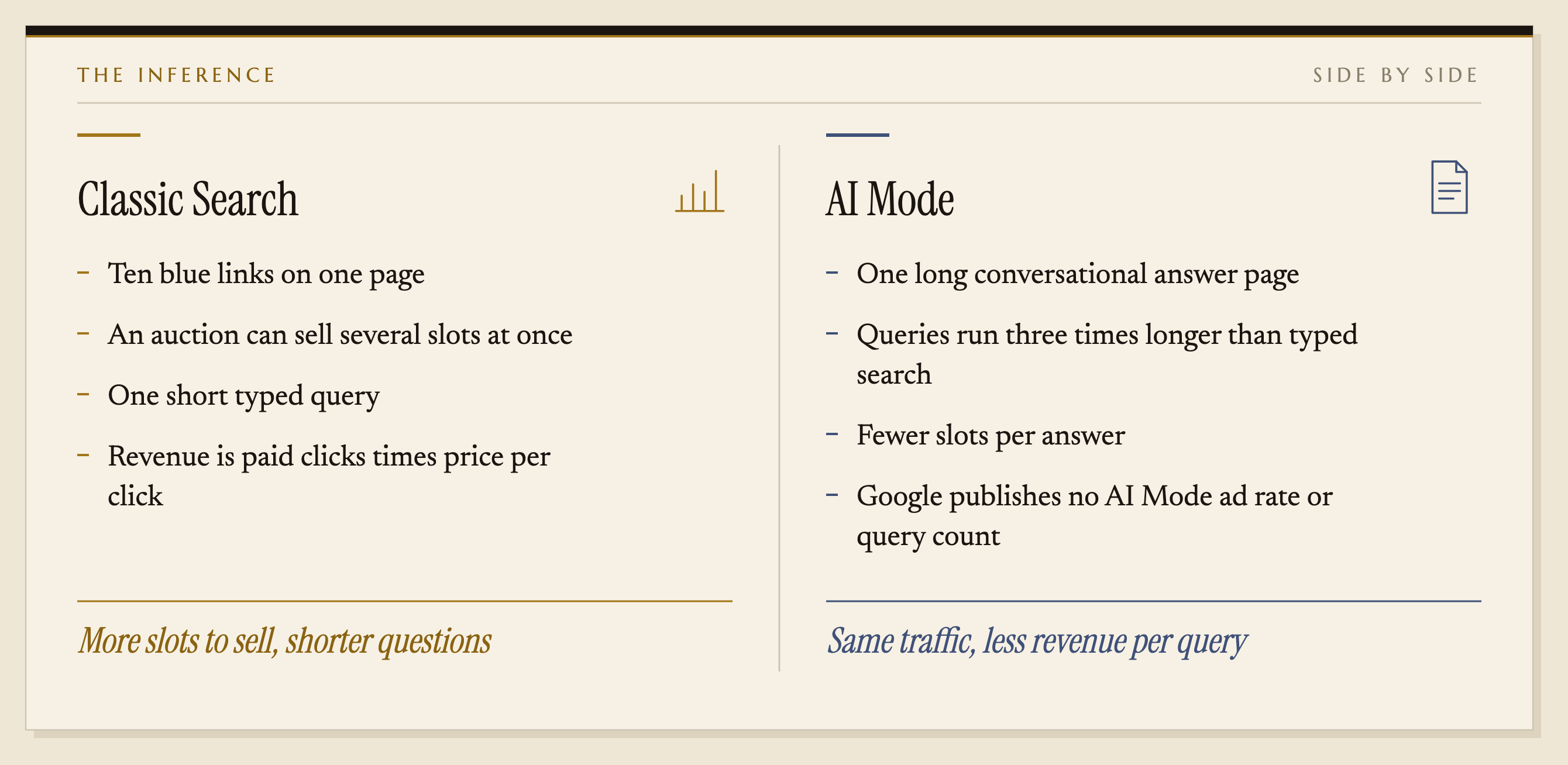
Search revenue has two moving parts: paid clicks times the price per click. Each query runs an auction against the old page of ten blue links, which could sell several slots at once. An AI Mode answer is one long, conversational page, and AI Mode queries are on average three times longer than a typed search 4. Longer questions, fewer slots per answer, less sold per query.
Chief business officer Philipp Schindler admitted as much on the earnings call: the surge in AI Mode queries "had an impact because of the lower monetization we're seeing in AI Mode" 4. He named currency swings as the biggest factor. Google publishes neither the AI Mode ad rate nor query counts, so the dilution can only be inferred 4. The shift is hurting Google's yield per query, not yet its traffic. Advertisers still buy; each query earns less.
The web that Google indexed for free is fencing itself off
That is a slower illness than the one bears describe, and survivable only if the gap closes. Google says click-through rates on sponsored product listings inside AI Mode already look similar to the classic results page 4. That is a start, not a parity claim for search as a whole.
The damage that is already visible falls on everyone else. Across 118,671 sites tracked by Ahrefs in October, Google still accounts for 24.74% of traffic and ChatGPT for 0.36% 5. But Reddit+5.67% — Reddit, up 5.67 percent today said Google's AI answers were cutting its search referrals by more than a million visits a week, and it is now testing a login wall around its 27 billion posts 18. An answer engine that must pay for its sources carries a cost the ten blue links never did.
The auction itself became a black box
The auction has also become harder to see, weakening a quieter moat. Google's AI Max left beta in April and is absorbing campaigns advertisers once ran by hand, and Performance Max has drawn two years of agency complaints about budgets spent where the buyer cannot look 1617.
In September Google finally added reporting that shows what earned an AI Max conversion, two years after advertisers started calling it a black box 17. Transparency was why a startup could trust the old system with its budget. Opacity invites that budget to look somewhere else.
The marshals left, and the ones who stayed were promoted
The talent story checks out, with the names corrected. Noam Shazeer, co-lead of Gemini, left for OpenAI in June, 22 months after Google paid $2.7 billion for his startup Character.AI to bring him back 10. John Jumper, who shared the 2024 Nobel Prize in Chemistry for AlphaFold, left DeepMind for Anthropic$350B — Anthropic, private, latest valuation $350B the following week 9. David Silver of AlphaGo did not go to a rival lab; he founded his own, and raised $1.1 billion 11.
In August the losses reached the top. Jeff Dean, chief scientist for 27 years, left with Sanjay Ghemawat, Oriol Vinyals and Quoc Le to start a company called Discovery Loop 8. Demis Hassabis stepped back from running DeepMind to become its chairman and Alphabet's chief scientist, handing the lab to its CTO, Koray Kavukcuoglu 8.
DeepMind now hires two researchers per departure; Anthropic hires twenty-two
DeepMind now adds two researchers for every departure; Anthropic adds twenty-two
Data
| Hires per departure | |
|---|---|
| DeepMind Q2 2023 | 12 |
| DeepMind Q3 2026 | 2 |
| Meta 2025 | 3 |
| OpenAI 2026 | 5.7 |
| Anthropic 2026 | 22 |
Pre-IPO equity is doing the poaching
DeepMind hired 12 researchers for every departure in mid-2023, and about two now 8. Anthropic adds 22 for every departure, OpenAI 5.7, and DeepMind's share of elite hires across Europe, the Middle East and Africa fell from 49% to 18.6% 8.
The pull is arithmetic as much as culture: pre-IPO equity. Anthropic filed its S-1 on October 26 and may list before Thanksgiving, showing $17 billion of quarterly revenue and $895.4 billion of purchase commitments 14. OpenAI filed confidentially in June 15. AMD+0.33% — AMD, up 0.33 percent today simply bought World Labs$1B — World Labs, private, latest valuation $1B and made Fei-Fei Li its chief scientist 19.
What a marshal costs now
A founder wanting to sign marshals now outbids public-market packages; Google tried once, paying $2.7 billion for Character.AI, and the marshal walked anyway 10. One comparison fails on the facts: Netflix+4.82% — Netflix, up 4.82 percent today did not fade into oblivion, it returned 5.4 times over the past decade 22.
The conglomerate already exists in the accounts
The October verdict was not about a dying franchise. It was about what Alphabet has become while fighting. Trailing net income of $235.7 billion includes $103.2 billion, after tax, of gains from below the operating line, 43.8% of the total 21. Nine-month filings show $127.3 billion of equity gains, of which $116.3 billion came from marking up private stakes 1. The balance sheet carries $75.2 billion of SpaceX−4.75% — SpaceX, down 4.75 percent today shares, an AI joint venture with its own $16.8 billion contract, and a $20 billion funding commitment to a private company 1.
Strip the gains out and the price-to-earnings ratio is not the headline 14.5; it is about 26 21. Meanwhile the operating company spends everything it earns and more. Capital spending doubled to $51.4 billion in the quarter, 89% of trailing operating cash flow, and free cash flow has been negative for two straight quarters, a first in the company's history 113.
Capital spending more than doubled in eight quarters while free cash flow turned negative
Capex doubled in a year to $51.4 billion a quarter while free cash flow went negative
- Capital spending
- Free cash flow
Data
| Capital spending | Free cash flow | |
|---|---|---|
| Q4 2024 | 14.3B | 24.8B |
| Q1 2025 | 17.2B | 19B |
| Q2 2025 | 22.4B | 5.3B |
| Q3 2025 | 24B | 24.5B |
| Q4 2025 | 27.9B | 24.6B |
| Q1 2026 | 35.7B | 10.1B |
| Q2 2026 | 44.9B | -5.9B |
| Q3 2026 | 51.4B | -9.1B |
43.8% of Alphabet's trailing net income is investment gains
43.8% of trailing profit is paper gains, which is why the 14.5 P/E is really about 26
Data
| Value | |
|---|---|
| Net income, trailing | 235.7B |
| Operating earnings inside it | 132.5B |
| After-tax investment gains | 103.2B |
Committed through 2032, and paid for with new shares
Signed commitments stand at $802.1 billion through 2032, and finance chief Anat Ashkenazi said capex will rise significantly again in 2027 13. Jefferies+5.27% — Jefferies, up 5.27 percent today expects negative free cash flow through 2028 12.
The peers spend fanatically too: $39.4 billion at Microsoft+6.34% — Microsoft, up 6.34 percent today, $33.9 billion at Meta+1.71% — Meta, up 1.71 percent today, $75.9 billion at Amazon+5.99% — Amazon, up 5.99 percent today and $28.5 billion at Oracle−1.70% — Oracle, down 1.70 percent today in their latest quarters 21. What sets Alphabet apart is how it pays. It raised $80 billion of equity in June, including a $40 billion at-the-market program, sold convertible preferred stock, and watched long-term debt rise from $21.6 billion to $125.1 billion in a year 2013.
The peers spend fanatically too; Alphabet is second only to Amazon
Alphabet's $51.4 billion of quarterly capex is second only to Amazon's $75.9 billion
Data
| Capital spending, latest quarter | |
|---|---|
| Alphabet | $51.4B |
| Microsoft | $39.4B |
| Meta | $33.9B |
| Amazon | $75.9B |
| Oracle | $28.5B |
It was the retail buyer who left, not the institutions
Nor is it obvious that institutions are fleeing. The quarterly holdings filings that large money managers file, the 13Fs, show Fidelity adding 8% to its Alphabet position in the June quarter, T. Rowe Price+5.97% — T. Rowe Price, up 5.97 percent today 8.2%, and Berkshire Hathaway+3.76% — Berkshire Hathaway, up 3.76 percent today 83% 21.
Large managers added to Alphabet in the June quarter
Berkshire Hathaway lifted its Alphabet position 83% in the June quarter
Data
| Value | |
|---|---|
| Berkshire Hathaway | 83% |
| T. Rowe Price | 8.2% |
| Fidelity | 8% |
What was missing on October 29 was the retail buyer who usually catches the dip: Goldman Sachs+3.67% — Goldman Sachs, up 3.67 percent today found US retail trading volumes down 45% since late 2025 12. A 14.5 multiple is not the market calling Google cheap. It is the market paying operating-company prices for the operating part, and conglomerate prices for a portfolio of stakes it cannot easily value.
At $280 the shares still need the bull case
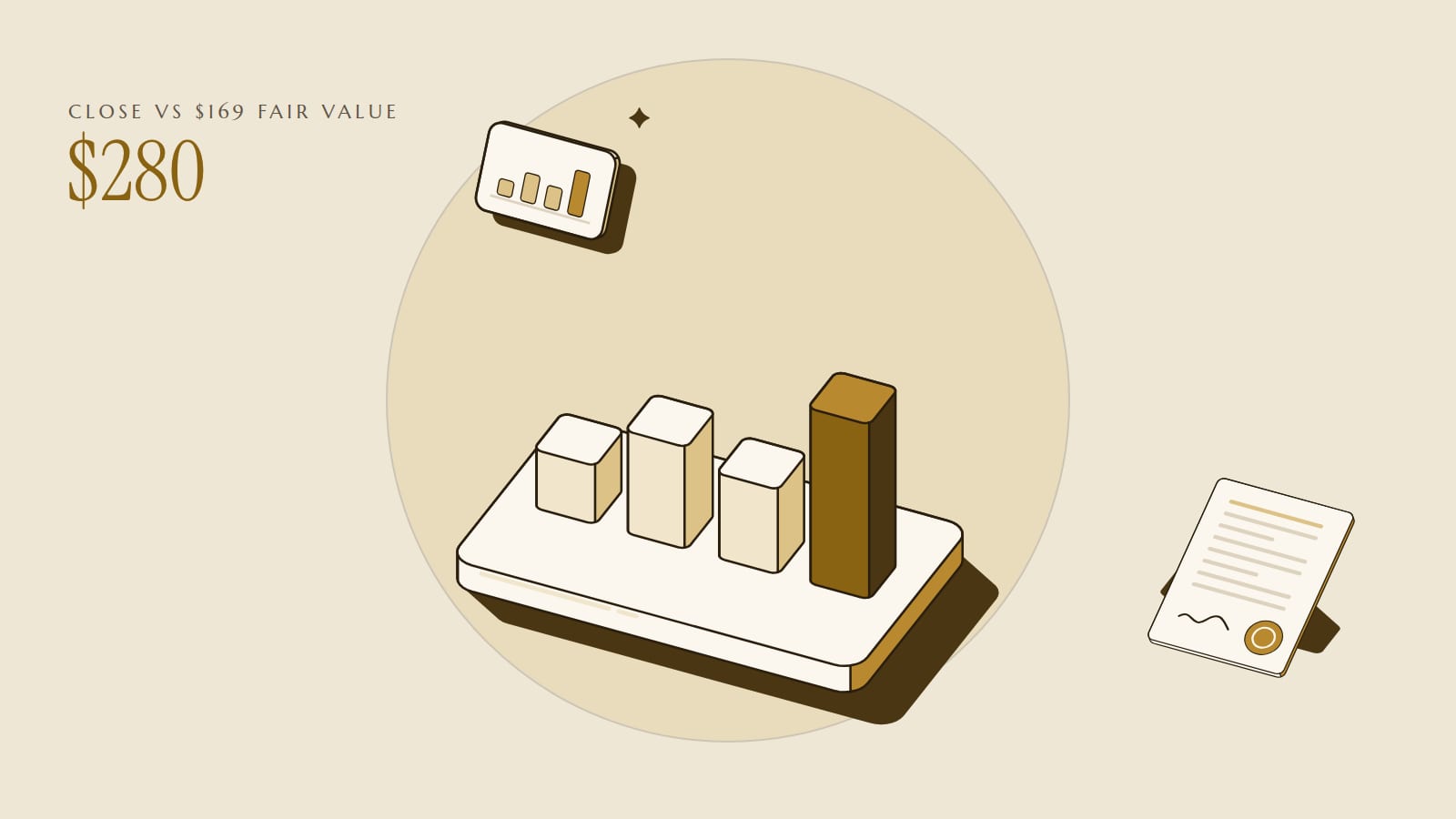
My model values Alphabet at about $169 a share against the last close of $280.03, 1.66 times fair value, which at high uncertainty reads as well above fair value: a clear sell at or above $245, a clear buy at or below $110 21. The base case, at 50% weight and $174 a share, holds operating margins near 33% and assumes capex peaks in 2027 while the AI Mode monetization gap narrows.
The bull case, 25% and $222, needs monetization parity by 2028 and the $567.7 billion cloud backlog converting at rising margins 1. The bear case, 25% and $107, has Search stalling near 3% and cash flow negative through 2028.
The margin assumption moves the value most
Four points of operating margin, from 33% to 29% or 37%, swings the base case by about $19 a share; a point of discount rate swings it by $16 to $20 21. The moat is narrow, not gone. Returns on invested capital ran 22.2% over the trailing year against an 11% cost of capital, built on default distribution, the query data that distribution produces, and the only stack that runs from chips to models to cloud 21.
Operating margin has run near the 33% the base case assumes
Operating margin has ranged from 30.5% to 36.1% over eight quarters
Data
| Operating margin | |
|---|---|
| Q4 2024 | 32.1% |
| Q1 2025 | 33.9% |
| Q2 2025 | 32.4% |
| Q3 2025 | 30.5% |
| Q4 2025 | 31.6% |
| Q1 2026 | 36.1% |
| Q2 2026 | 34% |
| Q3 2026 | 31.8% |
What could erode it is precisely the two leaks above: a structurally lower ad yield on conversational queries, and a lab that trains fewer of the field's best people. Uncertainty is high, and I raise it from the model's medium starting point for three reasons: free cash flow is negative, $802 billion of spending is already signed, and the scenarios sit $115 apart.
Capital allocation I rate adequate. The balance sheet is still sound and the cloud backlog is contracted revenue at good returns, but paying for the build partly with new shares, and $2.7 billion for a marshal who walked, are marks against it.
What would prove this wrong
Three dates settle it. The fourth-quarter call in late January carries the 2027 capex guide; a number that flattens spending kills the bear case on the spot 313. Before that, Anthropic's November listing prices the equity pulling talent out of Mountain View, and a weak debut would slow the exodus more surely than any counter-offer 14. Each quarter, watch two published numbers: Search and other revenue growth, which refutes the dilution thesis above 10% and confirms it below 8%, and paid clicks against query growth.
Google could end the argument tomorrow by disclosing the AI Mode ad rate. Until it does, the reader who knows the headline P/E of 14.5 should also know the honest one is about 26, and that a fifth of Google's searches answering themselves elsewhere is already in the numbers.
Get Applications by email, free
How AI is changing the software people and companies use. In our daily email, every weekday.