Bondholders and Macquarie eat first at Applied Digital's $36.2 billion table
A filings-based analysis published this week maps where Applied Digital's rent goes: $6.09 billion of campus notes and Macquarie's 12.75% preferred units rank ahead of a $5.5 billion equity holding about $41 million of reachable cash. The intended tenant of its newest site is again a company it controls.
 Vincent Jiang · 3 min read

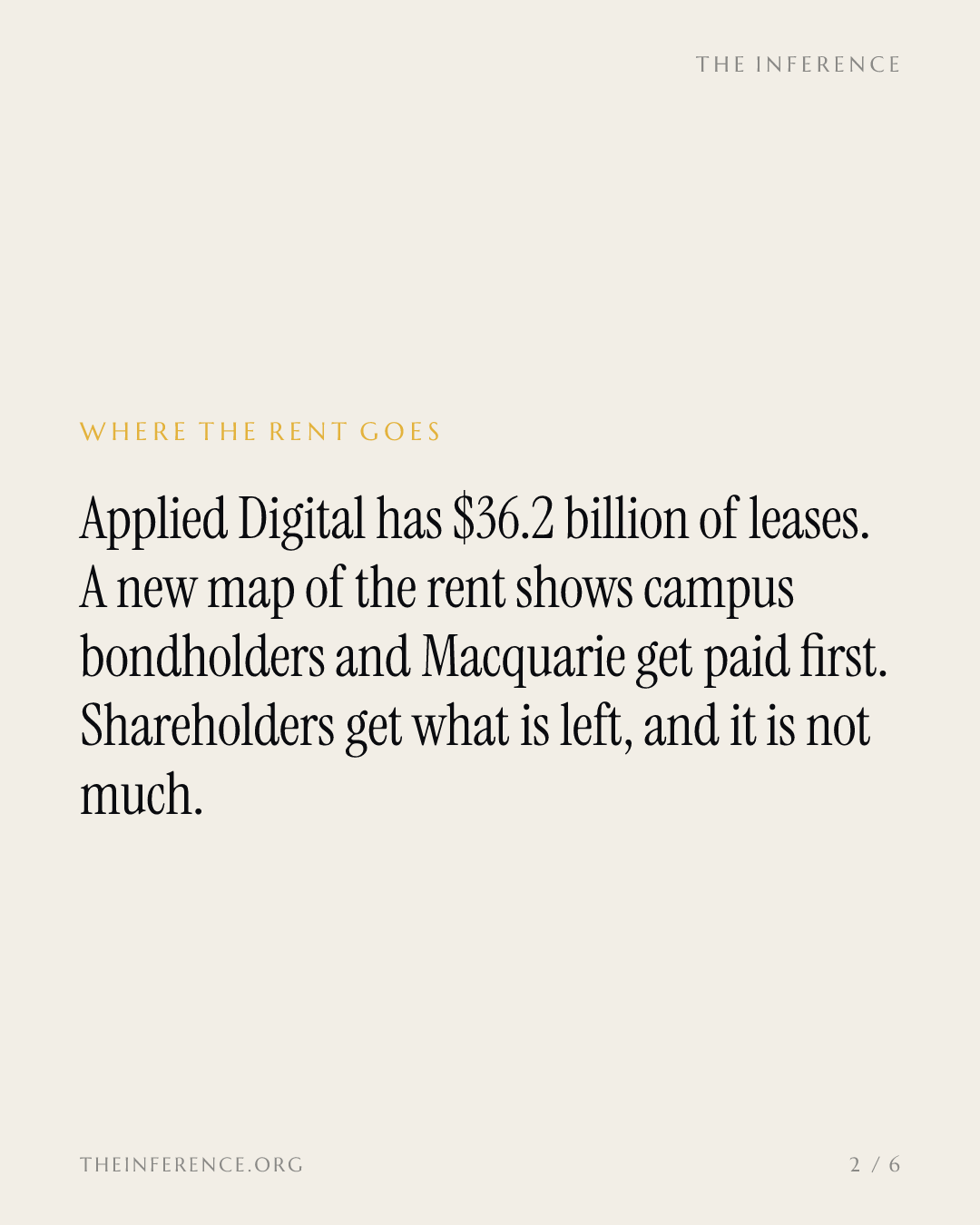
Applied Digital−2.91% — Applied Digital, down 2.91 percent today, the Dallas-based builder of AI data-center campuses, has signed about $36.2 billion of leases running roughly 15 years, and an equity worth about $5.5 billion at the October 16 close prices that book as its own 1. A capital-structure map published this week by the credit outlet Rackline follows the rent down the waterfall instead, and the shareholder is third in a queue of three 1.
Notes first, Macquarie second, equity last
Each campus pays its own noteholders first: $6.09 billion of secured notes in three issues, $2.35 billion at 9.25%, $2.15 billion at 6.75% and $1.59 billion at 7.00% 1. Macquarie Asset Management comes next, holding $1.8 billion of preferred units that pay 12.75%, can be paid in extra units rather than cash until 2035, and are guaranteed at least 1.8 times the money invested on a liquidation 1. The parent guarantees only that the buildings get finished 1.
At August 31, $2,909 million of the group's $2,950 million of unrestricted cash sat inside TopCo 2, the bankruptcy-remote holding company above the campuses, leaving about $41 million where the parent could spend it, the October 7 quarterly report shows 12. Rackline's arithmetic has fiscal 2028 rent of $1.58 billion leaving about $624 million for shareholders after costs, note service, overhead and parent debt 1. Shareholders do not own the rent; they own the residue.
Campus notes take $687 million of fiscal 2028 rent; shareholders keep $624 million
- Campus operating costs$167.3m10.6%
- Campus note service$686.9m43.5%
- Overhead$71.3m4.5%
- Parent debt and preferred$30.3m1.9%
- Left for shareholders$623.7m39.5%
Data
| Part | Fiscal 2028 rent, $m | Share |
|---|---|---|
| Campus operating costs | $167.3m | 10.6% |
| Campus note service | $686.9m | 43.5% |
| Overhead | $71.3m | 4.5% |
| Parent debt and preferred | $30.3m | 1.9% |
| Left for shareholders | $623.7m | 39.5% |
A power cap and a wall of debt
At Ellendale, the North Dakota flagship, CoreWeave−1.03% — CoreWeave, down 1.03 percent today has leased 400MW against a utility contract capped at 350MW that expires on August 31, 2030 1. Then $4.26 billion of the $6.72 billion of debt principal, about 63%, falls due in the fiscal year to May 2031, and the annual report says plainly: "It is likely that we will need to refinance at least a portion of our outstanding debt" 1.
CoreWeave's bonds slid in mid-October as investors questioned the debt behind the AI buildout, and Applied traded alongside; even after an 8.5% bounce to $21 on October 21 it sits 59% below its 52-week high 3.
Fiscal 2031 alone owes $4.26 billion, 63% of Applied Digital's debt
Data
| Value | |
|---|---|
| FY2027 | $108.7m |
| FY2028 | $221.5m |
| FY2029 | $341.5m |
| FY2030 | $354.3m |
| FY2031 | $4,256.7m |
| Later | $1,438.9m |
The credit is the sound part
The bear case has an honest opponent. Campus rent covers note service about twice over in fiscal 2028, and chief executive Wes Cummins argues that every new power restriction elsewhere makes what Applied owns harder to replicate 1. Nor is the intended Texas tenant hollow: ChronoScale booked $71.6 million of revenue in the year to May and has a 50MW Microsoft+0.58% — Microsoft, up 0.58 percent today buildout due in early 2027 4.
December decides what is left
The Texas venture with Soluna Holdings went definitive on October 21: Applied funds the development and holds 51%, Soluna contributes the land and power assets beside its 150MW wind farm, and closing is targeted by December 31 pending a county tax abatement and final agreements 56. The tenant lined up is ChronoScale, the compute platform Applied owns about 96% of, on a non-binding letter of intent, a structure The Inference reported on October 22 57.
The abatement vote, a binding lease and the January results will show whether the residue ever reaches the back of the queue.
What happens next
APLDWhether the county grants the tax abatement and the wind-powered Texas campus financing closes
The case for
Campus rent covers note service about twice over in fiscal 2028, so the secured notes and the campuses themselves look sound
The case against
Shareholders sit behind $6.09 billion of campus notes and Macquarie's 12.75% preferred units, with only about $41 million of cash reachable by the parent
- By December 31, 2026Soluna joint venture targeted to close.
- January 2027Applied Digital quarterly results. Whether any residue is reaching shareholders at the back of the queue
- Early 2027ChronoScale's 50MW Microsoft buildout due. Whether the intended Texas tenant's own credit holds up
Get our follow-up when these land
Free. We'll email you when we publish on Applied Digital, and send our free weekday newsletter. Unfollow in one click.