Exelon's ComEd holds $721 million against a $3.1 billion data-center bill; Illinois rules December 15
ComEd's price for wiring 30 data centers into its northern Illinois grid is $3.1 billion, and developers have deposited $721 million. Consumer groups warn a $2 billion gap could reach household bills, and state regulators rule by December 15.
 Vincent Jiang · 3 min read

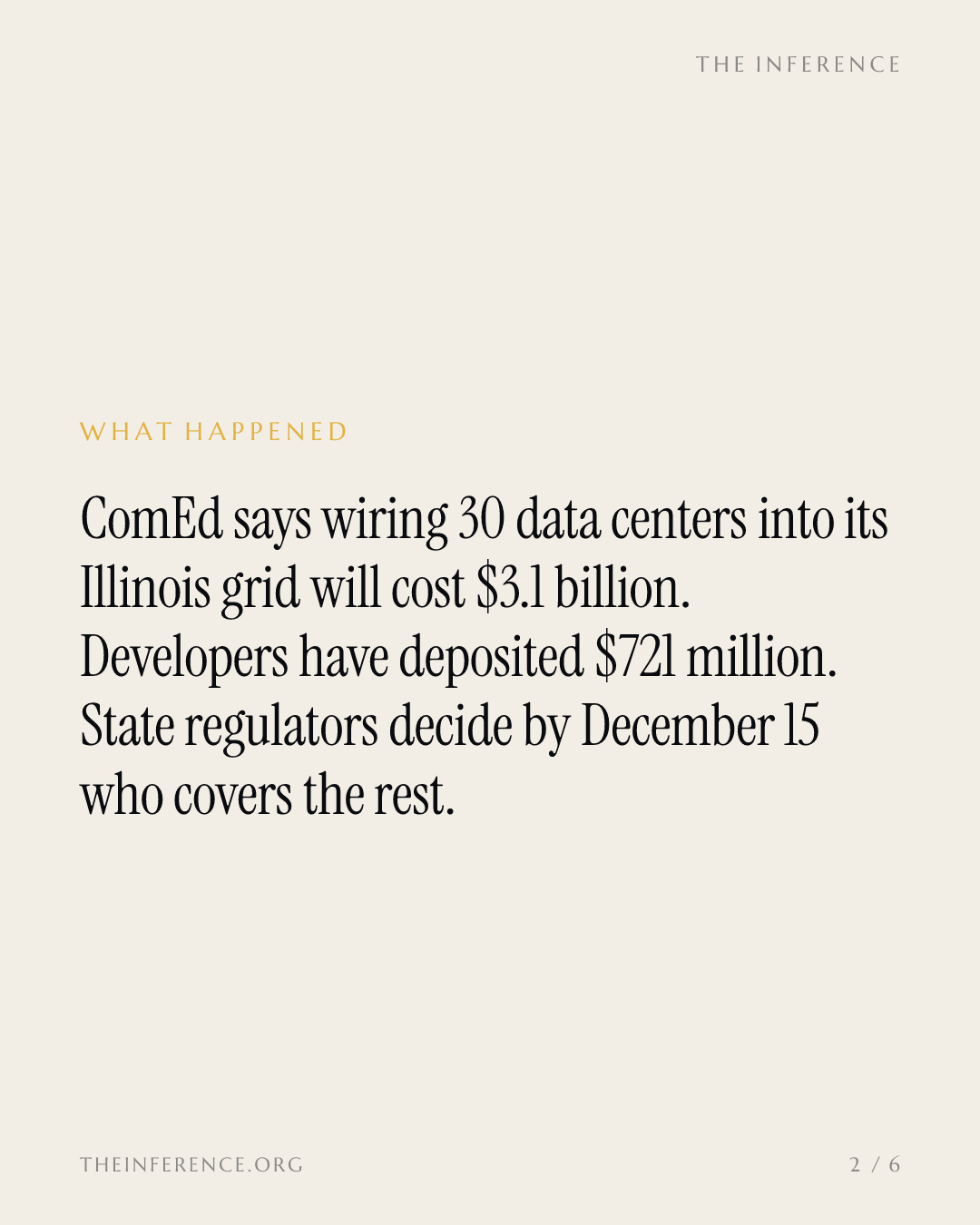
ComEd, Exelon's Illinois utility, has priced what the AI buildout costs just to plug in: $3.1 billion of transmission and distribution work to connect 30 data centers, each drawing 50 megawatts or more, built since 2021 or due online through 2031 123. Developers have deposited $721 million, less than a quarter of the bill 1. Who guarantees the rest is now before the Illinois Commerce Commission, the state's utility regulator.
A $2 billion warning aimed at household bills
The Citizens Utility Board and the Environmental Law & Policy Center, whose expert testimony surfaced the figures, say a project that collapses after the wires go up strands its costs on everyone else, and they put the potential exposure at about $2 billion 12. "We don't want to pay for grid bridges to nowhere," CUB general counsel Eric DeBellis said 1.
Their bill in Springfield, the Protecting Our Water, Energy and Ratepayers (POWER) Act, would require data centers to pay 100% of grid costs before connecting; the veto session that could take it up runs mid-November into early December 2.
Deposits cover less than a quarter of ComEd's $3.1 billion hookup bill
Advocates' warned $2B exposure tops the $1.8B of deposits plus TSA credit
Data
| Value | |
|---|---|
| Deposits paid by developers | $0.72B |
| Transmission under TSA credit lines | $1.1B |
| Shortfall consumer groups warn of | $2B |
ComEd counts credit lines that arrived late
ComEd's rebuttal is that the groups skipped $1.1 billion of transmission cost already secured by transmission security agreements, credit lines guaranteeing ten years of payments even if a project dies 1. Two caveats sit in its own records: 19 of the 30 projects were approved before regulators endorsed the TSA requirement in 2025, and the two priciest hookups cost $289 million and $269 million each 1. Deposits will rise as engineering matures, ComEd says, and TSA screening has culled speculative requests; of 11 projects recently reviewed, four survived 14.
Exelon's growth story is the defendant
Exelon+1.63% — Exelon, up 1.63 percent today told investors on October 30 that about 9 of its 11 gigawatts of high probability data center load sits at ComEd, 45% of it TSA-backed by $1.2 billion of collateral, with actual northern Illinois data center demand compounding at about 28% a year since 2022 5.
The parent's $41.7 billion capital plan runs on 7.9% annual rate base growth, yet only about a tenth of that load energizes by 2028 6. Jefferies+5.37% — Jefferies, up 5.37 percent today cut its Exelon target to $46 from $49 on October 28, RBC to $46 from $48 two days earlier, and the stock closed at $45.50 on November 3 7.
The order lands December 15
An administrative law judge has recommended approving ComEd's $15.3 billion grid plan with modifications, and the commission's order is due December 15 6. The same commission rejected ComEd's first grid plan in 2023 as unaffordable 3. Watch the deposits: if they climb toward filed costs, ComEd's model holds; if regulators or the POWER Act force full payment up front, Illinois writes the rule Florida and California are already arguing over 28.
Get Power by email, free
How AI's hunger for electricity moves utilities, power plants and the grid. In our daily email, every weekday.