Florida regulators rejected Duke Energy's data-center tariff 5-0; Evergy filed $61 million less in Missouri
Florida regulators rejected Duke Energy's data-center rate plan 5-0 on Tuesday; the same day, Evergy filed a Missouri request that is $61 million smaller because two data centers pay premium, contracted rates. The difference was contract design, and it is becoming the national template for who pays for AI's power.
 Richard Tang · 4 min read
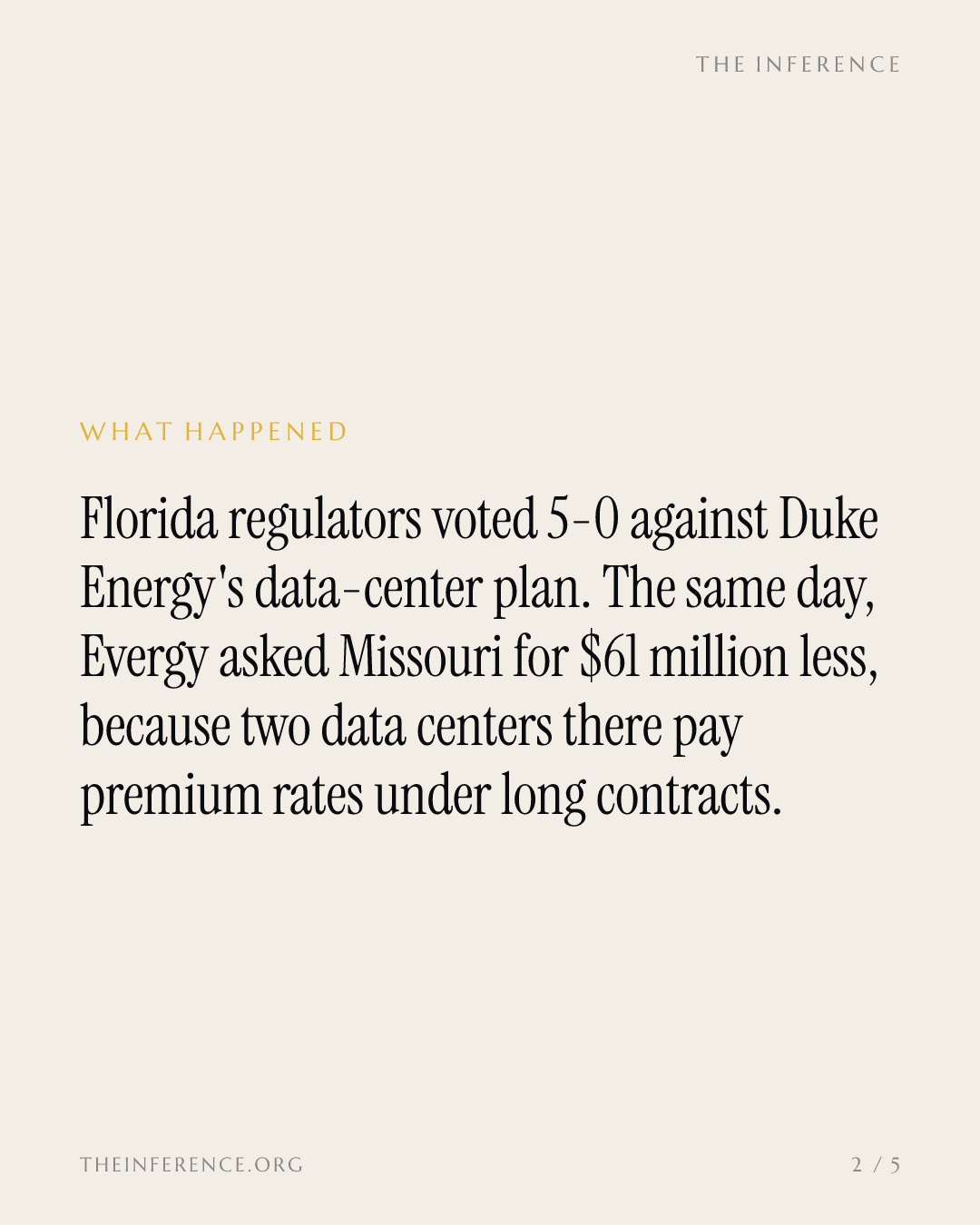
The rule for who pays for AI's electricity got written this week, and it is a contract clause. On Tuesday the Florida Public Service Commission, the state's utility regulator, rejected Duke Energy+2.62% — Duke Energy, up 2.62 percent today Florida's proposed data-center tariff 5-0 1. A tariff is a utility's filed rate plan, and Duke's was the first test of SB 484, the law Florida passed this year requiring utilities to reasonably ensure large customers bear the full cost of their power, with no cost or nonpayment risk shifted onto everyone else 1.
The same day, Evergy+0.88% — Evergy, up 0.88 percent today, the utility serving Kansas and Missouri, filed a rate request $61 million smaller than it would otherwise be, because two data centers on its wires pay premium rates under long contracts 2. Both filings answer one question: who signs for the cost before the load arrives.
The demand is real, and somebody's monthly bill carries it
Evergy's two Missouri data centers each need at least 75 megawatts 2. The filing seeks to recover new gas and solar plants plus more than $650 million of grid work done since its 2024 rate case 2. PJM, operator of the nation's largest grid, counts 32 gigawatts of demand growth between 2024 and 2030 3. Data centers account for 30 of them 3.
A typical Evergy Missouri West household would pay about $17.25 more a month if the request stands 2. A typical Duke Florida home will pay $33 less in January 2027 than a year earlier, a cut the same commission approved and Duke ties to a tax strategy, not data-center money 4. Duke's North Carolina rate ask, as we reported, was cut in half last month 4.
Missouri counted the credit; Florida demanded the arithmetic
Evergy's structure is built to survive review: its large data centers pay a premium over other big users, sign long contracts with guaranteed minimum payments, and cover their direct costs up front 2.
Duke failed on disclosure. In September hearings it would not make public what its plan would cost homes and small businesses, and the panel found the plan did not demonstrate compliance with the law 1. Amazon+6.52% — Amazon, up 6.52 percent today, Google, Meta+1.14% — Meta, up 1.14 percent today and Microsoft+6.64% — Microsoft, up 6.64 percent today signed Duke's tariff in other states, as we reported in October; Florida asked what it does to a household bill, and Duke would not answer.
The question Florida asked, Duke would not answer
The commission's chair says she is confident Duke can build a compliant tariff 1. Both companies' demand is untouched this week; what moved is the regulatory template they file under. The politics were already live: in Florida's governor race, Republican Byron Donalds drew more than $6 million from data-center backers while Democrat David Jolly campaigned on a one-year construction moratorium 1.
The same question is now testing older tariffs
Even existing contracts face tests. Pennsylvania's Office of Consumer Advocate alleges that under the large-load tariff of PPL Electric Utilities, the utility whose territory is forecast to take the state's steepest data-center growth, one campus's $178 million of network upgrades would leave most of the cost on other customers 35. The commission has not decided the complaint.
Most of one campus's grid upgrade would land on other customers
A pending complaint says ratepayers, not the campus, carry most of the cost
Data
| Value | |
|---|---|
| Upgrade total | $178.4M |
| Assigned to the campus | $21.5M |
| Falls to other customers | $156.9M |
In Illinois, consumer groups reading the projections of ComEd, the utility serving Chicago and its region, count $3.1 billion of grid work to connect large users 6. Deposits from those developers total $721 million, a figure ComEd says may rise; it also says its transmission security agreements keep large customers paying even if they go out of business 6.
The credit lasts only as long as the customers pay
That credit holds only while both data centers keep paying, and there this week's record ends and projection begins. Each decision settled who is liable if one stops: in Missouri, the data centers, under contracts guaranteeing minimum payments; in Florida, no one, so nothing was approved.
What is being rejected is the financing, not the demand, and anyone who wants AI's power needs met quickly should welcome that discipline. Duke must now refile a tariff Florida will accept 1, and Missouri's public hearings on the new gas plant and battery storage behind the Evergy plan open November 16 in St. Joseph 7.
Get Power by email, free
How AI's hunger for electricity moves utilities, power plants and the grid. In our daily email, every weekday.