indie's $6.2 Billion Backlog Is Nowhere in the Filing It Just Filed
Third-quarter revenue rose 31% to $70.2 million, and $29.5 million of it came from the Chinese subsidiary indie has agreed to sell. The strategic backlog investors are being asked to underwrite exists only on the earnings call.
 Vincent Jiangfive-minute read
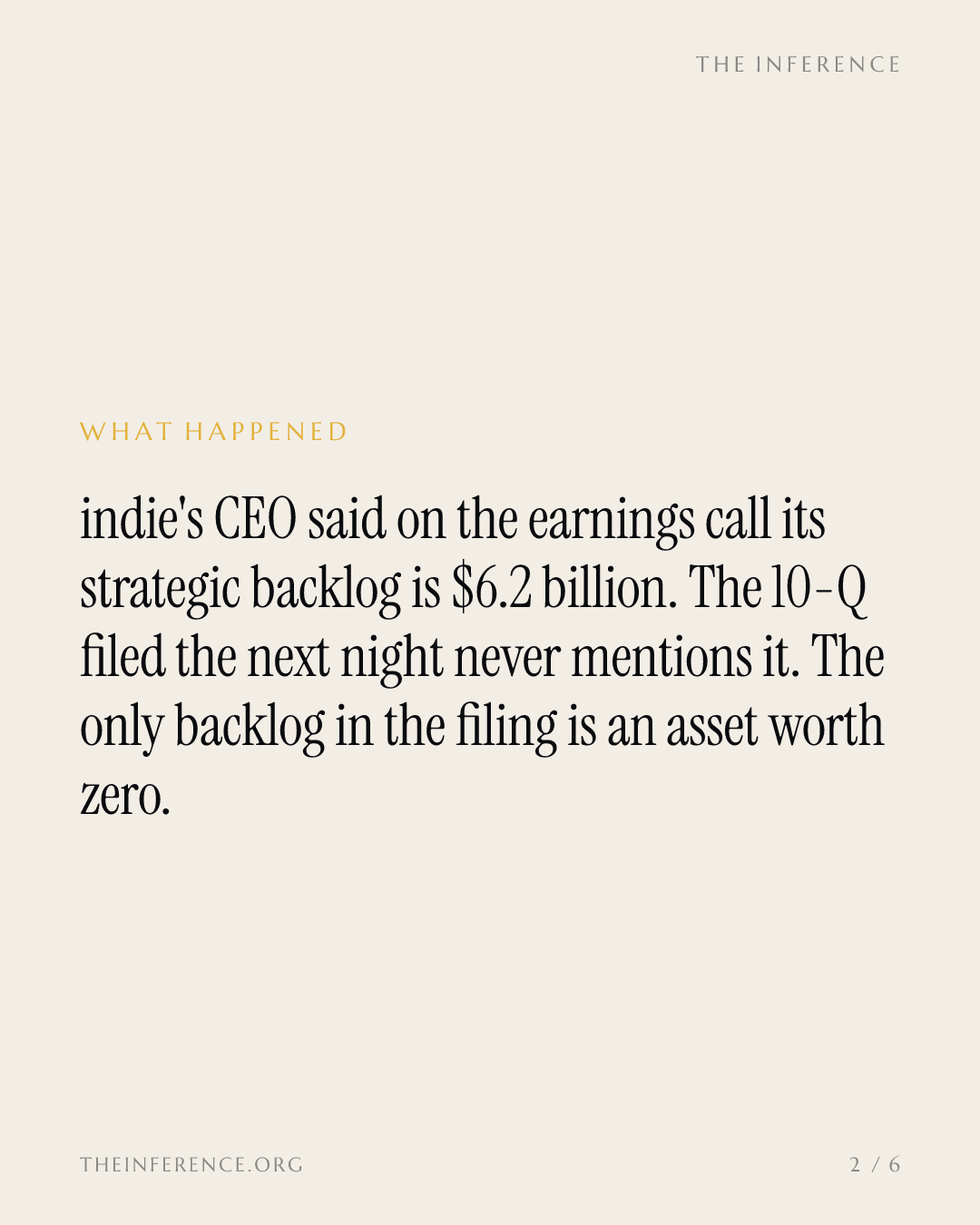
The number carrying indie Semiconductor's+32.84% — indie Semiconductor, up 32.84 percent today growth story is $6.2 billion 1. That is the "strategic backlog" chief executive Don McClymont reported on the November 5 call, described as "trended slightly up" over the past year once the Chinese unit being sold is stripped out, and "relatively flat versus the last year" 1. The 10-Q filed the following night does not contain the figure 2. The only "backlog" in it is an acquired intangible asset, fully amortized, with a net book value of zero at September 30 2.
The quarter behind it: revenue of $70.2 million, up 31% year on year, of which $29.5 million, or 42%, came from Wuxi, the Chinese subsidiary indie has agreed to sell 12. The shares closed at $1.81 on November 6, up 33.58% on 16.9 million shares against a 6.3 million average 4. McClymont said he was "somewhat confused by the market" 1.
Wuxi is 42% of the quarter and 39% of the guide
Core revenue, the advanced driver assistance systems business, was $40.7 million, up about 14% sequentially; Wuxi added $29.5 million, up 5% 1. The fourth-quarter guide is $73 million to $81 million, $77 million at the midpoint, built as roughly $47 million core and $30 million Wuxi, so the unit is 39% of the guided quarter 3. That $30 million was the subject of this column on October 30 3.
indie agreed on October 27, 2025, to sell its 34.38% stake to United Faith Auto-Engineering, a Shenzhen-listed company, for RMB 960.8 million, about $135 million at the time, and said then that it expected to close in late 2026 10. The deal needs Shenzhen Stock Exchange and China Securities Regulatory Commission approval, and indie may terminate if those approvals are not in hand within 18 months of signing, a window that runs out in April 2027 2. As of November 6 the unit still counted as a continuing operation 2.
Revenue sat between $51.6M and $58M for nine quarters, then rose 27% in two
Growth arrived in 2026 after a long plateau, and Q4 leans on Wuxi again
- Revenue
- Estimate
Data
| Revenue | |
|---|---|
| Q1 '24 | $52.35M |
| Q2 '24 | $52.36M |
| Q3 '24 | $53.97M |
| Q4 '24 | $58.01M |
| Q1 '25 | $54.08M |
| Q2 '25 | $51.63M |
| Q3 '25 | $53.68M |
| Q4 '25 | $58.01M |
| Q1 '26 | $55.46M |
| Q2 '26 | $64.01M |
| Q3 '26 | $70.24M |
| Q4 '26 guide (estimate) | $77M |
The backlog is a rolling ten-year window no outsider can audit
The method is unchanged, McClymont said: a rolling ten-year window of expected program revenue. Designs ramping now roll off the far end, and follow-on wins for some have not happened yet 1. This year's physical AI wins, the company's label for humanoid robots and drones, were excluded as too early to size; the vision portfolio alone holds more than 40 of them, and fewer than 20% are shipping 16. He expects to add "multiple $100 million of annual run rate" over the next couple of years 1.
What sits inside the $6.2 billion is not disclosed: not the share tied to programs already in production, not the share from customers who have not committed to a second generation, and not whether last year's number used the same exclusions 2. A total reported once a year, in a format the company defines, cannot be reconciled to revenue by anyone outside the room.
Radar's unit count implies two to four times the run rate described
Radar is the proof of the ramp: the chipset is in high-volume production and has been selected by one of the top three North American carmakers 3. Asked about an analyst's $100 million annual peak, McClymont said indie expects "50 million to 70 million units shipped per year, at an ASP between $5 and $6", an average selling price, or "maybe a little higher" than that peak 1.
Multiply it out. Fifty million units at $5 is $250 million a year; 70 million at $6 is $420 million, two to four times the run rate he was answering 2. Either the unit figure is a program lifetime rather than a year, or the run rate is understated by a multiple. No filing breaks out radar revenue 2.
The buyer pays three times sales for a company losing $150 million a year
On the 240,797,477 Class A and Class V shares outstanding at November 3 2, $1.81 values the equity at about $436 million. Add $430.0 million of debt and subtract $134.2 million of cash and equivalents, and enterprise value is about $732 million, 2.96 times trailing revenue of $247.7 million 24. That trailing year carries a net loss of $150.2 million, and nine-month operating cash flow was negative $73.4 million 24.
The share count settles a market-cap gap of nearly half
Yahoo puts market capitalization at $419.6 million and Benzinga at $286.2 million, which implies 158 million shares 45. The filing settles it: 240.8 million shares 9. The gap is a share-count error, not a discount. And 29.54% of the float was sold short before the print 9, which means part of the 34% day was short covering rather than a verdict on the backlog.
Gross margin is 41.6% on the call and 31.8% in the filing
The call put gross margin at 41.6%, down sequentially on mix and Wuxi price pressure 6. The 10-Q's own revenue and cost of goods sold lines give 31.8%, against 40.1% a year earlier, and indie states that it does not report a GAAP gross margin at all 238. Two numbers, and only the lower one ties to the statements.
Gross margin has fallen from 42.5% to 31.8% in eight quarters, as Wuxi mix rises
Data
| Gross margin | |
|---|---|
| Q1 '24 | 42.5% |
| Q2 '24 | 42.2% |
| Q3 '24 | 39.3% |
| Q4 '24 | 42.6% |
| Q1 '25 | 41.7% |
| Q2 '25 | 40.6% |
| Q3 '25 | 40.1% |
| Q4 '25 | 37.3% |
| Q1 '26 | 38% |
| Q2 '26 | 36.1% |
| Q3 '26 | 31.8% |
Cash is thinner than the headline
The $144.3 million quoted on the call includes restricted cash; cash and equivalents were $134.2 million 12. Before any Wuxi proceeds land, indie must pay €40 million, about $47.1 million, for AMS OSRAM's CMOS image sensor business, cleared by regulators on November 3 with €35 million due in cash at closing 2.
The other side: costs are falling and the cash covers the plan
The bull case does not rest on the backlog. Non-GAAP operating loss, which strips out share-based compensation, amortization and other one-off items, narrowed to $7.2 million from $11.3 million 3. Management targets non-GAAP profitability in the second quarter of 2027 and positive cash flow the quarter after, and says existing cash funds that path without Wuxi 1. Eight analysts average a $4.39 target 7. Physical AI carries content above $100 on some humanoid platforms, with wins at Agibot, Unitree and Figure AI$34.81B — Figure AI, private, latest valuation $34.81B 1.
Three dates decide the investment
The fourth-quarter print, when $47 million of core revenue has to stand on its own 3. The Wuxi closing, or April 2027, when the approval window from the October 27, 2025, signing runs out 2. And next November's backlog, the first that could include humanoids and drones, and the first real test of whether $6.2 billion moves 1. Until then the multiple is being paid for a number no outsider can see inside.
Get Chips by email, free
How AI demand is reshaping chipmakers, memory and the fabs behind them. In our daily email, every weekday.