Nebius borrows $3.5 billion 12 points cheaper than CoreWeave, whose bonds yield 15%
Nebius just borrowed $3.5 billion at 2.75 points over SOFR while rival CoreWeave's bonds yield 15 percent and its default insurance trades at distress levels. The same GPU business, priced two ways, and the spread tells you what the debt market is actually buying.
 Vincent Jiang · 3 min read

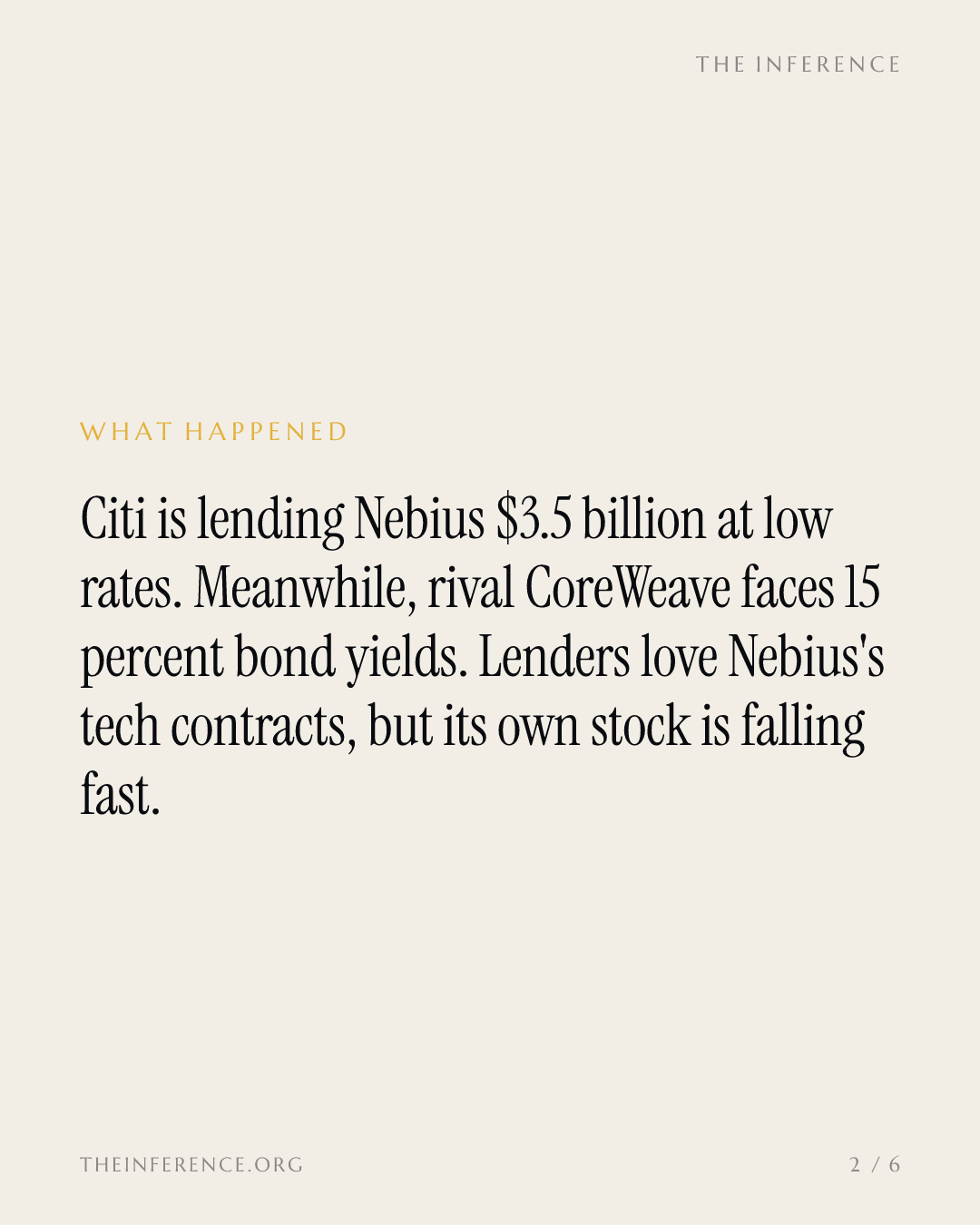
Nebius−6.86% — Nebius, down 6.86 percent today, the Amsterdam-based "neocloud" renting Nvidia−3.95% — Nvidia, down 3.95 percent today GPUs to AI labs, told the market on October 22 that Citi will lend it $3.5 billion 1. The facility runs 364 days and carries an initial rate of 2.75 percentage points over the term SOFR benchmark 1. A day earlier the company signed on as anchor customer for up to 50 megawatts at Oxagon, the data center campus rising in Saudi Arabia's Neom megaproject, alongside Humain and DataVolt 2.
Two prices for the same GPU business
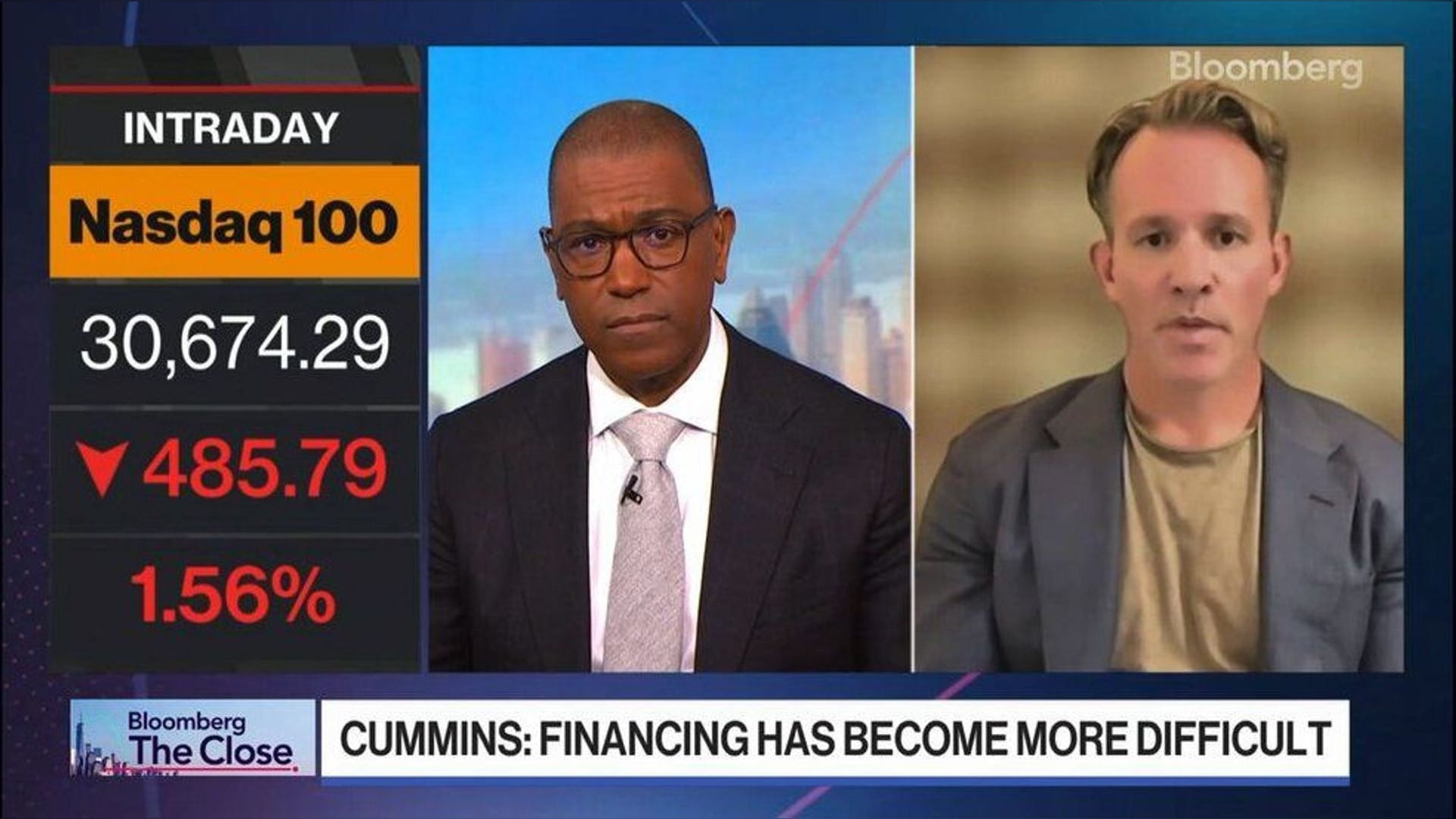
The number that matters is the rate. On October 13 and 14, CoreWeave−8.88% — CoreWeave, down 8.88 percent today, the biggest neocloud and Nebius's closest comparable, saw yields on its 2031 and 2032 bonds top 15 percent, and its five-year credit default swaps, the insurance against default, blew past 1,000 basis points, the level generally read as credit distress 57.
Two sellers of roughly the same GPU capacity, and the credit market is charging one of them a little over SOFR plus 2.75 points and the other about 15 percent. That twelve-point spread is the market's verdict on who can actually pay.
Nebius's case rests on contract credit, not chips. Chief Operating Officer Ophir Nave said the company could instead borrow against more than $40 billion of long-term contracts with investment-grade customers including Microsoft−1.31% — Microsoft, down 1.31 percent today and Meta−7.01% — Meta, down 7.01 percent today; it already carries around $10 billion of convertible debt after a $5.75 billion August issue 1. CoreWeave's ledger looks different: roughly $52 billion of debt obligations, second-quarter interest expense of about $640 million, more than its adjusted operating income 5.
The equity is priced like the credit, not the contracts
The catch for Nebius holders: the equity is being priced closer to CoreWeave's credit than to its contracts. The stock closed October 21 at $171.57, down 27.7 percent from $237.33 on September 25, even as it stayed 105 percent above its end-2025 close 3.
Q2 revenue of $582.3 million, up 454 percent, sits against capex of about $5.7 billion against $2.3 billion of operating cash flow, and a $20 billion to $25 billion full-year capex guide 3. Every point the share price falls makes the remaining $2.11 billion ATM raise cheaper per share sold, and the converts costlier to service 3.
Nebius capex is running at ten times its revenue
- Revenue
- Capex
Data
| Revenue | Capex | |
|---|---|---|
| Q3 '24 | $0.03B | $0.17B |
| Q4 '24 | $0.04B | $0.42B |
| Q1 '25 | $0.05B | $0.54B |
| Q2 '25 | $0.11B | $0.51B |
| Q3 '25 | $0.15B | $0.96B |
| Q4 '25 | $0.23B | $2.06B |
| Q1 '26 | $0.4B | $2.47B |
| Q2 '26 | $0.58B | $5.65B |
Nebius is up 105% this year but down 27.7% in a month
Data
| NBIS close ($) | |
|---|---|
| 31 Dec 2025 | 83.71 |
| 18 Jun 2026 | 286.69 |
| 25 Sep 2026 | 237.33 |
| 21 Oct 2026 | 171.57 |
The other side of the trade
CoreWeave's camp has an answer: CEO Michael Intrator told employees the market is irrational and the $100 billion backlog "more than supports all of our debt obligations" 7. Barclays−2.52% — Barclays, down 2.52 percent today still upgraded the stock. And credit desks told CNBC the high-yield market is effectively on hold until after the US midterms, which stalls everyone's funding, not just the distressed names 6.
What to watch: Nebius's third-quarter print, where CFO Dado Alonso's reaffirmed guide of $7 billion to $9 billion in year-end ARR meets the deferred 2027 revenue in the contract book 3. The Citi−1.35% — Citi, down 1.35 percent today facility matures in 364 days 3. Whoever refinances at 2027's rates finds out what the spread really was 3.
Get Data Center by email, free
Who is building AI's data centers, and who is paying for them. In our daily email, every weekday.