Spotify puts a $5 price tag on fan remixes as the unlicensed bill reaches $9 billion
Spotify's paid AI remix service targets the first quarter of 2027, possibly unveiled at the February Grammys. The licenses are half signed, the artists are not, and the alternative to licensing now carries a court price: 60,202 recordings at up to $150,000 each.
 Vincent Jiangthree-minute read

A $4 to $5 add-on, aimed at the Grammys
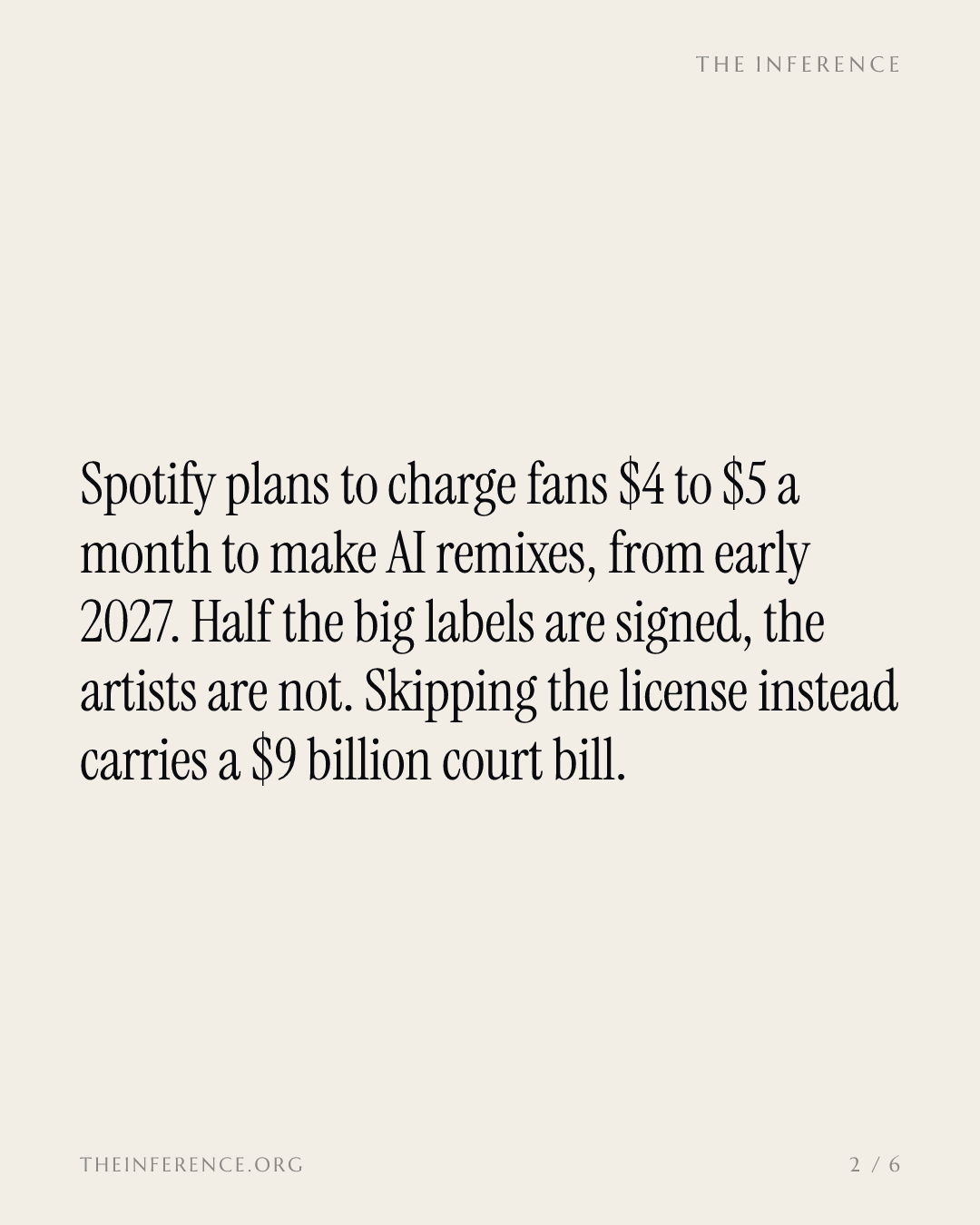
Spotify−2.80% — Spotify, down 2.80 percent today plans to let Premium subscribers generate their own AI remixes and covers of participating songs, targeting a first-quarter 2027 launch that could be unveiled around the Grammy Awards in February, the Financial Times reported on Friday, citing people familiar with the plans 17. Pricing under discussion is an extra $4 to $5 a month on top of the existing subscription, and neither the date nor the price is final 16.
Remix plays would count toward the original songs in Spotify's charts, and royalties would flow back to the artists who opt in 2.
The labels are half signed; the stars are not
Universal Music, independent label group Merlin, Kobalt and Believe have licensing deals; Sony−1.96% — Sony, down 1.96 percent today Music and Warner Music are still negotiating 12. Signing the labels does not sign the artists: each performer decides individually even when their label has a deal, and contemporary stars are proving harder to secure than legacy acts, a source told the FT 1.
Co-chief executive Gustav Söderström has said Spotify could move ahead without every major label 2. The base underneath is real: Spotify ended September with 306 million Premium subscribers and third-quarter revenue of €5.0 billion ($5.6 billion), up 16 percent 5.
The base the add-on sits on: ten straight quarters above $4B
Data
| Quarterly revenue (USD billions) | |
|---|---|
| Q2 '24 | 4.09 |
| Q3 '24 | 4.43 |
| Q4 '24 | 4.41 |
| Q1 '25 | 4.54 |
| Q2 '25 | 4.93 |
| Q3 '25 | 5.01 |
| Q4 '25 | 5.32 |
| Q1 '26 | 5.25 |
| Q2 '26 | 5.45 |
| Q3 '26 | 5.63 |
What the tier could be worth
Spotify calls the tool a paid add-on that "will create an additional revenue stream for participating artists" 4. The scale arithmetic: 306 million subscribers at the $4.50 midpoint is about $16.5 billion a year if every subscriber took it, and roughly $1.7 billion at 10 percent adoption 4.
That is an illustration of magnitude, not a forecast; nothing in the reporting says how many listeners will pay extra to remix songs.
Adoption, not price, decides the tier's size: $0.8B to $16.5B a year
- Annual add-on revenue at $4.50 a month
- Estimate
Data
| Annual add-on revenue at $4.50 a month | |
|---|---|
| 5% take it (estimate) | $0.83B |
| 10% take it (estimate) | $1.65B |
| 25% take it (estimate) | $4.13B |
| Every subscriber (estimate) | $16.52B |
The unlicensed camp's bill
The lawsuit over Suno~$2.45B — Suno, private, latest valuation ~$2.45B tested the same behavior by skipping the license. Universal- and Sony-affiliated labels matched 60,202 sound recordings in Suno's training files and seek statutory damages of up to $150,000 per infringed work, a ceiling that requires a willfulness finding; at that ceiling the claim reaches about $9 billion, an arithmetic on the docket figures, not an awarded sum 3.
Suno's October 20 answer admits pulling YouTube+1.01% — YouTube, up 1.01 percent today audio with YT-DLP for training and disputes infringement on fair-use grounds; no court has ruled 3. When The Inference covered the matching exercise on October 28, the licensed alternative had no consumer price yet 3.
The verdict watch
Three dated decisions size this product: whether Sony and Warner sign this quarter, whether enough current stars opt in before a February unveil, and whether a Massachusetts court treats AI training as theft or fair use 123. Universal has also licensed its catalog to ElevenLabs for a fan remix platform, so the labels are not betting on one buyer 2.
If the lawsuits price the risk and the tier prices the product, the labels have found a way to charge for the same behavior twice. Whether the second charge sticks is now the subscriber's call.
Get Applications by email, free
How AI is changing the software people and companies use. In our daily email, every weekday.