Vicor's $66.6 million royalty line, a third of a record quarter, comes from one unnamed license
Q3 revenue rose 78.5% to $197.1 million and the stock still fell from $212.00 to $136.02 in two weeks. The 10-Q shows $66.6 million of the quarter is royalties from one agreement whose terms, catch-up and counterparty are undisclosed.
 Vincent Jiang · 3 min read

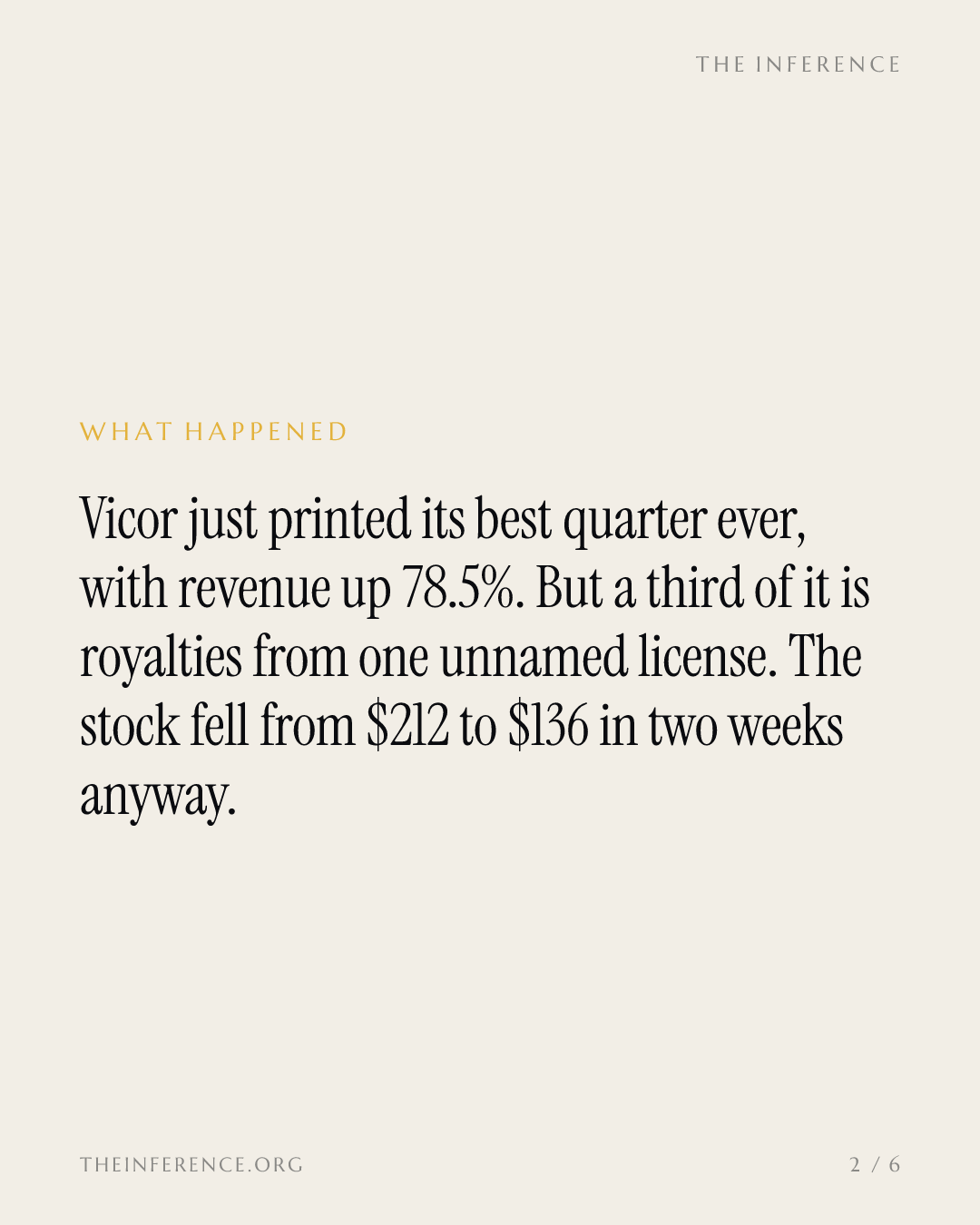
Vicor+6.86% — Vicor, up 6.86 percent today printed its best quarter ever on October 20 and the market spent the next two weeks cutting the stock by nearly a third 1. Revenue rose 78.5% year on year to $197.1 million, gross margin reached 68.3% and diluted earnings were $1.33 against $0.63 a year earlier 1. The shares still fell from $212.00 on October 28 to a $136.02 close on November 5, a 14.5% session that left the stock far below its 200-day moving average of $227.67 35.
The 10-Q filed October 26 shows why the print is hard to trust at face value 1.
A third of the record was royalties from one unnamed license
Royalties jumped to $66.6 million from $21.7 million, now 33.8% of revenue, and the 10-Q ties the jump to Vicor's first license for vertical power delivery, its patented way of feeding current to AI processors, granted during the quarter to an AI equipment maker the company does not name 1. Licence income carries no cost of revenue, so it lands whole in gross margin 1. Vicor announced the vertical power delivery license in September and the terms, the per-unit structure and the counterparty were all withheld 7.
The one number nobody can split is the one that matters
Neither the 10-Q nor the release says how much of the $66.6 million covers sales made before the quarter 1. History argues against reading the line as a run rate: third-quarter 2025 royalties also included a catch-up amount, and the line then fell to $14.5 million in the fourth quarter 1. Enforcement is not free either. Legal fees ran $16.1 million, 24.2% of royalty income, including contingency fees to the firms pursuing Vicor's patent claims 1.
The royalty line has spiked and fallen back before: $21.7 million, $14.5 million, $66.6 million
Royalties tripled in a year, then fell back 33% once before
Data
| Value | |
|---|---|
| Q3 '25 | 21.7 |
| Q4 '25 | 14.5 |
| Q3 '26 | 66.6 |
The license ladder now runs through one courtroom
The licensing program assumes a sales reply is not a license. On November 3 the Federal Circuit heard Vicor Corp. v 6. ITC, No. 25-1616, on whether a Vicor salesperson's answer to a Foxconn−4.47% — Foxconn, down 4.47 percent today purchase order, a bare list of ship dates, granted Foxconn a perpetual royalty-free license 6. The ITC held that it did, reversing its own administrative law judge; Judge Sorokin in Massachusetts read the same contract the other way 6.
A second Section 337 investigation, instituted October 9 against Delta, Foxconn, Flex+3.06% — Flex, up 3.06 percent today and Celestica+1.27% — Celestica, up 1.27 percent today with license rates that step up as the case advances, sits behind the same assumption (reported in The Inference on October 26 and 30) 6.
The module business underneath is real
The counterpoint is genuine. Product revenue rose 47.1% to $130.5 million, Advanced Products climbed 65% to $72.2 million, and backlog reached $406.0 million, up 166% year on year 12. Vicor holds $513.1 million in cash with no debt and has bought two more sites near Andover toward three fabs with roughly five times the first fab's capacity 12. The crash itself was partly mechanical: Nvidia+5.38% — Nvidia, up 5.38 percent today fell 9.06% the same session and the whole components complex sold off 34.
What decides it next
Q4 is the first quarter that must show the royalty line repeating without catch-up 1. The two facts that would settle the valuation question, whether the unnamed licensee is among the Section 337 respondents and how much of the $66.6 million was catch-up, appear nowhere in the filings 1. Watch the Federal Circuit's opinion: if a purchase-order answer can create a perpetual free license, the ladder of escalating rates loses its bottom rung. Investors who bought the quarter bought a royalty stream that has fallen back once before.
Get Chips by email, free
How AI demand is reshaping chipmakers, memory and the fabs behind them. In our daily email, every weekday.